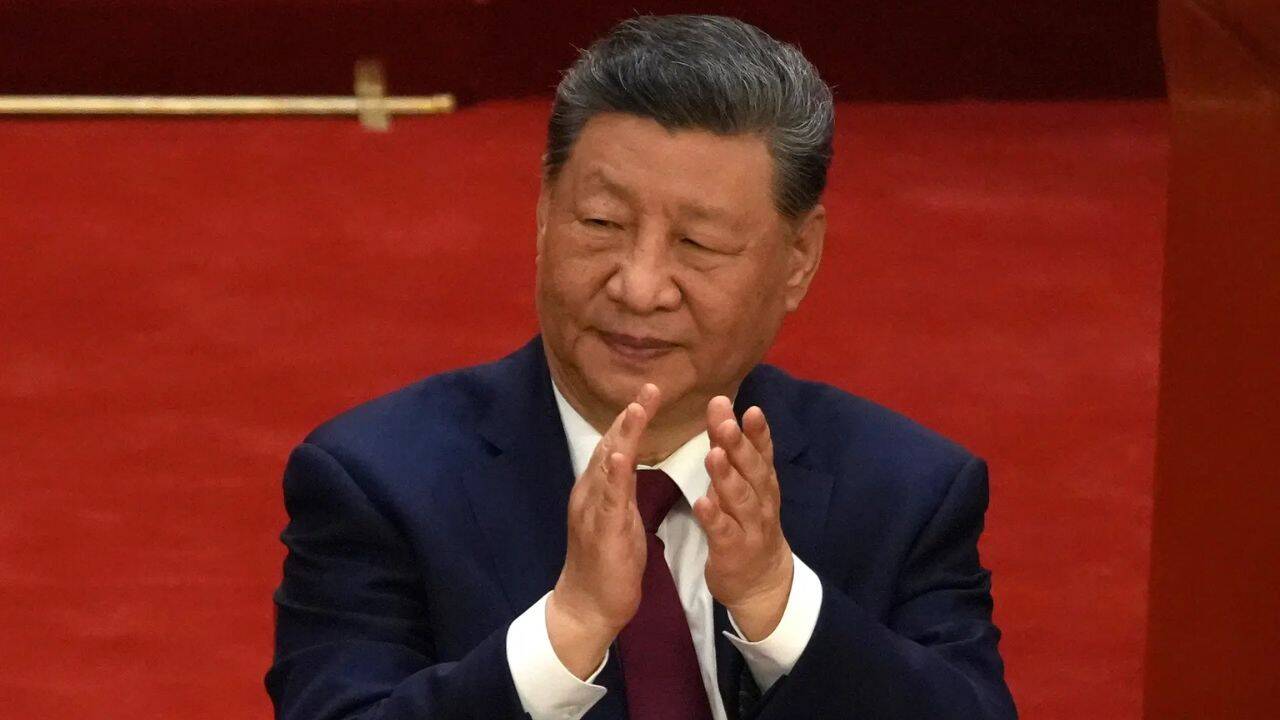
The heavy red doors of the Bayi Building in Beijing do not swing open for the public. Inside, the air smells faintly of polished wood, heavy drapery, and the distinct, freezing chill of absolute authority. On a normal day, the silence here represents order. But lately, that silence has felt different. It feels like an breath held too long. It feels like an interrogation.
Imagine standing in a room where your peers—men you have marched with, toasted with, and plotted military strategy alongside for three decades—vanish one by one. Their names are scrubbed from official documents. Their portraits are quietly removed from the walls. You don't ask where they went. In the upper echelons of the People’s Liberation Army, asking questions is a luxury that can cost you your life.
Instead, you look at the empty chairs. And you wonder if your name is written on the next folder.
This is the psychological reality behind the dry headlines reporting Chinese President Xi Jinping’s latest military reshuffle. To the outside world, it reads like bureaucratic maintenance: two new generals promoted, a few older ones sidelined. But beneath the stilted jargon of state media lies a high-stakes drama of survival, loyalty, and the relentless purge that is reshaping the most powerful military apparatus in Asia.
The Weight of the New Epaulets
Wang Renhua and Dong Jun stood before the commander-in-chief. The room was sterile, bathed in the sharp, unflattering light of television cameras meant for domestic consumption. Xi Jinping handed them their certificates of promotion, elevating them to the rank of general—the highest attainable rank for officers on active service in China.
Wang, the secretary of the political and legal affairs commission of the Central Military Commission, looked stoic. Dong, the newly minted defense minister, stood rigid.
Gold braid. Polished buttons. Heavy responsibilities.
But the real weight on their shoulders wasn't the uniform. It was the knowledge of who had worn those honors before them. Dong Jun was stepping into a position left vacant by Li Shangfu, a man who had disappeared from public view months earlier without explanation, only to be stripped of his title amidst whispers of massive corruption in the military procurement system. Before Li, there were others. The rocket force, the pride of China’s modern military modernization, had seen its top commanders swept away in a silent storm of investigations.
To understand the tension in that room, you have to understand the unique nature of power in China. In the West, an army swears an oath to a constitution or a nation. In China, the PLA does not belong to the state. It belongs to the Communist Party. More specifically, it belongs to the man who leads the party.
When Xi Jinping purges a general, he isn't just fighting corruption. He is clearing the chessboard.
The Invisible Tremor
For those observing from the borders, the constant churn at the top of the Chinese military raises a terrifying question: Is the dragon unstable, or is it sharpening its claws?
Consider the mechanism of a purge. It begins with a whisper. A mid-level official is detained. A bank account in Macau is flagged. Then, the circle widens. In a system where loyalty is verified through total obedience, any sign of independent thought or financial self-interest is treated as treason. The anti-corruption campaign, launched over a decade ago, was supposed to be a temporary cleanup. Instead, it has become a permanent feature of governance. A perpetual motion machine of fear.
This constant instability creates a strange paradox. On paper, the PLA is more modern, technologically advanced, and well-funded than at any point in its history. Its shipyards churn out vessels at a frantic pace; its missile capabilities cause sleepless nights in Washington and Taipei. Yet, the human nervous system driving this machine is under constant trauma.
When you replace the top brass every few years, you lose institutional memory. You destroy trust. A colonel wonders if the order given by his general today will be labeled a criminal conspiracy tomorrow. Fear makes men cautious. In battle, caution is fatal.
Yet, there is another perspective. By ruthlessly cutting out the rot, Xi may be forging a military that is fiercely loyal and terrifyingly disciplined. If the goal is absolute control before a potential conflict, then the empty chairs are not a sign of weakness. They are a declaration of intent.
The Long Shadow over the Taiwan Strait
The promotions of Wang and Dong are not happening in a vacuum. A few hundred miles across the water lies Taiwan, an island that exists in the permanent shadow of Beijing's ambitions. Every shift in the military hierarchy in Beijing sends a ripple through the defense ministries of Taipei, Tokyo, and Washington.
Military experts spend days analyzing the backgrounds of the newly promoted men. What is their expertise? Have they served in the Eastern Theater Command, the unit responsible for Taiwan? Are they ideologues or pragmatists?
But the truth is simpler, and far more sobering. The backgrounds matter less than the single, overriding qualification that brought them to the stage: absolute, unquestioning loyalty to Xi Jinping.
The strategy is clear. The old guard, with their personal networks and independent fiefdoms within the military, are gone. The new men owe everything to the current regime. They have no independent power base. They exist because they were chosen, and they can be unmade just as quickly.
The atmosphere in Beijing today mirrors the tense, quiet periods of past historical cycles, where the consolidation of internal power precedes an outward push. The silence in the Bayi Building isn't the silence of peace. It is the silence of a machine being calibrated for something massive.
Wang Renhua and Dong Jun stepped away from the podium, their new titles secure for now. They returned to their offices, passed the long corridors, and sat at their desks. The gold on their shoulders caught the light. Outside the window, the grey Beijing smog swallowed the horizon, hiding the vast country, the moving troops, and the uncertain future. They knew, better than anyone, that in this court, the music never stops playing, and the chairs are always being moved.