Cold rain on a November Friday in London feels different when your name used to guarantee a hundred-million-dollar opening weekend, and now, for nearly a decade, it mostly guarantees a headline about a courtroom.
Picture a hypothetical theater manager—let’s call him Arthur—standing in the lobby of a multiplex in Manchester on a damp Friday night in late November 2026. For eight years, Arthur has watched the posters change. He watched the pirate ships sail away. He watched the pale makeup and eccentric hats vanish from the main hallway, replaced by younger faces, shiny franchises, and algorithms that promised safe returns. Arthur knows the smell of stale popcorn when a prestigious gamble dies on arrival. He also knows the electric, unmistakable hum in the floorboards when a crowd actually shows up—not out of duty, not because a streaming service pushed a thumbnail to their home screen, but because people put on coats, paid for parking, and sat in the dark together.
That weekend, the hum came back.
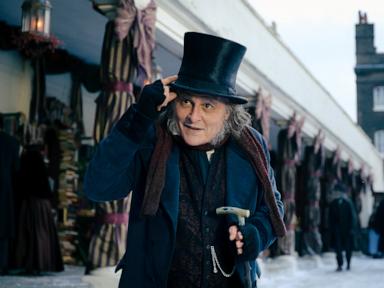
Ebenezer, the dark, frostbitten reimagining of Charles Dickens’ A Christmas Carol starring Johnny Depp as Ebenezer Scrooge, opened at number one at the box office. It handed Depp his first number-one theatrical debut in eight years—a streak stretching all the way back to Fantastic Beasts: The Crimes of Grindelwald in November 2018.
Numbers on a Monday morning spreadsheet look deceptively clean. Executives love clean numbers. They love percentages, per-screen averages, and four-quadrant demographic breakdowns. Yet behind that single digit—the number one sitting atop the weekend chart—lies one of the strangest, most bruising cultural experiments modern Hollywood has ever witnessed.
The Architecture of a Hollywood Exile
To understand why a Victorian ghost story opening at the top of the box office matters, you have to remember what the industry looked like in 2018.
Back then, the studio system operated on an unspoken rule: movie stars were indestructible until the exact second they became radioactive. Depp had spent fifteen years as the ultimate box office alchemy. Give him a tricorn hat, a smudge of eyeliner, or a scissor-handed silhouette, and audiences from Tokyo to Toledo would hand over their money. Between 2003 and 2017, films featuring Depp grossed billions globally. He was the eccentric uncle of the multiplex, proof that weirdness could be sold at mass scale.
Then the ground gave way.
The collapse was neither quiet nor private. Between 2018 and 2022, Depp’s public identity shifted from beloved shape-shifter to legal cautionary tale. The libel trial in London. The televised defamation trial in Fairfax, Virginia, watched live by millions like a grim daytime soap opera. Major studios did what major studios always do when risk outpaces projected revenue: they backed away slowly, then bolted the doors. He was dropped from Fantastic Beasts. The Pirates of the Caribbean franchise drifted into developmental limbo. For years, Depp’s screen appearances shrank to European festival dramas like Minamata and Jeanne du Barry—films admired in pockets, seen by fractions, and largely invisible to the mainstream American and British multiplex audience.
If you worked anywhere near film financing during those years, you heard the consensus repeated like gospel. Depp was finished as a commercial draw. The audience had moved on. Even if a studio dared to put him on a marquee, the thinking went, the baggage would crush the marketing campaign before the first trailer even dropped.
I remember talking to a mid-level distribution executive in Los Angeles a few years ago who compared casting a controversial legacy star to buying a historic house with a cracked foundation. You might love the architecture, he told me, but no bank will underwrite the mortgage if they think the roof will cave in during opening week.
That metaphor stuck with me because it explains the sheer terror governing studio decisions. Hollywood does not hate scandal; Hollywood hates unpredictability. And for eight years, Johnny Depp was the definition of an unpredictable asset.
Why Scrooge Was the Only Role That Could Work
Consider what happens next: a director and a studio decide to bet on the one story in the English language explicitly built around moral reckoning.
It would have been fatal for Depp to return as another swaggering rogue. A wink-and-a-nod pirate routine or a quirky, candy-colored eccentric would have felt grotesque—an attempt to pretend the last eight years never happened. Audiences possess a razor-sharp radar for denial. When a public figure tries to slip back into an old, beloved costume without acknowledging the scar tissue, the crowd rejects the performance before the first act ends.
Ebenezer Scrooge offered the exact opposite strategy.
Think about who Scrooge actually is in Dickens’ text. He is not a misunderstood hero. He is a man who has walled himself off from humanity, hardened by old wounds, hoarding his warmth while the world freezes outside his window. He is gaunt, bitter, haunted by the architecture of his own past, and utterly convinced that connection is a weakness he can no longer afford.
Casting Depp in that role turned his real-world baggage from a liability into raw fuel.
When audiences sat down to watch Ebenezer, they didn't have to suspend their disbelief about a man who had spent years in isolation and public judgment. They could see the mileage on his face. Every crease around his eyes, every raspy cadence in his voice carried the weight of a man who had been dragged through the fire and emerged thinner, colder, and harder to read. In traditional acting, performers spend months researching grief and alienation to fake it for the camera. Here, the camera simply had to point at what was already in the room.
This is a classic pattern in cinema history, though executives routinely forget it until it saves their quarter. Think of Mickey Rourke stepping into the ring in The Wrestler in 2008, or Robert Downey Jr. strapping on an iron suit in the same year after a decade of industry exile. Neither comeback worked because audiences suddenly forgot the past. They worked because the roles absorbed the past and gave the audience permission to watch a human being reckon with it in real time.
The Invisible Stakes of a Friday Night Ticket
Still, narrative symmetry alone doesn't sell tickets. Plenty of clever casting ideas die in empty theaters every autumn. So why did Ebenezer actually hit number one?
Part of the answer lies in a quiet hunger that streaming algorithms have completely failed to satisfy.
For the past five years, the movie business has trained audiences to stay home. Studios trained us to wait forty-five days—or seventeen days—until a theatrical release appeared on a subscription app. In doing so, they accidentally stripped movies of their communal electricity. Watching a film alone on a Tuesday night while checking notifications on your phone is not an event; it is background noise.
A theatrical opening weekend, by contrast, is still a vote.
When people showed up for Ebenezer during its Thanksgiving-window debut, they were participating in something that data models struggle to measure: curiosity mixed with nostalgia, wrapped in the seasonal ritual of the holidays. Late November is historically fertile ground for redemption stories, yet studios had spent years serving audiences either sanitized animated sequels or bloated superhero installments that felt like homework.
Ebenezer offered something tactile and slightly dangerous. Directed with a sharp, gothic edge rather than sugar-coated holiday cheer, it leaned into the horror elements Dickens originally wrote—the rattling chains, the suffocating fog of industrial London, the genuine terror of looking at your own unmarked grave.
And look at the timing. Eight years is a lifetime in pop culture. In 2018, a twenty-year-old college student was entering adulthood; by 2026, that same person is nearly thirty, carrying their own regrets, their own bruised relationships, their own understanding of what it means to make mistakes and wonder if the door is permanently locked. Meanwhile, an entire generation of younger viewers knew Depp mostly through viral courtroom clips and TikTok edits rather than actual theatrical releases. For them, seeing him command a massive screen in a dark room wasn't a nostalgic trip—it was a discovery.
The Illusion of the Clean Slate
It would be easy—and deeply dishonest—to look at a number-one box office headline and declare that everything is forgiven, forgotten, and back to normal.
It isn't.
If you talk to people who followed the trials closely, or read the debates flaring across social media this week, you quickly realize there is no consensus on Johnny Depp. There probably never will be. For millions of viewers, the legal verdicts in Virginia settled the matter and proved he had been wronged. For millions of others, the testimony painted a portrait of toxic behavior that a box office crown cannot erase. Both groups exist in the same culture, walking past the same theater marquees.
That tension is precisely why the industry watched Ebenezer with such sweaty palms.
Before Friday night, studio heads operated under the assumption that polarization equals box office poison. They believed a movie star needed near-universal approval—or at least polite indifference—to open a wide release at number one. Ebenezer just poked a massive hole in that theory. It proved that in a fragmented culture, you do not need everybody to love you to win the weekend. You just need enough people to care enough to leave their houses.
That distinction should terrify and fascinate anyone paying attention to modern entertainment. For years, corporate Hollywood sanded down every rough edge on its talent, terrified of offending a single demographic slice. The result was a parade of sterile, focus-grouped leading men who looked great on a billboard and vanished from memory the moment the credits rolled.
Depp, for all his flaws, contradictions, and self-inflicted wounds, has never been sterile. Watching him on screen feels like watching someone walk a tightrope without a net—you aren't entirely sure he'll make it to the other side, which is the exact reason you cannot look away.
The Ghost in the Machine
Let’s go back to Arthur, our hypothetical theater manager in Manchester, locking the glass doors at midnight after the final Friday screening of Ebenezer lets out.
The lobby floor is a mess of spilled popcorn and discarded ticket stubs. Outside, the November rain has turned to mist under the streetlights. As the last few couples walk toward the parking garage, pulling their coats tighter around their necks, they aren't talking about box office projections, studio stock prices, or eight-year commercial droughts. They are talking about the scene where Scrooge confronts the Ghost of Christmas Yet to Come—the moment a man who thought he had nothing left to lose realizes he still has a soul worth saving.
Hollywood spent eight years trying to calculate whether Johnny Depp still had a career. The spreadsheets said no. The risk analysts said no. The conventional wisdom of an entire industry said the door was bolted shut.
They forgot the oldest rule of storytelling: audiences don't go to the dark to see saints. They go to see ghosts figure out how to live again.