The fluorescent lights of a third-grade classroom hum with a very specific frequency of boredom.
Anyone who has ever sat in a plastic molded chair, staring at a dry-erase board covered in long division and vocabulary words, knows that hum. It is the sound of potential being put on hold. For decades, we have operated under an unspoken, deeply entrenched rule of childhood education: first, you memorize the past; much later, perhaps in college or your first corporate job, you are permitted to build the future.
Then an eight-year-old girl walked into her classroom, opened a laptop, and quietly broke that rule into pieces.
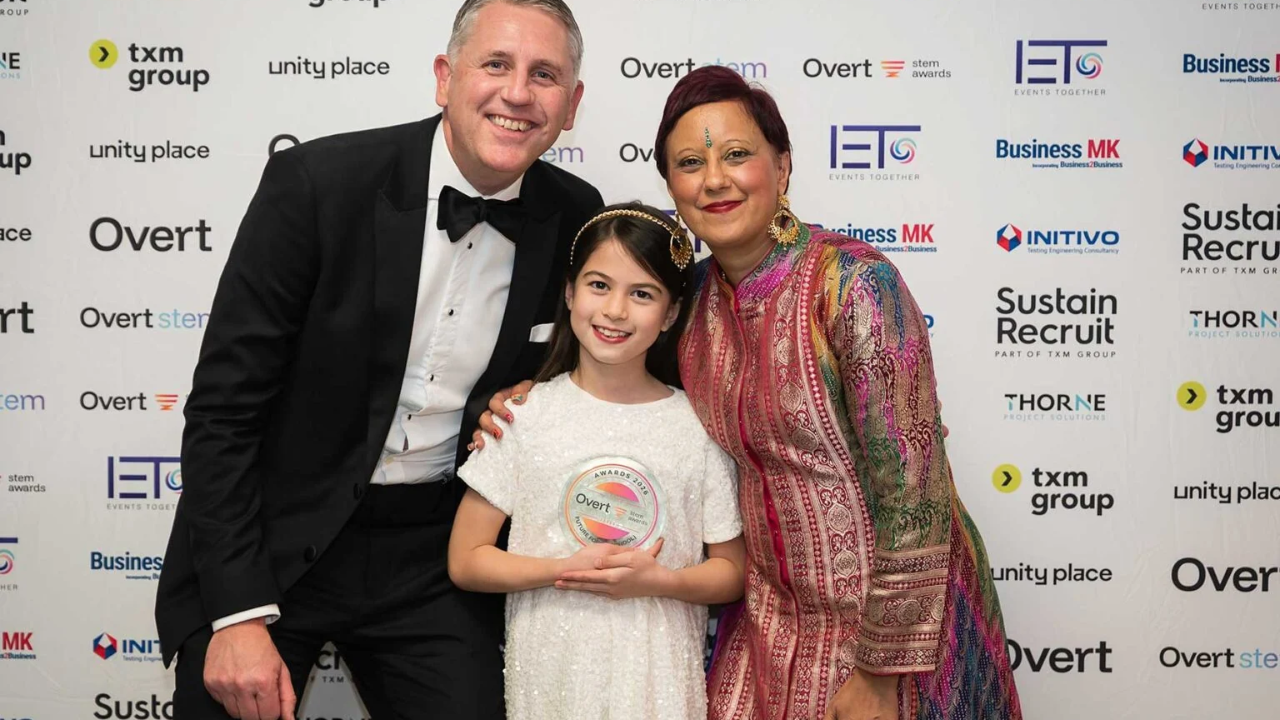
By the time most children her age were still mastering cursive or negotiating trades for fruit snacks at the lunch table, she had already built three functional artificial intelligence applications. Not content to hoard her newfound superpower, she turned around and taught all thirty of her classmates how to use the technology creatively. When the judges of a prestigious national STEM award finally looked at her portfolio, they didn't just see a precocious kid. They saw the youngest finalist in the competition's history—and they handed her the trophy.
On paper, those are the facts. They read like a neat, tidy press release designed to make adults feel warm and fuzzy about "the youth of today."
Strip away the applause, though, and look closer at what actually happened in that room. Because if we treat this story as a cute anomaly—a one-off miracle of a child prodigy—we miss the seismic shift occurring right beneath our feet. The real story isn't about a girl who is abnormally smart. It is about an adult world that has grown abnormally timid.
The Architecture of Fear
To understand why an eight-year-old building AI apps feels so radical, we have to be honest about how the rest of us are reacting to the exact same tools.
Walk into any corporate breakroom, faculty lounge, or dinner party right now, and bring up artificial intelligence. Watch the room's posture change. Shoulders tense. Jaws tighten. For millions of adults, the rapid rise of generative AI and machine learning feels less like a breakthrough and more like an ambush. We read the headlines about displaced workers, copyright battles, and algorithmic bias, and we freeze. We treat the technology like a volatile chemical stored behind thick glass—something to be debated, regulated, and feared from a safe distance.
I know that paralysis intimately. When the first wave of accessible AI builders hit the market a few years ago, I stared at the blinking cursor on my screen with a mixture of dread and imposter syndrome. As someone who has spent years writing and working alongside tech developers, I assumed that building with AI required a PhD in computer science, a fluency in Python, and a deep understanding of neural networks. So I waited. I read articles about it instead of touching it. I let the intimidation win.
Now, consider what happens when you hand that exact same technology to someone who hasn't yet learned to be afraid of looking foolish.
At eight years old, you do not carry the baggage of sunken career costs. You don't worry about whether a machine is going to disrupt your Q3 projections or invalidate your college degree. To an eight-year-old, an AI model isn't an existential threat.
It is a box of digital Legos.
When she sat down to create her three applications, she didn't start by asking, "How do I optimize a workflow?" She started with the purest, most potent engineering question in human history: "Wouldn't it be cool if..."
Inside the Third-Grade Incubator
Let’s step inside a hypothetical version of that classroom to feel the electricity of what she pulled off. Picture thirty eight- and nine-year-olds. Normally, getting thirty third-graders to focus on a single task for twenty minutes requires the vocal stamina of a drill sergeant and the patience of a saint.
Yet, there she was, standing at the front of the room, translating complex concepts—prompts, training data, algorithmic outputs—into the native tongue of eight-year-olds.
Think about the sheer cognitive leap required to do that. Building an app is one thing; teaching thirty peers how to use artificial intelligence creatively is another beast entirely. Most corporate workshops struggle to get thirty grown executives to move past using AI to summarize emails. Meanwhile, in that classroom, thirty children were suddenly generating interactive stories, designing custom artwork, and prototyping problem-solving tools.
Why did they succeed where so many adults stall out?
Because she bypassed the technical jargon and went straight to agency. In traditional schooling, children are almost exclusively consumers of information. They read the textbook; they watch the educational video; they fill in the bubble on the standardized test. Even when we introduce "coding" in elementary schools, it is often reduced to rigid, paint-by-numbers exercises—move the cartoon block three spaces left, hit run, collect the digital star. There is only one right answer, and the guardrails are welded shut.
AI upends that dynamic entirely. When you interact with a large language model or a no-code AI builder, the barrier between an idea and a working prototype evaporates. Suddenly, the skill isn't memorizing syntax. The skill is imagination, clear communication, and iterative problem-solving.
If the app gives a weird answer, you don't get a red 'X' in the margin. You figure out why it misunderstood you, adjust your parameters, and try again. You become the director, not the typist.
By teaching all thirty of her classmates how to wield these tools, this eight-year-old didn't just run a tech tutorial. She staged a quiet rebellion against passive learning. She handed thirty kids the keys to the studio and told them they didn't have to wait until they were grown up to make something real.
The Myth of the "Child Prodigy"
Whenever a young person achieves something extraordinary, adults have a predictable reflex: we put them on a pedestal so high that nobody else can reach it. We call them a "genius" or a "prodigy."
It sounds like a compliment, but psychologically, it is a defense mechanism. If we label her a one-in-a-million freak of nature, we let ourselves off the hook. Teachers don't have to rethink their lesson plans. Parents don't have to rethink screen time. And the rest of us don't have to confront the uncomfortable truth that we have been vastly underestimating what children—and frankly, what we ourselves—are capable of building.
History tells a very different story about youth and technological leaps.
Consider the personal computer revolution of the late 1970s and early 1980s. When the Apple II and the Commodore 64 first landed in homes and schools, the established experts in mainframe computing dismissed them as toys. Meanwhile, twelve-year-olds in suburban bedrooms were teaching themselves BASIC, writing video games, and crashing their parents' machines just to see how the memory worked. Those kids didn't succeed because their brains were wired differently from previous generations. They succeeded because they arrived at a brand-new frontier with zero preconceptions about what was "supposed" to be hard.
We are standing at that exact same inflection point right now.
The tools available today—visual AI builders, natural-language coding assistants, accessible APIs—have flattened the learning curve to a degree that would have looked like sorcery ten years ago. You no longer need to spend four years learning how to build a hammer before you are allowed to build a house. The hammer is sitting right there on the table.
The tragedy is that most adults are staring at the hammer, writing think-pieces about the philosophy of hammering, while an eight-year-old picks it up and builds a neighborhood.
What the Judges Actually Saw
When the STEM award committee named her the youngest finalist—and ultimately the winner—they were validating a fundamental shift in what technical literacy looks like.
For decades, STEM education has been obsessed with specialization. We separated science, technology, engineering, and math into neat little silos, testing students on their ability to execute formulas in isolation. If you were a "creative" kid who loved painting or storytelling, you were gently steered toward the humanities. If you were a "math" kid, you got pushed toward engineering. Never the twain should meet.
An eight-year-old building three AI apps and teaching creative AI use to her class destroys that false binary.
To build an effective AI application, you have to understand logic, data, and system constraints—the classic pillars of engineering. But to make it useful, and to teach thirty peers how to use it creatively, you have to master empathy, design, storytelling, and human psychology. You have to anticipate how another person will interact with your creation, where they will get confused, and what will delight them.
That is the hidden secret of the AI era that so many technical purists miss: as machines get better at pure calculation and syntax, human creativity and communication become the ultimate engineering skills.
When the judges looked at her work, they weren't just grading lines of code. They were looking at impact. They saw a young builder who recognized a gap in her community—a classroom full of curious minds without access to modern tools—and engineered a solution that elevated everyone around her. She didn't just build three apps; she built thirty new creators.
The Invisible Stakes of Screen Time
Let’s pause and look at the broader picture of childhood right now, because the stakes here are higher than a shiny trophy on a shelf.
Walk through any airport, restaurant, or living room, and look at what children are doing on their devices. For the past fifteen years, we have handed kids tablets and smartphones engineered by the smartest behavioral psychologists on earth to maximize passive consumption. Infinite scroll. Auto-playing videos. Dopamine loops designed to keep eyeballs glued to glass for hours without requiring a single original thought.
Parents are exhausted, guilty, and terrified about what this passive digital diet is doing to their kids' attention spans. The default response has been restriction: lock down the iPad, ban the apps, count the minutes, treat technology as a digital narcotic that must be rationed.
Restriction treats the symptom, not the disease.
The antidote to passive consumption isn't digital abstinence; it is active creation. When a child realizes that a computer isn't just a television that fits in their backpack—that it is actually an engine they can program, direct, and bend to their own imagination—the entire relationship with technology flips on its head.
Think about the difference between a kid spending two hours watching someone else play a video game on YouTube, and a kid spending two hours training an AI model to recognize drawings or generate custom choose-your-own-adventure quests for their friends. Both involve two hours of "screen time." On a parent's time-tracking app, they look identical.
In reality, one is a sedative, and the other is a gymnasium for the mind.
By showing her classmates how to use AI creatively, that eight-year-old handed them an escape hatch from the consumption trap. She proved that when you give kids real tools instead of digital pacifiers, they don't just consume the internet. They start building it.
The Permission Slip We All Need
It is easy to read about a third-grader winning a national STEM award and feel a pang of inadequacy. I certainly did when I first came across the headline. Here I was, decades older, carefully overthinking my own creative projects, while someone who still loses baby teeth was shipping functional software and running classroom workshops.
If you feel that same twinge of hesitation when you look at new technology, take a breath. Confusion is normal. Skepticism is healthy. The sheer speed at which these tools are evolving is genuinely disorienting, and anyone who claims they have it all figured out is lying to you.
But there is a massive difference between healthy skepticism and self-imposed paralysis.
We spend so much of our adult lives waiting for permission. We wait for the official training course to be approved by HR. We wait until we feel "ready." We wait until we understand every single gear inside the engine before we dare to turn the key.
Eight-year-olds don't wait for permission because they haven't learned that they're supposed to ask for it. They see a door standing slightly ajar, and they push it open just to see what's on the other side.
Somewhere in a third-grade classroom right now, thirty kids are looking at the blank screen of a computer, not with anxiety, not with existential dread, and certainly not with boredom. They are looking at it as a canvas waiting for their instructions—all because one girl refused to act her age.