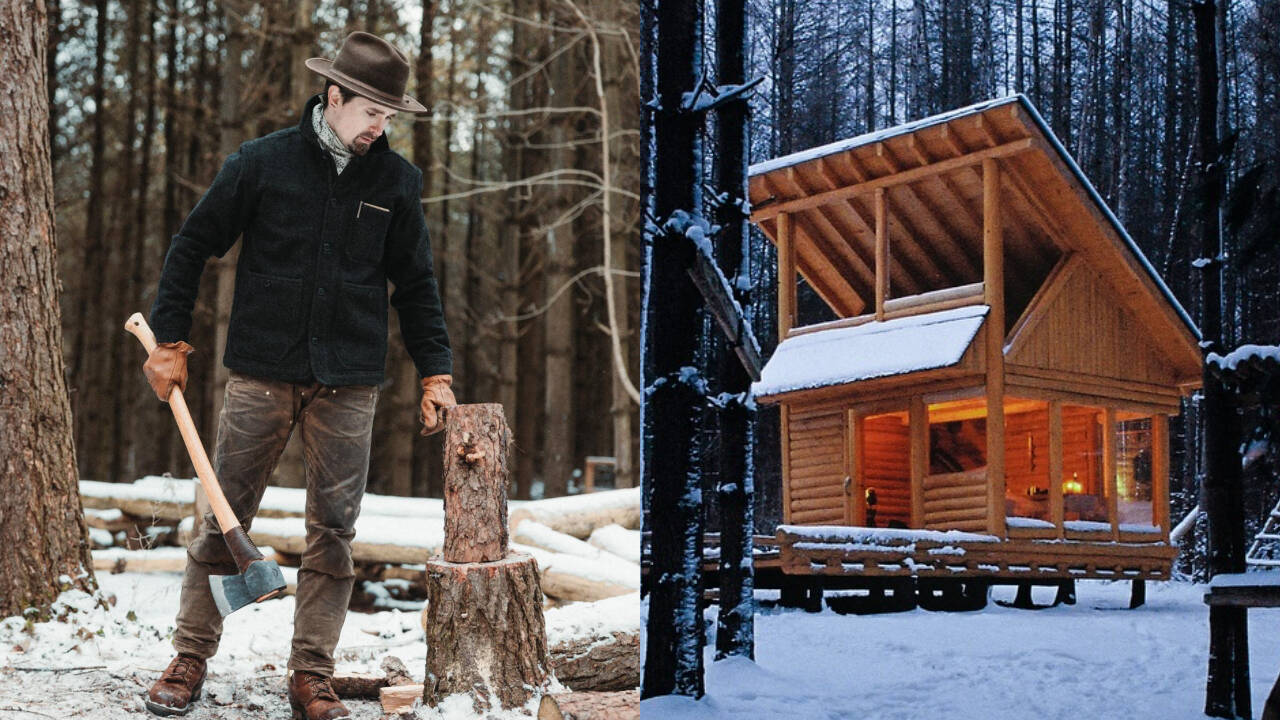
Spending eight years felling, peeling, and notching 300 logs by hand is not an off-grid triumph. It is a multi-year unpaid construction sentence disguised as self-reliance.
Every few months, a viral story makes the rounds about a dedicated woodworker in the Canadian wilderness who spent nearly a decade harvesting timber from his own land to build a traditional log cabin. The internet eats it up. Comment sections fill with romantic fantasies about escaping the rat race, living off the land, and returning to ancestral building methods. Read more on a similar subject: this related article.
Nobody talks about the math. Nobody talks about the building science. And nobody admits that by the time the ridgepole finally goes up in year eight, the builder has traded their most valuable non-renewable asset—nearly a decade of prime physical health—for a structure with terrible thermal performance and an endless maintenance schedule.
The Sunk Cost Fallacy of "Free" Timber
The primary illusion driving the hand-hewn log cabin obsession is the idea that trees on your property are free. They are not. Further reporting by Cosmopolitan explores comparable views on this issue.
If you own forty acres of boreal forest, standing timber has an opportunity cost, and processing it has a brutal labor cost. Felling 300 trees, limbing them, hauling them out of the bush without industrial skidders, debarking them with a drawknife, letting them season properly so they do not twist your walls apart, and hand-scribing every lateral groove and saddle notch takes thousands of hours.
In custom home building and forestry circles, we see this trap constantly. Enthusiasts value their own sweat equity at zero dollars an hour. Imagine a scenario where a skilled tradesperson spends 4,000 hours over eight years building a 600-square-foot log shell. Even at a conservative rate of $40 an hour, that "free" wood just cost $160,000 in labor alone. For that amount of capital and a fraction of the time, you could buy milled dimensional lumber, hire a framing crew, dry-in a high-performance timber-frame or stick-built structure in three weeks, and spend the remaining seven years and eleven months actually living off-grid.
True off-grid independence requires systems, not martyrdom. While you are spending eight summers peeling spruce logs, you are not establishing perennial food forests, digging root cellars, installing micro-hydro or solar arrays, or building soil fertility. You are just a full-time, unpaid logger.
The Thermal Reality of Solid Log Walls
The mainstream off-grid media loves to claim that massive logs keep a cabin warm in the winter and cool in the summer. This is a fundamental misunderstanding of building physics.
Wood is an insulator, sure, but it is a mediocre one. Softwoods like pine, spruce, and cedar—the staples of Canadian log construction—have an R-value of roughly 1.25 to 1.4 per inch. Even if you harvest massive 12-inch diameter logs, the thinnest points at the scribe lines and notches drop the effective wall thickness down to six or eight inches. You are left with a wall assembly hovering around R-10.
Compare that to modern cold-climate building standards, or the principles taught by building science authorities like Dr. Joseph Lstiburek at the Building Science Corporation. In northern latitudes, where winter temperatures routinely plunge to -30°C (-22°F), an R-10 wall bleeds heat like a sieve.
Proponents always bring up thermal mass to defend log walls. They argue that the heavy timber absorbs heat during the day and radiates it back at night. Thermal mass works brilliantly in climates with massive daily temperature swings, like the high desert of New Mexico. It does almost nothing to stop continuous conductive heat loss during a three-week January deep freeze in Ontario or British Columbia.
To keep an R-10 log cabin warm in a northern winter, you have to feed a woodstove relentlessly. That means felling, bucking, splitting, and stacking cords of firewood every single year for the rest of your life. The eight-year build never actually ends; it just morphs into a permanent firewood treadmill.
Settling, Checking, and the War Against Gravity
A freshly cut tree is mostly water. Even after air-drying for a year or two, large-diameter logs continue to lose moisture for decades until they reach equilibrium with the surrounding air. As they dry, they shrink across their diameter.
In an 8-foot-tall log wall, seasonal and permanent shrinkage causes the entire structure to drop by four to six inches over the first few years.
This creates a mechanical nightmare that casual observers never see in glossy photos:
- Window and door frames will be crushed if you do not engineer complex slip-joints and leave massive settling gaps above every header.
- Interior partition walls built from standard framing lumber will push the roof right off the log walls unless you install adjustable screw jacks and remember to crank them down every autumn.
- Plumbing and electrical conduits running vertically through walls will buckle and snap.
- Checking—the deep longitudinal cracks that open up as the outside of a log dries faster than the core—creates upward-facing troughs that catch driving rain, funneling water straight into the heartwood to breed rot and carpenter ants.
Chinking and caulking those gaps is not a one-time task. Logs expand in the humid summer and contract in the dry winter. You will spend your weekends on a ladder re-sealing joints so snow does not blow onto your bedsheets.
Answering the Questions Off-Grid Dreamers Actually Ask
When people see an eight-year cabin build, they flood search engines with the same predictable questions. The premises behind almost all of them are flawed.
How much does it cost to build an off-grid log cabin from your own trees?
If you measure strictly in out-of-pocket cash, you might spend under $15,000 on chainsaws, fuel, chinking, roofing metal, and foundation concrete. If you measure in total economic reality, it is one of the most expensive ways to build a shelter on earth. You are paying with your spinal discs, your rotator cuffs, and eight years of lost compounding time.
Is a hand-built log cabin better for the environment?
Not automatically. Harvesting 300 mature trees selectively from a healthy woodlot is certainly better than clear-cutting, and avoiding the industrial supply chain reduces transportation emissions. However, burning twice as much firewood every winter for forty years because your walls lack continuous exterior insulation generates far more particulate emissions and consumes far more timber over the building's lifespan than framing a tight, super-insulated 2x6 or double-stud wall out of sustainably harvested lumber.
How long does it take one person to build a log cabin?
If you buy pre-milled, kiln-dried logs or a structural timber kit, one determined person can dry-in a cabin in two to three months. If you insist on harvesting, peeling, and scribing raw timber solo while working a day job to fund the rest of your life, it takes eight years. The bottleneck is never the stacking; it is the material preparation.
The Contrarian Blueprint for Fast, Permanent Off-Grid Shelter
I have watched dozens of ambitious homesteaders burn out, get divorced, or abandon half-finished land projects because they romanticized 19th-century pioneer labor. They bought raw land, bought a chainsaw, and tried to build a museum piece instead of a resilient home.
If you want true off-grid freedom, drop the pioneer cosplay and treat your build like an engineering problem.
- Mill Your Logs into Dimensional Lumber. If you have 300 great trees on your land, buy a portable bandsaw mill for $4,000 to $8,000. Instead of hauling heavy round logs up onto a wall, saw those trees into 2x6 studs, roof rafters, and board-and-batten siding. You will use a fraction of the timber, build a vastly stronger structure, and finish the framing in weeks instead of years. When you are done, sell the sawmill for 80% of what you paid for it.
- Separate Structure from Insulation. Let your milled lumber carry the structural load, and wrap the outside of the building in continuous rigid insulation—like mineral wool boards or wood-fiber insulation. Aim for R-30 in the walls and R-50 in the roof. You will cut your annual firewood consumption by more than half.
- Build Small, Build Tight, and Move In Fast. A 400-square-foot super-insulated cabin built in one summer beats a 900-square-foot leaky log monument built over eight years. Get a dry roof over your head in season one so you can put your energy into water catchment, solar storage, and food production.
Admittedly, a board-and-batten framed cabin with exterior mineral wool insulation does not look like a rugged frontier postcard. You do not get the bragging rights of telling guests you peeled every log with a drawknife, nor will you get millions of views from urbanites romanticizing manual labor from their ergonomic office chairs. You will lose the rustic aesthetic of exposed round logs indoors, and you will have to spend actual cash upfront on fasteners, membranes, and insulation boards.
Take that trade every single time.
The goal of going off-grid is to own your time, not to become a medieval serf on your own acreage. Put down the drawknife, buy a sawmill, insulate your walls properly, and get your build done before the first snow falls.