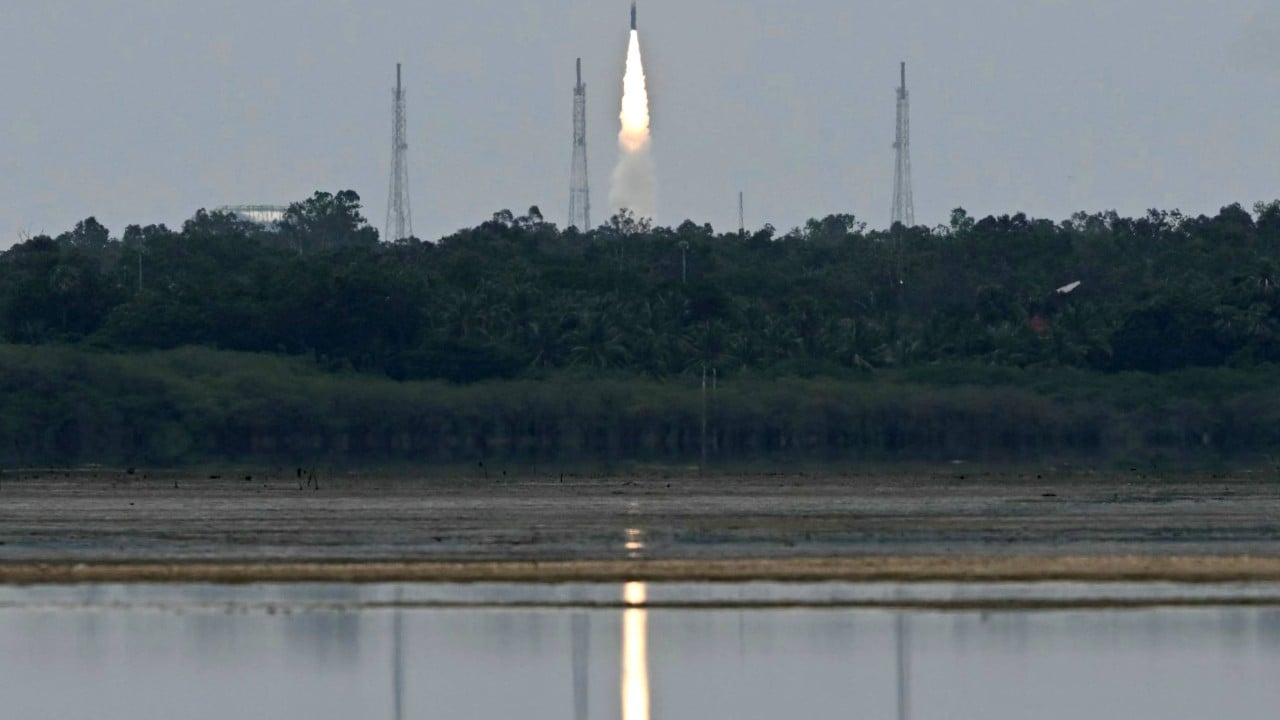
The maiden orbital launch of Skyroot Aerospace’s Vikram-1 rocket establishes a tripartite structure in private orbital launch capabilities, placing India alongside the United States and China. This shift alters the unit economics and geopolitical dynamics of small-satellite orbital deployment. Up to this milestone, state-backed monopolies and heavy-lift rideshare providers dictated the timeline and vector of small satellite constellations. The structural dynamics of smallsat deployment are transitioning from a consolidated batch model to an on-demand, customized orbital insertion model.
Evaluating the Vikram-1 orbital flight requires a breakdown of the three key levers governing the contemporary commercial space ecosystem: capital efficiency, schedule flexibility, and local manufacturing density.
┌─────────────────────────────────────────────────────────────┐
│                    TRIPOLAR LAUNCH ECOSYSTEM                │
├───────────────────┬───────────────────┬─────────────────────┤
│   United States   │       China       │        India        │
├───────────────────┼───────────────────┼─────────────────────┤
│ • High-CAPEX      │ • State-Subsidized│ • Low Cost Structure│
│ • Reusability     │ • High Cadence    │ • Solid Propulsion  │
│ • SpaceX/RocketLab│ • Galactic Energy │ • Skyroot Aerospace │
└───────────────────┴───────────────────┴─────────────────────┘
The Three Pillars of Smallsat Unit Economics
The global launch market evaluates providers through a tri-part trade-off space consisting of cost per kilogram, launch schedule certainty, and orbit specificity.
- Payload Mass and Orbital Vector Precision: Heavy-lift rideshare vehicles like SpaceX’s Falcon 9 offer low cost per kilogram (roughly $2,700/kg) but operate as public transit systems. Satellites are dropped into a uniform sun-synchronous orbit (SSO). Adjusting individual orbital planes requires onboard propulsion, consuming propellant and cutting satellite operational lifespans. Small orbital launchers like Vikram-1 trade raw capacity (350 kg to Low Earth Orbit) for targeted orbital insertion, preserving satellite fuel.
- Capital Expenditure and Manufacturing Cycles: Vikram-1 relies heavily on carbon-composite airframes and 3D-printed engine components, such as its liquid-fuel upper stage. Combining high-thrust solid-fuel boosters for lower stages with additive-manufactured upper-stage liquid engines simplifies assembly lines. Solid propellant eliminates complex cryogenic turbopump management during early flight stages, reducing development CAPEX and cycle time.
- The Cadence Metric vs. Cost Bottleneck: Operating at an estimated $5 million to $10 million per launch target, small launchers compete against established vehicles like Rocket Lab’s Electron ($7.5 million for ~300 kg). The competitive edge depends on factory throughput. Achieving a rate of one launch per month converts fixed infrastructure overhead into variable operating efficiency.
                  +-----------------------+
                  | Orbit Specificity     |
                  | (Custom Inclination)  |
                  +-----------+-----------+
                              |
                              |
                              |
    +-------------------------+-------------------------+
    |                                                   |
+---v-------------------+                   +-----------v-----------+
| Schedule Certainty    |                   | Unit Cost Optimization|
| (Dedicated Timelines) |                   | (High Cadence/3D Print|
+-----------------------+                   +-----------------------+
Structural Cost Functions and Propulsion Architecture
Vikram-1's four-stage configuration—utilizing three solid-propellant stages and a liquid-fueled velocity trimming stage—presents a specific cost structure compared to liquid-only systems. Solid propulsion stages offer reliable ignition and dense storage, lowering launch-pad infrastructure costs. Liquid engines require complex fluid management, cryogenic infrastructure, and long countdown cycles.
By offloading early staging to solid rocket motors (Kalam series) and reserving precision thrust-vectoring for the final liquid-fueled upper stage, Skyroot minimizes engine failure points while maintaining orbital placement tolerances.
| Metric / Parameter | Skyroot Vikram-1 | Rocket Lab Electron | ISRO / NSIL SSLV |
|---|---|---|---|
| LEO Capacity (kg) | 350 | ~300 | 500 |
| Primary Propulsion | Solid (1-3), Liquid (4) | Liquid (RP-1/LOX Electric) | Solid (1-3), Liquid VTM |
| Est. Cost / Launch | $5M – $10M | ~$7.5M | ~$4.2M |
| Primary Advantage | Rapid turnaround, low infrastructure | High launch cadence history | Lowest state-backed cost |
The reliance on carbon fiber composites reduces dry mass, allowing a higher payload fraction without expensive high-thrust liquid engines. This design choice is critical for emerging space ecosystems operating without deep sovereign subsidies.
Market Constraints and Operational Risks
Despite successful orbital insertion, small-launcher operators face three primary structural vulnerabilities:
- Rideshare Price Compression: Heavy-lift operators continue to lower marginal costs per launch. If mega-constellation operators deploy secondary payload adapters at steep discounts, small launchers lose customers who prioritize low cost over orbit specificity.
- Supply Chain Bottlenecks in Carbon Composites: Carbon fiber composite airframes demand tight supply chains. Manufacturing delays in high-grade carbon tow or curing autoclaves can choke the assembly cadence, undermining the scale required to amortize fixed R&D costs.
- Launch Site Dependency: Operating out of state-run launch complexes like the Satish Dhawan Space Centre introduces scheduling dependencies on national space agency priorities. Establishing dedicated private launch pads or streamlined range-allocation models remains necessary to achieve high launch frequencies.
To scale from initial orbital qualification to a sustainable enterprise, Skyroot must execute a dual strategy. First, it must transition from solid stages to reusable liquid architectures in higher-capacity variants (e.g., Vikram-2) to bring down long-term marginal costs. Second, it must capture domestic defense and earth-observation constellation contracts to maintain base-level demand, shielding the enterprise from commercial launch cycles while scaling factory output toward target operational rates.


:max_bytes(150000):strip_icc():focal(749x0:751x2)/Arnold-Schwarzenegger-Joseph-Baena-032926-a90f8d3315fc44a6aebc6d7bb44bda01.jpg)