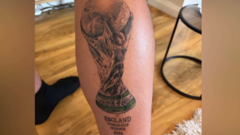
Committing permanent physical capital to an unverified future event represents the ultimate breakdown of risk-adjusted decision-making. When an England football supporter permanently inks "World Cup Winners" onto their skin before the final whistle blow, they are not merely expressing fandom; they are executing an irreversible long position on a highly volatile, binary outcome. The subsequent defeat of the team transforms this physical asset into an immediate reputational liability. To understand how individuals navigate this self-inflicted crisis, we must analyze the structural mechanics of premature commitment, the economic cost of regret mitigation, and the semiotic pivots available to salvage personal brand equity.
The phenomenon of the premature championship tattoo offers a pristine case study in cognitive bias, asymmetric risk, and post-crisis mitigation. By treating a highly volatile sporting event as a deterministic certainty, the individual enters a negative expected value ($EV$) trap. When the predicted outcome fails to materialize, the individual faces a stark choice: absorb the permanent social depreciation of a failed prediction, or incur financial and physical costs to modify the asset.
The Asymmetric Risk Profile of Premature Commitments
In classic decision theory, commitments are made based on probability distributions. The decision to acquire a tournament-winning tattoo prior to the event's conclusion violates basic risk-management principles by treating a stochastic system—a football tournament—as a deterministic one.
We can model this behavior through three primary cognitive distortions:
- Optimism Bias and the Illusion of Control: The fan conflates intense emotional investment with causal influence over the pitch. This leads to an overestimation of the probability of victory, effectively pricing the risk of defeat at or near zero.
- Social Signalling Dynamics: The value of the tattoo is front-loaded. Prior to the match, the individual captures immense social capital, attention, and media coverage by projecting absolute certainty. This "hero or fool" binary risk profile is highly attractive in attention-based economies, where even negative attention holds non-zero utility.
- Hyperbolic Discounting: The immediate utility of pre-victory social status is heavily prioritized over the future utility of avoiding lifelong embarrassment. The individual discounts the pain of post-defeat regret because the potential triumph feels immediate and overwhelming.
The core vulnerability of this position is its complete lack of downside protection. If the team wins, the utility cap is reached, but the incremental gain of having the tattoo early versus after the victory is marginal. If the team loses, the utility drops to a severe negative value, creating a permanent, highly visible record of failed forecasting.
The Cost Function of Post Defeat Brand Salvage
Once the negative outcome is realized, the owner of a premature tattoo holds a depreciated asset. The management of this liability is governed by a strict optimization problem. The owner must minimize total cost, which is a function of financial outlay, physical pain, and residual reputational damage.
The three primary operational pathways for addressing this liability include:
                  [ Premature Tattoo Liability ]
                                |
         +----------------------+----------------------+
         |                      |                      |
  [ 1. Abstention ]     [ 2. Obliteration ]    [ 3. Semiotic Pivot ]
  (Zero cost,           (Laser removal or      (Adding context, e.g.,
   high social tax)      complete cover-up)     "Only Joking")
1. The Strategy of Absolute Abstention
Choosing to do nothing requires the individual to internalize the full social tax of the failed prediction. The tattoo remains a permanent marker of misplaced confidence. While the financial cost of this strategy is zero, the ongoing social depreciation is high, requiring the individual to continuously explain, defend, or hide the asset.
2. The Strategy of Complete Obliteration
This pathway involves laser removal or a complete black-out cover-up.
- Laser Removal: This is a high-cost, multi-session intervention. It demands significant financial resources and physical endurance over several months or years. The primary limitation of this strategy is the temporal lag; the individual must carry the failed brand throughout the duration of the treatment cycles.
- Cover-Up Tattoos: This option replaces the failed prediction with a new, unrelated visual asset. While faster and often cheaper than laser removal, it requires a larger, darker design, which may not align with the individual's aesthetic preferences. This represents a forced reallocation of physical capital.
3. The Strategy of Semiotic Pivot
The most analytically interesting pathway is the modification of the existing text to shift its meaning. This is exemplified by adding qualifiers like "Only Joking" or "Nearly" to the original "England World Cup Winners" statement.
Instead of erasing the error, this strategy leans into the failure, transforming a sincere, incorrect prediction into a self-deprecating joke. This structural pivot attempts to convert a reputational liability into a humorous asset, recapturing social capital by signaling humility and self-awareness.
Semiotic Modification as a Reframing Framework
To understand why a modification like adding "Only Joking" is highly efficient, we must look at the mechanics of linguistic reframing. The original tattoo is a declarative assertion: "England World Cup Winners [Year]."
The addition of a modifier changes the semantic framework:
- The Original Frame (Sincere/Hubristic): The individual presents themselves as an oracle or a hyper-confident believer. Post-defeat, this frame collapses into foolishness.
- The Modified Frame (Irony/Satire): The individual repositions themselves as a self-aware participant in a public joke. The failure is acknowledged, packaged, and neutralized.
This modification alters the social feedback loop. A viewer who encounters the original tattoo post-defeat feels pity or amusement at the wearer's expense. A viewer who encounters the modified tattoo experiences amusement with the wearer. The power dynamic is inverted; the wearer regains control of the narrative by being the first to laugh at their own mistake.
Furthermore, this pathway is highly cost-effective. Adding a small textual qualifier requires minimal skin real estate, a single short tattooing session, and low financial outlay compared to full laser removal or a massive cover-up design. It is a low-cost, high-efficiency solution to a high-exposure risk event.
The Strategic Play for Irreversible Commitment Risks
For individuals and brands looking to navigate high-stakes, public commitments, the lessons of the premature sports tattoo are highly transferable. When managing public-facing predictions, the optimal play relies on establishing clear hedge mechanisms before the event occurs.
- Implement a Semantic Contingency Plan: If a bold, pre-emptive statement must be made for marketing or personal branding purposes, ensure the medium allows for rapid contextual modification. Digital assets can be updated instantly; physical assets must be designed with modification in mind.
- Calculate the Modification Footprint: Before executing any permanent branding, calculate the physical and financial cost of reversing the statement. If the cost of correction exceeds the short-term value of the publicity, the venture is a structural negative-value play.
- Embrace the Post-Failure Pivot: If a public prediction fails, do not attempt to deny or quietly erase the mistake if the public is already aware of it. Instead, lean into the error. Modifying the statement to highlight the failure is almost always more socially profitable than pretending the prediction was never made. This transforms a structural failure into an authentic moment of human vulnerability.