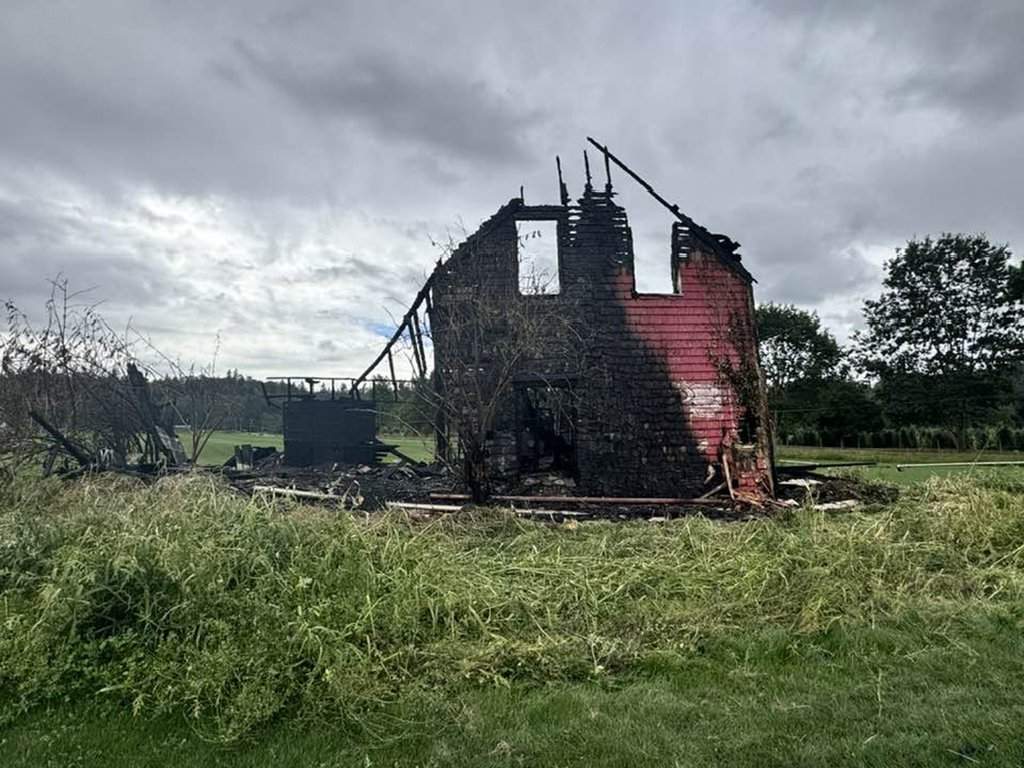
The incineration of the McIver Residence in the Township of Langley exposes a structural failure within municipal heritage preservation economics. Commonly known as the Little Red House, this Gothic-style farmhouse stood in Glen Valley for nearly 140 years before a structural fire reduced it to ash. Public commentary has fixated on the loss of a cultural touchstone, a frequently painted landmark sitting marooned in the middle of a commercial turf farm. Beneath the sentimental grief lies a predictable economic calculus. Unoccupied historic properties sitting on privately held agricultural land face an inevitable trajectory of decay, driven by liability, prohibitive rehabilitation costs, and municipal policy incentives that favor demolition by neglect over active capital allocation.
Evaluating the collapse of this asset requires examining the structural pressures governing derelict rural architecture. The property math of historic preservation involves a clear cost function where the private expenditure required to stabilize a decaying structure vastly outstrips any potential return on investment, particularly when the building is zoned for agriculture rather than commercial or residential density.
The Three Variables of Heritage Decay
Structural Depreciation Rate
Uninhabited wooden structures constructed between 1887 and 1890, such as the McIver House, rely on timber frames that degrade rapidly once climatic envelope integrity fails. Without active climate control, moisture intrusion accelerates rot in foundational sills and load-bearing framing. The absence of occupants means water leaks, pest infestations, and structural shifts go undetected until the remediation threshold crosses from maintenance into total reconstruction.
The Liability Asymmetry
Private landowners carry absolute legal and financial liability for injuries sustained by trespassers or vandals on their property. An abandoned, unsecured building acts as an attractor for youth and transient populations. The rational response for a private property owner is risk mitigation, which paradoxically conflicts with historical conservation. Securing a decaying building against entry requires capital expenditure that yields zero cash flow, creating an economic disincentive to invest in structural preservation.
Opportunity Cost of Land
The McIver Residence occupied land optimized for commercial turf farming. Every square meter dedicated to a non-functional historic relic represents foregone agricultural yield or holding value. When the cost of holding a derelict asset exceeds its sentimental or historical valuation to the owner, the asset enters a terminal phase where natural or accidental destruction becomes the default economic clearing event.
The Structural Failure of Preservation Policies
Municipal heritage designations frequently operate on a model of regulatory restriction rather than financial subsidization. When a property is designated historic, the owner absorbs the restriction of not being able to easily alter or demolish the asset, while receiving little to no capital support from the municipal tax base to offset the exorbitant costs of specialized restoration.
This creates a perverse incentive structure. The capital cost function of restoring a rotting 19th-century farmhouse to modern building codes often exceeds the total replacement cost of building a new structure. When structural deterioration reaches a critical point, the cost of stabilization surpasses the property's total valuation.
In the case of the Glen Valley property, ownership by a local municipal official brought heightened visibility to the tension between private property rights and public heritage aspirations. Public statements acknowledged that the deterioration made restoration financially unrealistic, confirming that market forces had long rendered the building functionally obsolete. When an asset reaches functional obsolescence and private owners are expected to subsidize public nostalgia out of pocket, preservation fails.
Preventing Future Losses
Municipalities aiming to prevent the recurrence of such losses must transition from punitive designation models to active economic incentive programs. Preservation policy must recognize that historic structures on private lands are private economic units subject to market laws.
Tax-increment financing for heritage properties, transferable development rights, and municipal maintenance funds represent the mechanical interventions required to alter the cost function of derelict architecture. Until local governments internalize the cost of keeping history standing, rural heritage assets will continue to follow the path of least resistance, decaying in plain sight until a spark resolves the equation.