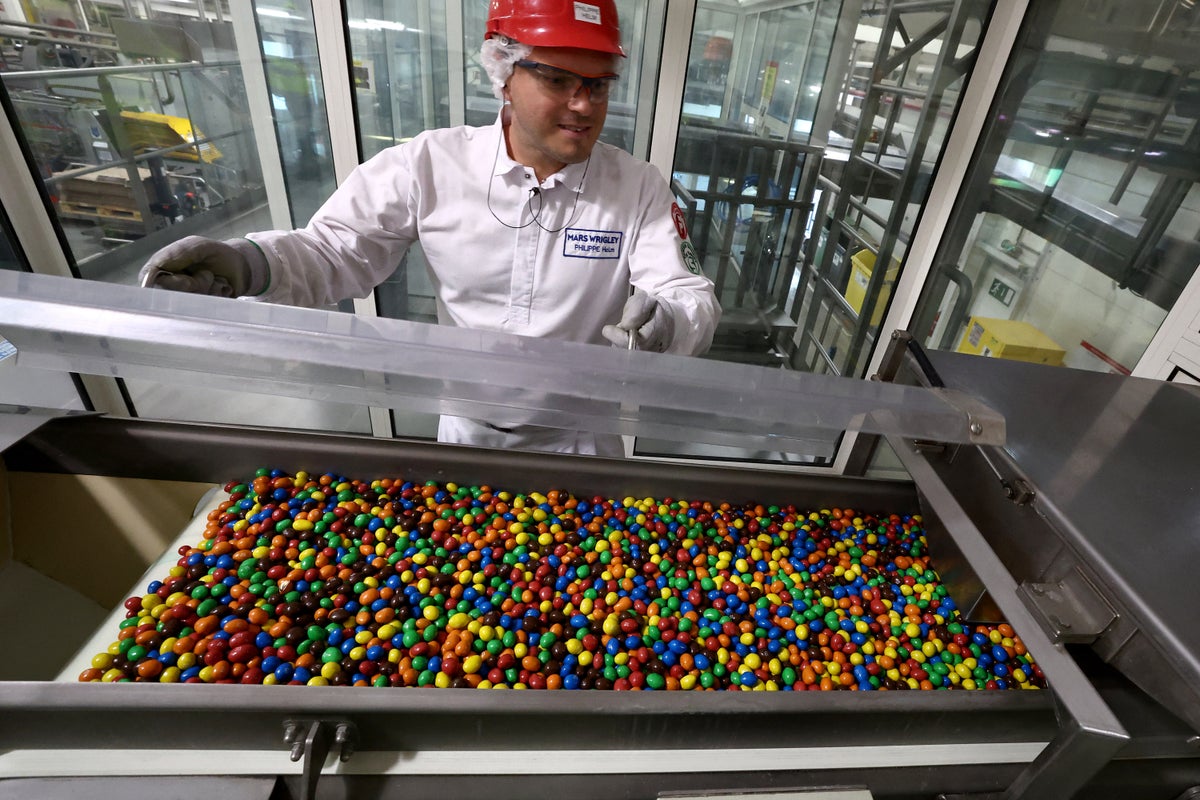
The physical manifestation of regulatory and political pressure on consumer packaged goods (CPG) is visible in the structural alteration of flagship products. Mars Company's decision to launch a synthetic dye-free line of M&Ms exclusively via e-commerce highlights the profound technical and economic bottlenecks of scaling natural alternatives to petroleum-based colorants like FD&C Blue 1. By executing a product launch that entirely omits blue and brown candies, Mars reveals a fundamental vulnerability in modern supply chains: the asymmetric difficulty of replacing cheap, stable synthetic molecules with complex biological compounds.
Understanding this product shift requires moving past political rhetoric regarding the "Make America Healthy Again" (MAHA) movement and examining the core industrial engineering and raw material constraints that govern multinational food manufacturing.
The Triple Constraint Bottleneck of Natural Formulations
Industrial food dye substitution is constrained by three variables that must achieve simultaneous parity with synthetic benchmarks: color fastness, mechanical processing compatibility, and unit economics. When Mars attempted to transition its hard-shell panning process to natural alternatives, the system broke down along these specific parameters.
       [Color Fastness / Fidelity]
                   /\
                  /  \
                 /    \
                /      \
               /________\
[Processing Compatibility] [Unit Economics]
1. Organic Rheology and Factory Downtime
Synthetic dyes like Blue 1 dissolve predictably in sugar syrups without altering the viscosity or fluid dynamics of the coating mixture. Natural substitutes, specifically the phycocyanin pigment derived from spirulina algae, behave entirely differently. To achieve the deep blue hue expected by consumers, the concentration of spirulina extract must be exponentially higher than its synthetic counterpart.
This high mass-fraction introduces organic macromolecules into the panning sprayers, converting a low-viscosity liquid into an unstable, goopy foam. The mechanical consequence is immediate: spray nozzles clog, automated lines seize, and standard CIP (Clean-In-Place) sanitation cycles must be executed at multiples of their standard frequency. The operational cost of this downtime destroys the efficiency of high-speed manufacturing assets.
2. The Multi-Pigment Synthesis Challenge for Brown
The omission of brown highlights a deeper chemical limitation. While the interior chocolate core of an M&M is naturally brown, the exterior protective shell requires a uniform opaque layer to prevent the internal fat from blooming and turning grey. Synthetically, brown is achieved via a highly stable blend of Red 40, Yellow 5, and Blue 1.
Removing synthetic dyes forces food scientists to blend natural equivalents like beet juice (red), turmeric or beta-carotene (yellow), and spirulina (blue). Because these organic molecules have completely divergent degradation profiles, thermal tolerances, and pH sensitivities, blending them uniformly is highly volatile. The blue component degrades faster under factory drying heat than the red and yellow components, turning the intended brown shell into an unappealing, muddy green or greyish hue. Rather than risk catastrophic product variance on retail shelves, Mars elected to completely eliminate the color from the initial product matrix.
The Cost Function of Global Supply Chain Bifurcation
The decision to limit the initial launch to Amazon indicates an intentional mitigation of supply chain risk. Scaling a new CPG formula to physical retail requires massive upfront inventory commitments and strict slotting fees with national distributors. By confining the natural variant to an online-only channel, Mars protects its legacy factory footprints from contamination and avoids retail penalties for out-of-stock items.
The underlying economic drivers forcing this transition stem from a fragmented regulatory environment across US states, paired with federal signaling from the Department of Health and Human Services.
| Variable | Synthetic Food Dyes (FD&C Blue 1, Red 40) | Natural Food Dyes (Spirulina, Turmeric, Beet) |
|---|---|---|
| Raw Material Cost | Extremely Low (Petrochemical derivative) | High to Variable (Agricultural yield dependent) |
| Dosage Requirements | Minimal (High color intensity per mg) | Substantial (Requires thick layers for opacity) |
| Thermal Stability | High (Survives industrial drying ovens) | Low (Prone to browning and fading under heat) |
| Supply Chain Elasticity | High (Industrial chemical synthesis) | Low (Vulnerable to crop failures and weather) |
The divergence in raw material elasticity is the primary long-term operational risk. Petrochemical synthesis offers an almost perfectly elastic supply curve; production can scale instantly to match global demand. Agricultural colorants, conversely, depend on specialized crop yields, microclimates, and complex extraction facilities. A sudden global mandate to eliminate synthetic dyes across all confectionery brands would instantly break the global supply of high-grade spirulina and turmeric, driving input costs to prohibitive levels.
Strategic Paths to 2028: Solving the Extraction Bottleneck
Mars has publicly signaled a target of 2028 to achieve a full, five-color natural product portfolio. To move from the current online-only, missing-color compromise to a mass-market retail standard, the engineering strategy must pivot from simple agricultural extraction to advanced biotechnology.
The first operational path involves precision fermentation. By inserting the genetic sequences responsible for phycocyanin production into yeast or fungal strains, manufacturers can bypass the inconsistent yields of open-pond algae farming. Fermentation tanks operate under tightly controlled conditions, producing a highly purified, consistent blue pigment that contains fewer of the cellular structural elements that cause clogging and foaming in factory machinery.
The second path requires a structural redesign of the candy shell itself. Instead of relying on a translucent sugar glaze that requires high pigment density to mask the dark chocolate underneath, engineering teams are testing natural opacifiers like calcium carbonate or rice starch. By creating a bright white, highly reflective base coat on the candy shell first, the subsequent layer of natural dye requires significantly less pigment density to achieve a bright, vibrant visual output. This reduction in required pigment mass directly alleviates the rheological strain on factory sprayers, reducing maintenance intervals to standard operational tolerances.
The current online iteration of dye-free M&Ms is a live market experiment in consumer behavior and operational viability. The true test of this transition will not be whether consumers accept missing colors in exchange for a cleaner ingredient label, but whether industrial food engineers can alter the fundamental physical chemistry of natural pigments before state-level synthetic bans outrun corporate timelines.