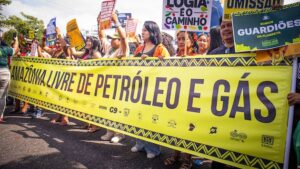
The Santa Marta Summit represents a critical shift in the climate transition from symbolic climate diplomacy to a contest over the structural ownership of natural capital. While the public discourse focuses on the "phase-out" of fossil fuels, the underlying mechanism is a radical reallocation of resource rights and the pricing of carbon-intensive assets. The conflict at the summit centers on a specific friction: the delta between the international community’s mandate for rapid decarbonization and the sovereign demands of Indigenous populations who inhabit the geographies where these resources—and their cleaner alternatives—are situated. To understand the summit's outcome, one must analyze the tension through three primary lenses: the stranded asset risk, the Indigenous veto power as a regulatory barrier, and the capital gap in the transition from extraction to stewardship.
The Stranded Asset Dilemma and Economic Path Dependency
The primary obstacle to a fossil fuel phase-out is not a lack of technological substitutes, but the existing path dependency of national balance sheets. For nations participating in the Santa Marta Summit, fossil fuel reserves represent "underground wealth" that has already been factored into long-term sovereign debt and infrastructure planning. For an alternative look, see: this related article.
When Indigenous voices demand an immediate cessation of extraction, they are effectively advocating for the "stranding" of these assets. A stranded asset is an investment that loses its value or becomes a liability before its expected economic life ends. The cost of this stranding is not merely the lost revenue from oil or coal sales; it includes:
- Unamortized Infrastructure Costs: The billions in sunk costs for pipelines, refineries, and transport networks that cannot be repurposed.
- Decommissioning Liabilities: The massive environmental cleanup costs that are typically deferred until a well or mine is exhausted.
- Sovereign Credit Down-rating: For many global south nations, the sudden removal of energy exports can lead to a credit squeeze, making the transition to renewables prohibitively expensive.
The Santa Marta Summit attempts to resolve this by proposing a "just transition" framework, but this often lacks the quantitative rigor required to replace the lost GDP. Without a mechanism to monetize "non-extraction"—essentially paying countries to keep carbon in the ground—the demand for a phase-out remains an unfunded mandate. Further analysis on the subject has been provided by USA Today.
Indigenous Sovereignty as a Non-Technical Risk Factor
Institutional investors and multinational energy firms have historically treated Indigenous opposition as a PR issue. However, the Santa Marta Summit highlights a shift toward treating this as a "Non-Technical Risk" (NTR) that can determine the Net Present Value (NPV) of any energy project. Indigenous groups are increasingly utilizing a legal and regulatory framework known as Free, Prior, and Informed Consent (FPIC).
FPIC acts as a gatekeeping mechanism. When Indigenous voices at Santa Marta demand urgent action, they are signaling that the social license to operate has been revoked. This creates a bottleneck in the following ways:
- Permitting Lead Times: Projects that ignore Indigenous land rights face litigation that can extend permitting phases by 5 to 10 years, eroding the Internal Rate of Return (IRR).
- Operational Security: Projects in contested territories face higher insurance premiums and security costs.
- Equity Risk: Modern ESG (Environmental, Social, and Governance) benchmarks increasingly penalize firms that lack documented Indigenous partnerships, limiting their access to low-cost capital from institutional lenders.
The Santa Marta Summit serves as a laboratory for a new model: Indigenous-led conservation and energy management. Instead of being external stakeholders, these groups are positioning themselves as primary equity holders in the new energy economy.
The Cost Function of the Transition
The transition from a fossil-based economy to a renewable one is often described in terms of "levelized cost of energy" (LCOE), which shows wind and solar as cheaper than coal or gas. This is a simplification that ignores the total system cost. The Santa Marta Summit’s push for a phase-out must account for three specific cost functions that are currently under-analyzed:
1. The Intermittency Tax
Renewables require massive overbuilding of capacity and significant investments in long-duration energy storage (LDES) to match the base-load reliability of fossil fuels. For developing regions, this "intermittency tax" is a major hurdle.
2. Mineral Intensity
A wind turbine or electric vehicle requires significantly more copper, lithium, and rare earth elements than their fossil fuel counterparts. Indigenous lands frequently contain these critical minerals. The irony of the Santa Marta Summit is that the phase-out of fossil fuels may necessitate a massive increase in mining on the very lands Indigenous groups are trying to protect. This creates a "Green Paradox" where the solution to climate change threatens the biodiversity and land rights of the groups advocating for action.
3. Knowledge Transfer and Human Capital
Phase-out strategies often fail because they treat labor as a fungible commodity. A petroleum engineer's skill set does not transfer 1:1 to a solar grid architect. The summit must address the human capital gap—specifically, how to integrate traditional ecological knowledge (TEK) with modern climate science to create a sustainable management model that doesn't rely on Western technocratic imports.
The Mechanism of Debt-for-Nature Swaps
One of the most tactical tools discussed in the context of summits like Santa Marta is the "Debt-for-Nature" swap. This is a financial mechanism where a portion of a developing nation's foreign debt is forgiven in exchange for local investments in environmental conservation and the abandonment of fossil fuel expansion.
This is not a philanthropic gesture; it is a sophisticated risk-management tool. For the creditor, it reduces the risk of a total default by making the remaining debt more manageable. For the debtor, it provides immediate fiscal space to fund Indigenous-led conservation programs. However, the success of these swaps depends on the "Additionality Principle"—proving that the conservation would not have happened without the debt relief. Indigenous leadership is vital here because they provide the boots-on-the-ground verification that carbon sinks (like forests) are actually being protected.
Institutional Inertia and the Information Gap
The primary reason the Santa Marta Summit risks ending in rhetoric rather than results is the information gap between policymakers and the actual mechanics of the energy market. Global energy markets are characterized by extreme inertia. The average lifespan of a coal plant is 40 years; the global shipping fleet takes decades to turn over.
The summit’s call for "urgent action" must be translated into "incremental systemic shifts." These include:
- Carbon Pricing Parity: Until the externalized cost of carbon (health impacts, climate damage) is baked into the price of fuel, fossil fuels will remain artificially cheap.
- Subsidy Realignment: Globally, fossil fuel subsidies still dwarf renewable incentives. Redirecting these funds is the single most effective lever for a phase-out, but it faces intense domestic political resistance due to its impact on consumer energy prices.
Strategic Priority: The Ownership Pivot
The path forward identified at Santa Marta requires a pivot from extraction-based economies to stewardship-based economies. This is not a "return to nature" but a sophisticated evolution of asset management.
For governments and corporations, the strategic move is to move beyond "consulting" Indigenous groups and toward "co-investing" with them. This involves creating "Sovereignty Wealth Funds" where the proceeds of a managed fossil fuel ramp-down are directly funneled into Indigenous-owned renewable infrastructure. This aligns the economic incentives of the state with the land-right demands of the inhabitants.
The failure to integrate these frameworks leads to a "lose-lose" scenario: the state faces economic collapse from stranded assets, while Indigenous groups face the continued degradation of their ancestral lands through both climate change and the aggressive mining of "green" minerals.
The success of the Santa Marta objectives depends on the creation of a "Climate-Sovereignty Bridge." This requires a radical transparency in how carbon credits are valued, a formal legal recognition of Indigenous land rights as a prerequisite for any international climate funding, and a commitment to "technological pluralism" that values traditional land management as highly as carbon capture technology.
The immediate action for stakeholders is to audit their portfolios for "Indigenous Risk" and transition toward a model of Joint Venture Stewardship. This is the only path that bypasses the regulatory and social bottlenecks currently stalling the global energy transition.


