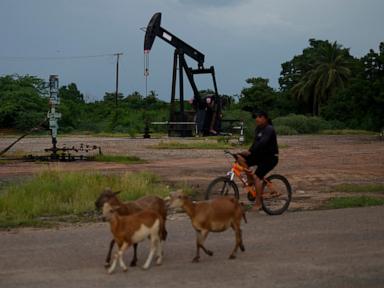
The operational expansion of Chevron within Venezuela represents a calculated exercise in navigating structural asset degradation, regulatory arbitrage, and heavy crude refining logistics. When a multinational energy operator scales footprint inside a sovereign jurisdiction recovering from systemic institutional collapse, the transmission mechanism between political announcements and actual barrel recovery is governed by three distinct constraints: reservoir decline rates, capital allocation discipline, and ring-fenced cash flow mechanics.
Standard media reporting reduces this operational pivot to a simple binary of political will, ignoring the underlying cost functions of heavy oil extraction in the Orinoco Belt. Understanding why Chevron remains uniquely positioned to expand while other supermajors stay sidelined requires deconstructing the microeconomics of joint ventures with Petróleos de Venezuela, known as PDVSA, and the physical realities of extra-heavy crude upgrading.
The Structural Mechanics of the Joint Venture Portfolio
Chevron operates through a series of historical equity partnerships with the state oil company, including Petropiar, Petroboscán, Petroindependencia, and Petromonotonic. These entities operate under specific operating agreements where historical debt collection and crude allocation formulas dictate financial returns.
The primary operational bottleneck in these fields is not the absence of hydrocarbons, but the degradation of subsurface pressure maintenance systems and upgrader reliability. Extra-heavy crude from the Orinoco Belt possesses an API gravity typically ranging between 8 and 10 degrees, rendering it effectively solid at ambient temperatures. It requires continuous dilution with lighter naphtha or heavy vacuum gasoil to flow through export pipelines, followed by processing in specialized coking or hydrotreating upgraders to yield a marketable syncrude.
When sanctions restrict the import of U.S.-sourced diluents, joint ventures face immediate operational throttling. Chevron's expansion strategy relies on securing continuous access to these diluent supply chains and ensuring that joint-venture governance allows for direct supervision of field maintenance. Without physical oversight of surface facilities, fluid handling efficiency degrades exponentially, driving up the operating expenditure per barrel.
The Capital Allocation Dilemma and Risk Discounting
Allocating capital to Venezuelan assets involves an asymmetric risk profile that differs fundamentally from shale plays in the Permian Basin or deepwater assets in the Guyana-Suriname basin. In conventional portfolios, capital expenditure decisions are driven by internal rate of return hurdles benchmarked against short-cycle payback periods. Venezuelan assets, conversely, demand long-cycle capital commitments subject to severe sovereign risk discounting.
Competitor analyses frequently misinterpret corporate announcements of expanded operations as aggressive greenfield exploration. In practice, Chevron’s operational expansion is an brownfield optimization strategy. The objective is the reactivation of shut-in wells, the replacement of damaged electrical submersible pumps, and the incremental debottlenecking of existing gathering stations.
Capital Deployment Vector -> Subsurface Remediation -> Fluid Viscosity Management -> Syncrude Upgrading -> Export Logistics
This sequence dictates the cash conversion cycle. By focusing capital on brownfield restoration rather than frontier exploration, Chevron minimizes geological risk while maximizing the utilization rate of sunk infrastructure built over decades of prior operation.
Regulatory Arbitrage and the Fiscal Architecture
The legal framework governing foreign participation in Venezuela's hydrocarbon sector has undergone continuous iteration, shifting between restrictive state monopolies and pragmatic concessions designed to attract foreign exchange. Operating under specific licenses issued by the Office of Foreign Assets Control creates a controlled regulatory sandbox.
Under these frameworks, the mechanisms for tax and royalty settlements are tightly partitioned to comply with U.S. sanctions law while satisfying local statutory requirements. Historically, a significant portion of Chevron's output was directed toward debt repayment and historical dividend recovery rather than immediate cash distributions to the state. As licensing terms evolve to permit broader commercialization and cash-based tax settlements, the corporate treasury gains greater flexibility in balancing working capital requirements against reinvestment rates.
This dynamic creates a complex tax-to-equity transmission mechanism. When royalties are settled via crude allocation rather than cash, the company acts as both producer and marketer, capturing refining margins along the Gulf Coast where heavy sour grades feed complex refineries optimized for high-TAN, high-sulfur inputs.
The Refining Integration Variable
The strategic rationale for processing Venezuelan crude extends beyond production volume metrics. U.S. Gulf Coast refining capacity was historically engineered to process heavy, sour crude grades originating from Mexico, Venezuela, and the Middle East. As Mexican production declines and domestic U.S. output skews heavily toward light, sweet tight oil, Gulf Coast refiners face a structural deficit of heavy feedstock.
Chevron’s downstream integration allows it to absorb Venezuelan heavy crude directly into its proprietary refining network, capturing the crack spread between heavy feedstock acquisition costs and refined product pricing. This downstream pull provides a secure, captive market for equity barrels produced in Venezuela, insulating the enterprise from third-party spot market volatility.
Competitors lacking equivalent downstream conversion capacity in the U.S. Gulf Coast cannot replicate this arbitrage mechanism. For firms without captive heavy-oil refining configurations, processing Orinoco crude requires significant capital expenditure on refinery modifications, altering the marginal economics of extraction.
Deploy capital exclusively into brownfield well remediation and upgrader reliability enhancements within existing joint-venture footprints to maximize immediate throughput without assuming greenfield exploration exposure.