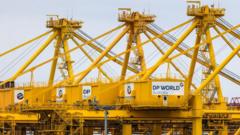
The strategic standoff between the Maritime Union of Australia (MUA) and global port operator DP World exposes a structural friction point in industrial asset optimization: the conversion of algorithmic productivity gains into labor-side concessions. By demanding a compressed 28-hour workweek with zero wage degradation as a precondition for the rollout of artificial intelligence and automated systems, organized labor is attempting to fundamentally recalibrate the marginal rate of technical substitution (MRTS) between capital and labor. This maneuver shifts the debate from a baseline discussion of headcount reduction to a sophisticated dispute over corporate surplus extraction, data sovereignty, and operational resilience.
To evaluate the validity of these competing operational models, this analysis formalizes the friction points across distinct mathematical and strategic frameworks: the Total Cost Function of Port Automation, the Elasticity of Labor Substitution under Algorithmic Management, and the Sovereign Risk Matrix of Infrastructure Interdependency.
The Total Cost Function of Capital-Labor Reallocation
Industrial automation projects are traditionally justified by a reduction in variable labor expenses that offsets a substantial increase in fixed capital expenditure. However, container terminal operations do not behave like closed-system manufacturing environments. They function as highly volatile, stochastic queues dependent on weather, global shipping schedules, and landside intermodal synchronization.
The Total Cost Function ($TC$) of terminal operations under an integrated AI deployment can be expressed through the following structural framework:
$$TC = F_C + \alpha K_{AI} + L_M(W_H \cdot H_W) + \Phi(S_{NL})$$
Where:
- $F_C$ represents baseline fixed infrastructure costs.
- $K_{AI}$ represents the capital expenditure required to deploy automated guided vehicles (AGVs), remote-controlled quay cranes, and predictive machine learning rostering software.
- $\alpha$ is the amortization and operational maintenance coefficient of that technological stack.
- $L_M$ represents the residual mandatory labor force required to oversee, override, and maintain the automated infrastructure.
- $W_H$ represents the hourly wage rate.
- $H_W$ represents total weekly operational hours per worker.
- $\Phi(S_{NL})$ represents the systemic penalty cost associated with non-linear disruption variables, including algorithmic edge cases, system downtime, and labor friction.
DP World’s strategic trajectory targets an estimated 60 percent reduction in the active stevedoring workforce—approximately 1,000 positions across major Australian maritime hubs. The corporate hypothesis posits that minimizing $L_M(W_H \cdot H_W)$ yields an optimization curve where the reduction in variable payroll structurally outpaces the rise in $\alpha K_{AI}$.
The counter-position introduced by the MUA directly attacks this optimization curve by manipulating $H_W$. By driving down the standard workweek to 28 hours while enforcing a static total wage payout ($W_H \cdot H_W = \text{Constant}$), the labor organization artificially inflates the effective hourly wage rate ($W_H$). This structural adjustment alters the optimization equation in two distinct ways:
- Compression of the Capital Payback Period: If the effective hourly rate of residual labor rises sharply, the projected cost savings of the automation initiative diminish. Capital deployment that previously yielded an attractive Internal Rate of Return (IRR) degrades into a low-yield infrastructure expense.
- Expansion of the Systemic Penalty Vector: Container terminals operate continuously (24/7). Compressing individual shifts to achieve a 28-hour workweek necessitates a multi-layered, highly complex rotational roster. If the interface between human operators and automated assets is not perfectly synchronized, the value of $\Phi(S_{NL})$ spikes due to operational handoff delays and structural coordination bottlenecks.
The Elasticity of Labor Substitution under Algorithmic Management
Port operators routinely claim that integrating AI into scheduling and yard layout optimization enhances throughput by stripping out human error and reducing dwell times. The operational reality, however, reveals a steep marginal diminishing return when replacing human stevedores with automated systems.
The core vulnerability of algorithmic port management lies in the difference between deterministic data environments and stochastic real-world anomalies. Predictive scheduling tools perform exceptionally well under normalized supply chain conditions. Yet, when global maritime choke points experience delays, or when localized cyber incidents halt operational networks, algorithmic models fail to adapt dynamically without human intervention.
[Algorithmic Model Inputs] ──> [Deterministic Execution] ──> [Edge Case Encountered]
                                                                     │
                                                                     ▼
[Systemic Bottleneck] <── [Throughput Degradation] <── [Manual Override Latency]
This creates an operational bottleneck defined by high manual override latency. When an automated system encounters an edge case—such as a misaligned container chassis or a sensor blind spot caused by severe weather—the entire automated subsystem halts until a human supervisor intervenes. If the available workforce has been minimized to satisfy aggressive capital investment models, the time required to resolve these exceptions expands exponentially.
Organized labor leverages this structural limitation. The demand for a 28-hour workweek recognizes that while AI can execute routine tasks, human capital remains highly inelastic during systemic disruptions. By limiting the weekly hours each worker is available, the union creates a supply constraint on operational resilience. If the port operator minimizes human headcount while simultaneously facing shorter individual shift availabilities, its capacity to absorb operational shocks collapses.
The Sovereign Risk Matrix and Data Autonomy
A significant omission in standard corporate analyses of industrial automation is the geopolitical and infrastructural vulnerability introduced by centralized algorithmic control networks. The operational systems deployed across major global port terminals are frequently developed, hosted, and maintained by transnational entities or foreign state-backed enterprises.
When a terminal operator shifts from localized, human-driven orchestration to cloud-linked AI optimization, the infrastructure converts into an asymmetric security risk vector. This vulnerability manifests across three separate operational domains:
- Systemic Cyber Vulnerability: Centralized AI orchestration engines rely on continuous streams of IoT data from cranes, straddle carriers, and external trucking fleets. This interconnected surface area expands the cyber threat landscape. A disruption to the core scheduling algorithm, whether via ransomware or state-sponsored intrusion, can instantly paralyze a nation's trade gateway.
- Corporate Tax Asymmetry: Financial analyses from groups like the Centre for International Corporate Tax Accountability and Research (CICTAR) indicate that major multinational terminal operators frequently utilize offshore debt loading and intellectual property licensing to minimize local corporate tax obligations. When human labor is eliminated, the primary mechanism of domestic economic retention—income and payroll tax contributions—is decoupled from the host nation. Automated assets do not contribute to local tax bases, creating an extractive economic cycle where the domestic economy bears the infrastructure wear-and-tear while capital returns flow offshore.
- Data Exploitation and Labor Surveillance: Automated rostering software and performance-tracking algorithms require continuous monitoring of human biometric and operational data. This creates an asymmetric information environment where corporate managers can accelerate work paces past safe physiological limits, escalating workplace injury rates and driving up long-term healthcare externalities borne by public systems.
Strategic Playbook for Infrastructure Stabilization
Resolving the structural conflict between capital modernization and labor preservation requires moving past binary concession bargaining. The current adversarial stance threatens long-term supply chain predictability. A sustainable framework must focus on co-determination, where technical investments are directly linked to human-centric operational flexibility.
Terminal operators must transition from an asset-replacement model to a human-augmentation framework. Instead of deploying AI to eliminate human agency, automated systems should be architected with clear, human-in-the-loop protocols that prioritize worker safety and cognitive load balancing.
- Dynamic Resilience Rostering: Rather than flatly rejecting a shorter workweek, operators should integrate the 28-hour threshold into a highly flexible, predictive scheduling model that compensates for shorter shifts by guaranteeing predictable, permanent rosters for the entire active workforce. This stabilizes employee turnover, drives down operational error rates, and ensures an optimal volume of rested personnel are available to manage the unavoidable edge cases generated by automated hardware.
- Sovereign Data Guardrails: To mitigate national security risks, all algorithmic decision engines, optimization models, and predictive systems operating within critical infrastructure must be hosted on sovereign, air-gapped infrastructure. Workplace data collection must be governed by strict transparency mandates, ensuring that tracking metrics are used exclusively for physical safety optimization rather than punitive labor pacing.
- Modernization Gain-Sharing: Capital allocation plans must include structured productivity dividends. If automated systems successfully drive down container dwell times and improve gross crane rate metrics, a contractually mandated percentage of that economic surplus must be automatically distributed into workforce training, upskilling for specialized technical maintenance roles, and funding the shift-reduction models demanded by changing macroeconomic realities.
The structural transition toward algorithmic automation in heavy industry is inevitable, but its trajectory remains highly volatile. The organizations that thrive will not be those that execute aggressive workforce liquidations, but those that design robust, highly resilient operating models capable of harmonizing advanced software capabilities with an agile, protected, and properly compensated human workforce.