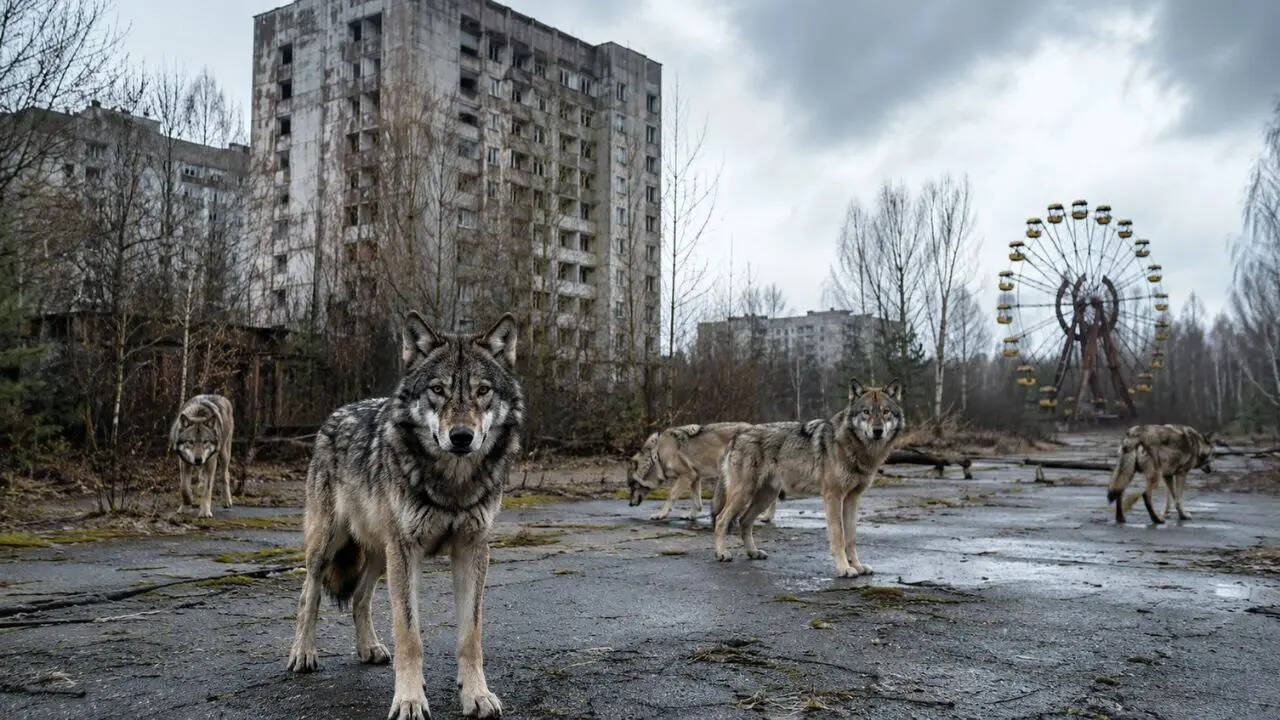
The repopulation of the Chernobyl Exclusion Zone (CEZ) by Canis lupus (the gray wolf) represents a profound case study in inadvertent ecological engineering. When human habitation ceased across approximately 2,800 square kilometers in 1986, it eliminated the primary pressure variable driving regional apex predator mortality: human interference. The subsequent resurgence of the wolf population to densities reportedly seven times higher than those in comparable, non-contaminated regional reserves presents a biological paradox. It forces a rigorous assessment of a critical trade-off: the chronic, multi-generational physiological cost of ionizing radiation versus the immediate, systemic benefit of total anthropogenic relief.
Understanding this dynamic requires moving past sensationalized narratives of a "wildlife paradise" and instead mapping the precise mechanics of the CEZ ecosystem. This analysis deconstructs the zone through three structural vectors: top-down trophic cascades, the biomechanics of radiological tolerance, and the geographic boundaries of the zone as an ecological source-sink model.
The Trophic Architecture of Anthropogenic Relief
The primary driver of the wolf resurgence is not mutations or radiological adaptation, but the absolute removal of human agricultural, urban, and hunting pressures. To quantify this shift, we must evaluate the ecosystem through a basic carrying capacity framework.
Human absence altered the landscape via two distinct phases:
- The Primary Biomass Surge: The cessation of farming allowed agricultural land to undergo rapid secondary ecological succession. Abandoned fields reverted to perennial grasslands and scrub, dramatically increasing the available forage biomass for large herbivores.
- The Ungulate Population Boom: With hunting eliminated and forage abundant, populations of Capreolus capreolus (roe deer), Alces alces (elk), and Sus scrofa (wild boar) experienced exponential growth phases in the decades following the evacuation.
This surge in prey biomass fundamentally altered the predator-prey dynamic. In a typical managed landscape, human culling and vehicular mortality truncate ungulate numbers well below the theoretical carrying capacity of the environment. In the CEZ, the prey base expanded to its natural limit, creating an abundant energy surplus at the secondary trophic level.
Because wolf population density is directly coupled with prey biomass availability, the apex predator population expanded to exploit this energetic windfall. The removal of the human apex predator opened a vacant ecological niche, which Canis lupus filled completely. The negative health impacts of radiation were systematically overridden by the sheer abundance of caloric resources and the elimination of targeted human harvesting.
Radiotrophic Dynamics and the Mechanics of Exposure
Evaluating the health of the CEZ wolf population requires breaking down how ionizing radiation interacts with mammalian biology over extended timelines. The wolves of Chernobyl are not uniform in their exposure; they exist within a highly heterogeneous radiological landscape.
The risk profile is governed by two distinct exposure pathways:
External Irradiation
Wolves traverse a mosaic of contamination. Radioactive isotopes like Cesium-137 ($^{137}\text{Cs}$) and Strontium-90 ($^{90}\text{Sr}$) are not distributed evenly; they are concentrated in specific pedological sinks, such as low-lying wetlands and dense forest floors. A wolf’s external dose rate varies hourly based on its territorial movement patterns, den selection, and the specific deposition gradients of the sectors it patrols.
Internal Bioaccumulation
The more severe, chronic risk stems from trophic transfer. $^{137}\text{Cs}$ behaves chemically like potassium, meaning it is readily absorbed by plants, consumed by herbivores, and concentrated in the muscle tissue of apex predators. $^{90}\text{Sr}$ mimics calcium, sequestering itself in the skeletal structures of prey animals. When wolves consume contaminated ungulates, they ingest concentrated doses of these radionuclides, leading to continuous, internal beta and gamma irradiation of their vital organs and bone marrow.
The persistence of a high wolf population density despite this continuous internal bombardment suggests specific biological buffering mechanisms. Research indicates that while individual wolves exhibit elevated rates of genetic mutation, chromosomal aberrations, and altered immune profiles reminiscent of radiation-induced stress, these pathologies rarely manifest as acute, population-limiting mortality events.
The primary explanation is demographic pacing. In the wild, the average lifespan of a wolf is typically six to eight years due to intraspecific conflict, hunting injuries, and disease. Because ionizing radiation-induced malignancies (such as advanced carcinomas) generally require extended latency periods to develop, a significant percentage of the wolf population succumbs to natural, wild mortality factors before radiological pathologies can critically compromise their reproductive fitness. The population reproduces faster than the chronic radiation can kill them.
The Source-Sink Dynamic and Regional Ecological Export
The CEZ does not exist in a vacuum; it functions as a highly pressurized ecological engine with fluid borders. To understand the long-term strategic implications of this wildlife recovery, the zone must be modeled using source-sink evolutionary dynamics.
A "source" habitat is an area where local reproductive success exceeds the mortality rate, leading to a surplus of individuals that must emigrate. A "sink" habitat is a lower-quality region where mortality exceeds reproduction, relying on immigration to maintain its population.
+-------------------------------------------------------+
|              CHERNOBYL EXCLUSION ZONE                 |
|                      (SOURCE)                         |
|                                                       |
|  * Zero Human Interference                            |
|  * High Prey Biomass Density                          |
|  * Positive Population Growth (Reproductive Surplus)  |
+-------------------------------------------------------+
                           |
                           | Dispersion of sub-adults
                           | across porous borders
                           v
+-------------------------------------------------------+
|             OUTSIDE SURROUNDING REGIONS               |
|                       (SINK)                          |
|                                                       |
|  * Active Hunting & Trapping                          |
|  * Agricultural Fragmentation                         |
|  * Negative/Unstable Population Growth                |
+-------------------------------------------------------+
Data tracking the movement of collared CEZ wolves demonstrates that sub-adults regularly disperse past the perimeter fence, moving into the wider landscapes of Ukraine and Belarus. This creates a distinct set of operational realities:
- Genetic Fluviality: The continuous outward migration of wolves prevents the CEZ population from becoming a closed genetic bottleneck. It allows for a constant exchange of alleles with clean populations, potentially diluting the accumulation of deleterious, radiation-induced mutations over generations.
- The Exportation of Ecological Pressure: As wolves leave the safety of the zone, they transition from an unmanaged wilderness to a human-dominated landscape. Outside the perimeter, they immediately encounter hunting, vehicular traffic, and livestock conflict, shifting their status back into a traditional, human-regulated mortality framework.
- The Spread of Radiologically Stressed Genomes: A critical uncertainty is the long-term effect of CEZ-dispersed wolves breeding with outside populations. It remains unproven whether the subtle genetic variations observed in Chernobyl wolves offer a true adaptive advantage to radiation or if they represent a load of genetic damage that could lower the fitness of surrounding populations over time.
Limitations of the Current Ecological Dataset
Any analytical model is only as robust as its underlying data inputs. The study of the CEZ ecosystem is constrained by structural limitations that prevent definitive conclusions on long-term evolutionary outcomes.
The first limitation is the difficulty of conducting controlled, long-term longitudinal studies on large, free-ranging carnivores within a highly contaminated zone. Tracking precise dosage metrics requires capturing animals, fitting them with dosimeter collars, and securing continuous telemetry data over multiple years. Current data points are often fragmented, relying on opportunistic sampling or short-term tracking windows.
The second bottleneck is the confounding variable of disease. The CEZ has seen outbreaks of sarcoptic mange and African Swine Fever, the latter heavily impacting the wild boar population. Distinguishing whether fluctuations in predator numbers are driven by radiological stress, shifting prey bases, or infectious disease vectors is a recurring analytical challenge. The ecosystem is a complex web of overlapping pressures, making the isolation of radiation as a single variable nearly impossible.
Strategic Outlook for the Exclusion Zone Landscape
The trajectory of the CEZ points toward an ecosystem locked in a stable, climate-driven climax state, provided the human exclusion mandate remains strictly enforced. The territory has effectively converted from an industrial-agricultural zone into a self-regulating wilderness laboratory.
The immediate threat to this ecological balance is not internal radiological collapse, but external infrastructure encroachment. As regional demands for timber, renewable energy placement (such as solar arrays in lower-contamination sectors), and managed tourism grow, the borders of the exclusion zone face incremental degradation.
Maintaining the current high density of apex predators depends entirely on preserving the integrity of the inner core of the zone. If roads fragment the contiguous forest blocks or if limited culling is introduced to manage dispersing populations, the structural advantages of the zone—the lack of human contact and the resulting prey abundance—will evaporate. The future of the Chernobyl wolf is inextricably tied to the continued enforcement of the human absence that accidentally created its sanctuary.


