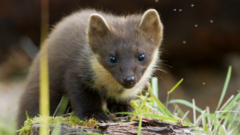
The reintroduction of Martes martes, or the European pine marten, represents a high-stakes exercise in biological asset recovery rather than a simple conservation project. To evaluate the success of increasing wild birth rates, we must move beyond sentimental narratives of "returning nature" and instead analyze the species as a critical biological regulator within a fragmented forest infrastructure. The viability of these populations depends on three non-negotiable variables: the availability of high-grade denning sites, the density of small mammal prey cycles, and the mitigation of competitive exclusion by larger predators or human-induced mortality.
The Tri-Factor Model of Marten Recruitment
The survival and proliferation of pine martens in the wild are dictated by a specific ecological cost function. If the energy expenditure required for territorial defense and foraging exceeds the caloric intake available during the winter gestation period, reproductive failure is certain.
1. The Denning Bottleneck
Pine martens are obligate cavity nesters. Unlike generalist predators that might utilize burrows or ground nests, martens require elevated, thermally regulated spaces—typically ancient tree hollows. The lack of "old-growth" characteristics in managed timber plantations creates a structural deficit. Artificial den boxes serve as a temporary bridge, but they introduce a risk of predation if they are not strategically dispersed to mimic natural low-density patterns.
2. Prey Base Stochasticity
The population follows the boom-and-bust cycles of voles (Microtus agrestis) and wood mice (Apodemus sylvaticus). A successful breeding season is not merely a product of the number of adults released; it is a lagging indicator of the previous year’s rodent biomass. To forecast future birth rates, analysts must track the vegetative density of the forest floor, which provides the primary cover for marten prey.
3. Territorial Thresholds
Male pine martens maintain large, non-overlapping territories, often spanning 10 to 25 square kilometers. Females occupy smaller ranges within these boundaries. The spatial math is unforgiving: a forest block of 100 square kilometers can only support a finite number of breeding pairs. Increasing wild births requires "expanding the envelope" through the creation of wildlife corridors that link isolated forest patches.
The Competitive Displacement Hypothesis
A significant driver behind the push for pine marten recovery is their role in the "squirrel wars." The resurgence of martens correlates with a decline in invasive grey squirrel (Sciurus carolinensis) populations, which in turn facilitates the recovery of the native red squirrel (Sciurus vulgaris).
This is not a matter of martens simply "preferring" greys. The mechanism is evolutionary. Red squirrels have co-evolved with pine martens; they are smaller, more agile on thin branches where the heavier marten cannot follow, and possess an innate predator-avoidance response. Grey squirrels are larger, spend more time on the ground, and lack the evolutionary "fear memory" of the marten. This creates a selective predation pressure that serves as a biological control mechanism.
The economic value of this displacement is substantial. Grey squirrels cause millions in damage to broadleaf timber through bark stripping. By reintroducing a natural predator, the forestry industry effectively outsources pest management to a self-sustaining biological agent. However, the efficacy of this strategy is limited by forest fragmentation; martens will not cross wide open fields to hunt squirrels in isolated copses, creating "refuge zones" for the invasive species.
Operational Hurdles in Translocation and Monitoring
Translocating martens from source populations—often in Scotland—to recovery zones involves a high degree of biological risk. The "soft release" method, where animals are acclimated in pens at the release site, is the industry standard for reducing post-release dispersal. When martens are "hard released" (simply let go), their instinct is to travel long distances to return to their original home, leading to high mortality rates from road traffic and exhaustion.
Monitoring via Genetic Fingerprinting and Scat Analysis
To quantify wild births, researchers have shifted away from invasive trapping. Modern analysis relies on:
- DNA Metabarcoding: Collecting scat (droppings) and analyzing DNA to identify individual animals and their sex. This allows for a "census by proxy" without disturbing the animals.
- Remote Camera Trapping: Utilizing heat-sensor cameras at bait stations to identify kit (young marten) activity.
- Thermal Imaging: Employing drones equipped with FLIR (Forward Looking Infrared) sensors to locate active dens in the canopy during the spring.
The data gathered from these methods suggests that while initial survival rates of translocated adults are high, the "recruitment rate"—the number of kits that survive to their first breeding season—remains the primary volatility factor.
Genetic Diversity and the Founder Effect
A critical limitation in reintroduction strategy is the "founder effect." If a new population is started with too few individuals, the lack of genetic diversity leads to inbreeding depression, which manifests as lower fertility and higher susceptibility to disease.
To achieve long-term resilience, a population needs a minimum viable size that allows for genetic drift without losing essential traits. Strategy consultants in the conservation space now advocate for "genetic reinforcement"—the periodic introduction of new individuals from different source populations over a ten-year horizon. This prevents the population from becoming a genetic island.
Strategic Landscape Integration
The push for more wild births cannot succeed in a vacuum. It requires a shift in land-use policy. Current agricultural subsidies often incentivize the removal of hedgerows and scrubland, which act as the "arteries" for marten movement.
The move toward "Continuous Cover Forestry" (CCF) is the most viable path forward. By moving away from clear-felling and toward selective logging, the forestry sector can maintain the canopy connectivity martens require. This creates a dual-use landscape: high-value timber production coexisting with a high-functioning ecosystem.
The primary threat to this model is the "Perception Gap." Stakeholders in the poultry and gamebird industries often view the pine marten as a threat. While martens are opportunistic generalists, data shows their impact on commercial livestock is negligible when proper biosecurity (predator-proof fencing) is implemented. The strategy here must be one of "mitigation through infrastructure" rather than "population control."
The success of the pine marten is a litmus test for our ability to manage complex biological systems. If the goal is a self-sustaining wild population, the focus must shift from the act of "release" to the long-term management of "carrying capacity." This involves aggressive reforestation, the installation of permanent nesting structures in young woodlands, and a commitment to the "corridor" model of landscape connectivity. The data indicates that when the structural requirements of the habitat are met, the reproductive biological drive of the species will handle the rest. The focus must remain on the hardware of the forest to allow the software of the species to run effectively.
Deploying resources toward the creation of "Marten Recovery Areas" (MRAs) that bypass high-traffic infrastructure via green bridges is the next logical step in stabilizing the recruitment curve.