Frost clings to the cuffs of a heavy wool coat. It is three in the morning. The neighborhood sleeps behind locked doors and drawn curtains, entirely unaware that overhead, a silent, celestial geometry is unfolding.
Consider Elena, standing on her back porch with a mug of lukewarm chamomile tea growing cold between her palms. She is not a professional astronomer. She is simply a person who grew tired of the relentless blue glow of screens and chose, for one night, to look up.
Most people dismiss an overnight partial lunar eclipse as a minor astronomical footnote. They see a headline, shrug, and go to bed. They miss the poetry of the mechanics.
A partial lunar eclipse happens when the Sun, Earth, and Moon fail to achieve a pristine, straight-line alignment. Instead, they line up just off-center. Earth slips directly between the other two, but our planet's bulk blocks only a portion of the solar radiation streaming toward the lunar surface.
To visualize this from a human scale, imagine standing in a darkened room with a single floor lamp, holding your hand out between the bulb and the opposite wall. Your palm casts a sharp silhouette, but your fingers blur at the edges where the light bends around them. On a planetary scale, the Earth does the exact same thing. It casts two distinct shadows into space: the penumbra, a faint outer smudge, and the umbra, a dark, definitive abyss.
During this event, the Moon does not vanish. It merely dips one side into that deep umbral shadow.
For thousands of years, this exact alignment triggered absolute panic. Ancient civilizations watched the bright silver orb turn a bruised, coppery grey and believed a cosmic beast was devouring their source of night illumination. They beat drums. They lit massive bonfires. They prayed for the return of the light.
Today, we possess the math. We know the exact millisecond the Earth's shadow will first graze the lunar limb. We know the orbital speed of our home world—roughly sixty-seven thousand miles per hour—and we can predict these dances centuries in advance. Yet, standing alone in the freezing dark, that ancient, primal shiver refuses to vanish.
The air is dead quiet. No cars pass. No neighbors shout.
Upward.
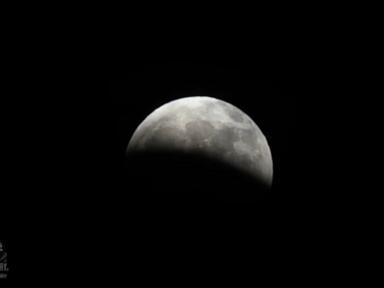
The moon looks bruised. A dark, charcoal bite has been taken out of its lower edge, rendering the familiar, cratered face lopsided and strange. It is a stark reminder of our place in the solar system. We are not passive observers floating on an independent rock; we are actors in a vast, shadow-casting machine. The curved edge of the shadow creeping across the moon is the physical silhouette of the very curve of the Earth we walk upon every day. You are looking at the footprint of your own home, projected onto the cosmos.
Minutes stretch into an hour. The temperature drops another degree. The tea is ice now.
In astronomy terms, the partial phase is just an orbital overlap. In human terms, it is an interruption of the ordinary. It forces a pause. It asks us to look away from our digital anxieties and remember that we live on a sphere hurtling through a vast, indifferent dark.
Slowly, imperceptibly, the geometry shifts. The shadow begins to retreat. The dark curve slides upward, thinning into a pale smudge, and then dissolves entirely back into the brilliant, indifferent silver of a full moon.
The show is over. The universe does not wait for applause.
Elena steps back inside, closing the sliding glass door against the chill. The house is warm, but the night feels different now. Somewhere out there, the shadow is still drifting, and the world keeps spinning.