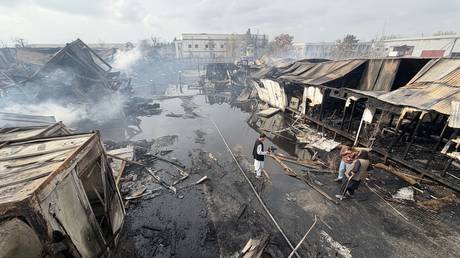
The teacup did not fall. It shattered on the shelf before the sound even arrived, a sharp vibration traveling through the mud-brick floor of the compound just ahead of the roar. In the mountains dividing Pakistan and Afghanistan, sound plays tricks. It bounces off the jagged ridges of Khost and Paktika, making it impossible to tell if the fire is coming from the next valley or from the sky.
When the air cleared, the quiet returned, heavy and choked with pulverized stone.
Standard news dispatches summarize these moments with surgical precision. They report that Pakistani military aircraft launched overnight retaliatory airstrikes inside Afghanistan, targeting suspected hideouts of the Tehrik-e-Taliban Pakistan (TTP). They count the dead in dozens. They cite official statements about sovereignty, cross-border terrorism, and diplomatic protests. But a spreadsheet cannot capture the smell of cordite mixing with burning pine wood, or the sound of a shovel hitting packed earth in the dark.
To understand the crisis currently destabilizing the thin line between these two nations, look past the press releases. Look at the mud.
The Ghost Line
For over a century, the border known as the Durand Line has been less of a wall and more of an open wound. Drawn by British colonial administrators in 1893, it sliced directly through the heart of the Pashtun tribal lands. Families woke up one morning to find their grazing lands in one empire and their mosques in another.
They ignored it. For generations, they simply walked across.
But geography has a way of weaponizing itself. When the Taliban regained control of Kabul, Islamabad expected a partner who would help secure the western frontier. Instead, the border became a revolving door. Militants would cross into Pakistan, execute complex ambushes against security forces, and slip back into the rugged sanctuary of the Afghan highlands.
Consider the mathematics of this friction. Pakistan spent years building a massive, chain-link fence topped with barbed wire along the 2,600-kilometer border. It cost fortunes. It was meant to be definitive. Yet, an invisible network of ravines, tunnels, and local complicity renders billions of dollars of steel completely useless.
The tension snapped when an improvised explosive device and a suicide vehicle targeted a Pakistani military outpost in North Waziristan, killing seven soldiers. The response was not a diplomatic memo. It was a squadron of jets cutting through the midnight air.
The Anatomy of an Airstrike
When a state decides to project power across an international boundary, the justification is always wrapped in the language of self-defense. Islamabad stated unequivocally that the targets were specific commanders belonging to the Hafiz Gul Bahadur group, a faction of the TTP.
But bombs do not read intelligence dossiers.
In the villages of Sperah and Barmal, the explosions did not hit fortified bunkers. They tore through homes. Local officials in Afghanistan quickly countered the Pakistani narrative, asserting that the casualties were entirely civilians—mostly women and children who had no say in the geopolitics of the region.
This is where the narrative splits into two irreconcilable realities.
- The Pakistani Perspective: A sovereign nation cannot allow its soldiers to be slaughtered by militants operating from a safe haven next door. Inaction is interpreted as weakness, inviting further bloodshed.
- The Afghan Perspective: An unprovoked violation of territorial integrity that terrorizes civilians under the guise of counter-terrorism, radicalizing the next generation of border residents.
The truth is rarely found in the middle. It is usually buried under the rubble of both sides.
The Currency of Retaliation
Step back from the immediate carnage and the strategic failure becomes glaringly obvious. Retaliation is a short-term narcotic. It satisfies the domestic demand for action, but it leaves the root ecosystem completely untouched.
Every time an airstrike claims innocent lives, the recruitment pipeline for militant groups grows wider. A young man who watches his family home disintegrate does not read the international analysis on cross-border terrorism. He looks at the crater, looks at the sky, and looks for a weapon.
The Taliban government in Kabul responded to the strikes by firing heavy weaponry at Pakistani military positions along the border. It was a theatrical display of defiance, a warning that they would not be bullied by their larger, nuclear-armed neighbor.
Yet, beneath the posturing lies a profound vulnerability. Afghanistan is trapped in a devastating economic crisis, isolated from much of the global financial system. Pakistan is grappling with chronic political instability and an economy on life support. Two fragile states, bound by geography, are choosing to bleed each other rather than confront the shared gravity of their collapse.
Where the Road Ends
The dust eventually drops back to earth. The politicians return to their secured compounds in Islamabad and Kabul to draft their next round of condemnations. The fighter jets sit cooling on tarmac runways.
Left behind are the people who actually inhabit the Durand Line. For them, the conflict is not an analytical puzzle to be solved over coffee. It is a daily calculation of survival. They must decide whether to plant crops that might be burned by mortar fire, or whether to send their children to schools that sit in the shadow of military outposts.
A elders' council gathers in the ruins of a home in Khost. There are no television cameras here. There are no spokespeople. There is only an old man smoothing his gray beard, looking at a piece of shrapnel that still carries the heat of the strike. He does not care which government claims victory today. He only knows that tomorrow, he will have to dig another grave in the rocky soil, wondering if the next sound from the mountains will be thunder or the end of his world.