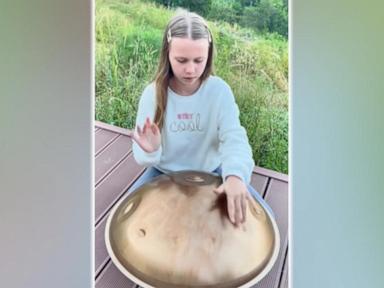
You’ve probably seen the viral video. A young girl with absolutely zero musical training sits down with a metallic, UFO-shaped drum and starts playing a mesmerizing, complex melody. Within seconds, she stuns everyone around her. The internet loses its mind, calling her a prodigy. But while her natural rhythm is genuinely impressive, this viral moment reveals a bigger truth about the instrument itself.
The handpan is designed to make anyone sound like a seasoned musician almost instantly.
Most traditional instruments force you to fight through months of agonizing practice just to play a clean scale. The violin sounds like a dying cat for the first year. The guitar covers your fingers in blisters before you can change chords smoothly. The handpan skips that entire painful initiation. It is an inherently intuitive instrument. If you can tap a finger in time with your heartbeat, you can play it.
Let's look at why untrained players can create breathtaking music on this instrument right away, and how you can replicate that magic without spending years studying music theory.
The Secret Scale Behind Handpan Magic
Watch that viral video closely. The girl isn't reading sheet music. She isn't thinking about key signatures, accidentals, or chord progressions. She is just exploring the metal surface with her hands.
She sounds incredible because the handpan possesses a built-in safety net called a fixed scale.
Most handpans are tuned to a specific musical scale, very often the D minor Celtic tuning or a similar pentatonic scale. This means every single note on the instrument is harmonically related to every other note. You literally cannot play a bad note. There are no dissonant mistakes waiting to trip you up. If you hit two notes at random, they will harmonize. If you strike three in a row, you just played a beautiful chord progression.
Traditional instruments like the piano give you access to every correct and incorrect note simultaneously. Hit a wrong note on a piano during a solo, and the whole room winces. The handpan removes that risk entirely. It curtails your choices in the best way possible, freeing your brain to focus purely on rhythm and expression rather than memorizing complex finger patterns.
How Untrained Players Achieve Instant Flow
When you see an untrained player stun an audience, they aren't relying on technical theory. They are relying on tactile feedback and muscle memory. The instrument rewards curiosity over rigid practice.
The Layout is Geometric, Not Linear
On a piano or a flute, notes move in a straight line from low to high. The handpan arranges notes in a zigzag or circular pattern around a central deep note known as the Ding. This layout means your hands naturally alternate hits. Left, right, left, right. By simply moving your hands back and forth across the circle, you create a cascading melody that sounds incredibly intricate to anyone listening.
Sound Mechanics Do the Heavy Lifting
The instrument is highly resonant. When you strike a single note area, the entire steel shell vibrates sympathetically. You get a rich, layered sound with multiple overtones from a single touch. A beginner might only hit one note, but the listener hears a deep, complex wave of sound. The physics of the steel drum do about seventy percent of the artistic work for you.
The Flaw in the Prodigy Narrative
Media outlets love the narrative of the uneducated genius who picks up an instrument and magically plays like a master. It drives clicks. It makes for great television. But labeling these viral musicians as supernatural prodigies actually does a disservice to regular people who want to learn music.
When we call someone a prodigy, we create a barrier. We tell ourselves, "Well, they have a rare gift, so I could never do that."
The truth is much more exciting. The girl in the video possesses great rhythm and a relaxed touch, but her performance is a testament to brilliant instrument design, not mystical intervention. The handpan bridges the gap between human intuition and musical output faster than almost anything else on earth. You don't need a certificate from a conservatory to tap into that.
Getting Started Without a Musical Background
If you want to recreate that viral magic yourself, you don't need to sign up for music theory classes. You don't need to learn how to read notation. You just need to follow a few basic physical principles.
First, focus entirely on your strike technique. The biggest mistake beginners make is pressing into the metal. That chokes the sound. Think of the handpan like a hot stove. You want to tap the note quickly and pull your finger away instantly to let the steel breathe and ring out. Use the pad of your finger, not the tip.
Second, start with a simple hand-to-hand rhythm. Don't try to play fast melodies right away. Establish a steady pulse with your dominant hand on the central Ding note, then use your other hand to explore the outer notes on the alternating beats. Within ten minutes, your brain will map the geometry of the shell, and you'll be composing your own ambient tracks without even realizing it.
Find a high-quality instrument tuned to a minor scale, sit down, clear your mind, and let your hands do the walking.


