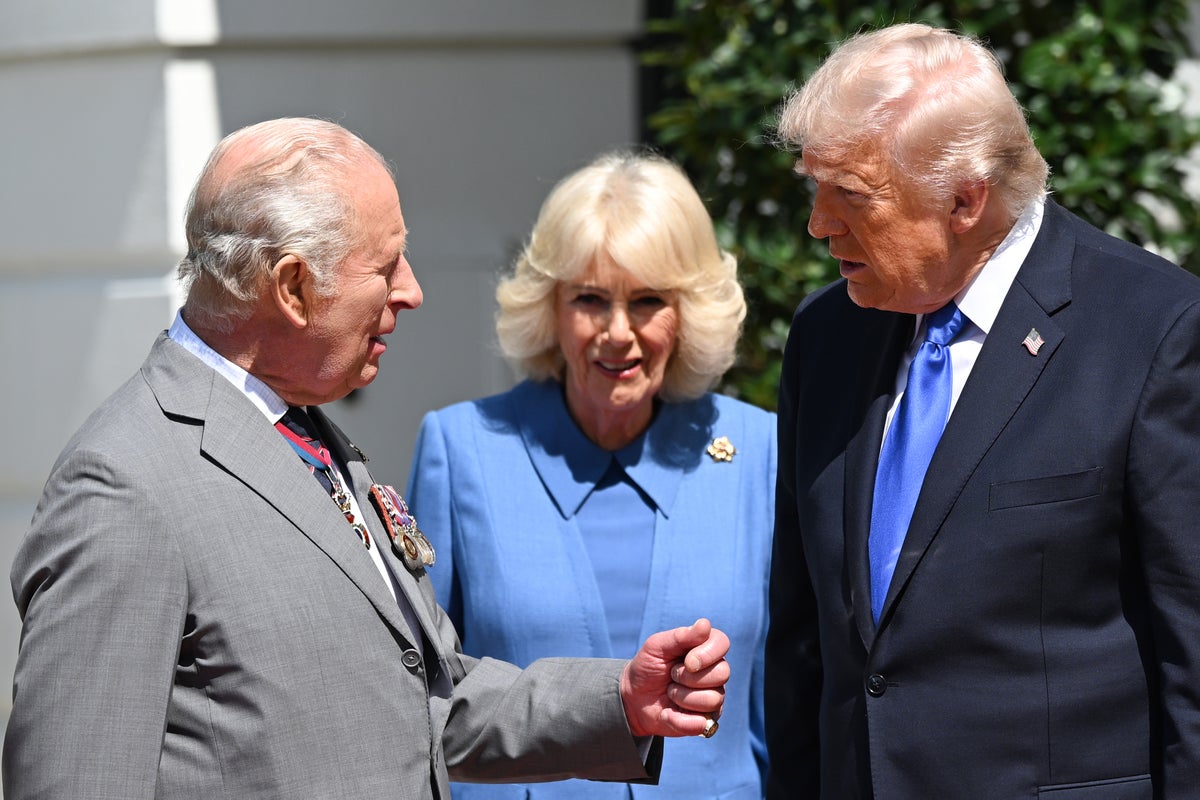
Donald Trump recently sparked a familiar wave of confusion and critique after praising the British monarchy, suggesting the United States could use "more people like that" in reference to King Charles III and Queen Camilla. While critics dismissed the remark as a characteristic lapse in historical literacy or a bizarre affinity for pomp, the comment actually signals a much deeper shift in the American conservative psyche. This isn't about a sudden desire for powdered wigs or tea ceremonies. It is an expression of a growing appetite for a form of leadership that sits above the messy, bureaucratic friction of modern democracy.
The remark came during a period of heightened political tension, where the former president has increasingly framed himself not just as a candidate, but as a personification of national identity—a role traditionally reserved for a monarch. By signaling admiration for the British Royals, Trump is tapping into a specific, powerful yearning among his base for a "steady hand" that remains untouched by the traditional checks and balances that define the American Republic.
The Constitutional Friction Point
The American experiment was built on a fundamental rejection of the Crown. The Founders went to great lengths to ensure that no single individual could embody the state. However, the reality of the twenty-first-century executive branch has drifted far from the original intent of the Constitution. We now see a presidency that carries the weight of a "secular king," expected to solve every economic woe and cultural grievance through sheer force of will.
When Trump praises the King and Queen, he is highlighting a perceived efficiency in the royal model. To his supporters, the "people like that" he refers to are individuals who command respect by virtue of their position, rather than through the grinding gears of legislative compromise. It is a critique of the administrative state. He sees a system where the figurehead is the law, or at least represents a moral authority that cannot be easily voted away or litigated into submission.
The Attraction to Inherited Legitimacy
There is a psychological comfort in the concept of a sovereign. In a world characterized by rapid change and the erosion of traditional institutions, the British monarchy represents an unbroken chain of history. For a political movement that views itself as the protector of "heritage," the appeal is obvious.
Trump’s rhetoric often leans on the idea of restoration. He isn't promising a new future so much as a return to a perceived golden age. The British royals are the ultimate symbols of that endurance. By aligning himself with them, he suggests that his movement is not a temporary political faction, but a permanent fixture of the national character. This is the "why" behind the headline. It is an attempt to borrow the gravity of a thousand-year-old institution to bolster a decade-old political movement.
Beyond the Gilded Surface
To understand the weight of these comments, one must look at the specific individuals Trump chose to highlight. King Charles III and Queen Camilla do not hold actual political power in the sense of making law or commanding armies in the field. Yet, they possess "soft power" that is immune to the news cycle.
Trump’s admiration reveals a frustration with the limitations of the American presidency. A president is hounded by special interest groups, an independent judiciary, and a divided Congress. A King, in the romanticized view Trump seems to hold, simply is. This distinction is vital for an industry analyst to parse. Trump isn't looking to become a figurehead who cuts ribbons; he is looking for the immunity and the inherent deference that the crown provides.
The Counter-Argument of Republicanism
The immediate backlash from constitutionalists is grounded in the fear of "Caesarism." This is the historical phenomenon where a republic, exhausted by internal strife and gridlock, voluntarily hands over its liberties to a strongman. The irony of an American leader praising the very institution the nation was founded to escape is not lost on historians.
However, the "how" of this rhetoric works because it bypasses the intellectual argument for republicanism and goes straight to the gut. It speaks to a segment of the population that feels the current system is broken beyond repair. If the courts, the media, and the legislature are seen as corrupt, then a singular, "pure" authority starts to look like a solution rather than a threat.
The Cultural Weight of the Royal Brand
We must also consider the brand. The British Monarchy is one of the most successful branding exercises in human history. It manages to remain relevant while staying fundamentally the same. For a man who built his career on branding his own name, the King and Queen represent the ultimate "Tier 1" status.
- Longevity: The ability to stay at the top for decades.
- Aura: A sense of being "untouchable" by common criticism.
- Legacy: The assurance that the name will carry forward through bloodlines.
These are the metrics Trump uses to measure success. When he says the U.S. needs "more people like that," he is talking about people who possess a level of fame and social standing that cannot be touched by a bad polling cycle or a legal indictment.
A Global Trend Toward Centralized Identity
This isn't an isolated incident or a random slip of the tongue. Across the globe, there is a visible trend of voters gravitating toward leaders who promise to embody the nation's spirit. From Viktor Orbán in Hungary to the rise of various nationalist movements in Western Europe, the "strongman" archetype is being rebranded as the "national protector."
Trump’s comments bridge the gap between the American populist movement and this global shift. He is signaling that he understands the appeal of the old world’s hierarchies. It is a tactical move to redefine "American Greatness" not as a set of democratic processes, but as a collection of powerful, iconic figures who stand above the fray.
The Risk of the Royal Comparison
The danger for Trump in this line of rhetoric is the inherent "un-Americanness" of the sentiment. The U.S. identity is forged in the fire of anti-monarchism. For some swing voters, the praise of a King feels like a betrayal of the basic tenets of the country. It suggests a lack of respect for the citizen-servant model of leadership.
Yet, for his core base, the risk is negligible. They don't see a threat to democracy; they see a leader who finally appreciates the value of real authority. They see a man who isn't afraid to say that some people—the right people—should be in charge by virtue of who they are, not just what they do.
The Architecture of Power
If we look at the way Trump has structured his inner circle, it mirrors a royal court more than a traditional cabinet. Loyalty is the primary currency. Familial ties often outweigh professional resumes. In this context, the King and Queen of the UK are not just foreign dignitaries; they are the gold standard for the kind of "family business" approach to governance that Trump has always preferred.
The "investigative" truth here is that Trump’s comments aren't about the British people or their specific laws. They are about his desire to transform the American presidency into a permanent, hereditary, or at least culturally dominant institution that operates on the level of myth. He is tired of being a temporary employee of the American people. He wants the job security of a sovereign.
The Displacement of Policy by Personality
In the modern political landscape, policy has become secondary to persona. We no longer argue about tax brackets with the same fervor that we argue about the "soul" of the nation. By focusing on the "people" (the King and Queen) rather than the "system," Trump successfully shifts the conversation away from his own policy failures or legal challenges.
He makes the debate about "vibe." Do you want the chaos of the current bureaucracy, or do you want the dignified, absolute presence of someone who "needs" to be there? It is a masterful, if dangerous, bit of rhetorical framing. It suggests that the problem with America isn't our laws or our economy, but our lack of "class" and "strength" at the very top.
The American public has always had a complicated relationship with royalty. We watch the weddings, we follow the scandals, and we buy the tabloids. Trump is betting that this fascination can be converted into political capital. He is betting that, deep down, a large enough portion of the electorate is tired of being citizens and would rather be subjects, provided the person on the throne is someone they like.
The move away from democratic norms isn't usually a violent coup. It is a slow, steady erosion of the idea that the leader is equal to the led. It starts with a compliment. It grows with an obsession over "strength." It ends when the people decide that the friction of freedom is more exhausting than the comfort of a crown. If you want to know where the country is headed, stop looking at the polls and start looking at the idols we are being told to worship.
Stop expecting a return to the "normalcy" of 1995. The era of the technician-president is over. We have entered the era of the figurehead-warrior, where the goal is not to manage the government, but to occupy the cultural throne. The King is dead; long live the brand.