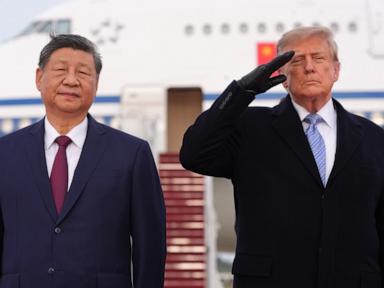
High-level state visits between major economic powers function as calculated exercises in mutual deterrence, optics management, and commercial negotiation. When Chinese President Xi Jinping arrived at Joint Base Andrews for a state visit preceded by a rare planeside greeting from U.S. President Donald Trump, the diplomatic choreography offered clear insight into the underlying mechanics of bilateral statecraft. Deconstructing the mechanics of this encounter reveals the structural variables governing trade truces, technological competition, and geopolitical positioning.
The Mechanics of Symbolic Statecraft
Diplomatic protocols are rarely improvised. A planeside greeting departs from standard protocol, elevating the visual status of an arriving head of state before formal indoor negotiations commence. In international relations, such asymmetry in hospitality functions as a signaling mechanism.
From Washington's perspective, personalizing the reception creates immediate relational capital, setting an informal tone intended to influence subsequent bargaining phases. For Beijing, domestic and international optics are paramount; imagery of high-level foreign leaders standing shoulder-to-shoulder on the tarmac provides valuable state media material to project parity and global standing.
However, this approach carries distinct domestic political costs. Legislative critics often scrutinize high-visibility welcomes, arguing that ceremonial deference risks signaling weakness or overlooking substantive policy disagreements regarding trade compliance, human rights, and military expansion. The friction between executive-level relationship building and legislative oversight introduces a structural tension into long-term foreign policy execution.
The Economic Cost Function of Trade Truces
The timing of the visit coincided with the extension of bilateral trade arrangements, offering a temporary window of market stability. Structurally, short-term extensions rather than long-term treaties serve a distinct economic function: they act as compliance mechanisms.
By tying the duration of trade truces to incremental performance—such as specific agricultural procurement targets or critical mineral export commitments—the United States retains continuous leverage. Conversely, China utilizes high-level summits to institutionalize economic predictability, seeking to mitigate unilateral tariff escalation that disrupts industrial supply chains.
The inclusion of prominent technology executives, including leaders from semiconductor and aerospace sectors, at subsequent state events underscores the intersection of commercial interests and national security. Industrial policy in both nations is increasingly inseparable from geopolitical strategy, particularly in sectors governing advanced computation, artificial intelligence, and material supply chains.
Strategic Vectors in Bilateral Negotiations
Bicontinental negotiations of this scale operate across multiple distinct vectors, each governed by different constraints:
- Technology and Supply Chain Controls: Export restrictions on critical components and raw materials remain primary instruments of state power. Discussions center on carving out functional boundaries where commercial exchange can occur without compromising national security infrastructure.
- Macroeconomic Alignment: Currency valuation, market access, and intellectual property protections continue to form the baseline friction points of economic diplomacy.
- Geopolitical Security Parameters: Regional stability, particularly concerning maritime trade routes and sovereignty disputes, frames the backdrop against which all economic bargains are struck.
Strategic Forecast
The durability of any diplomatic thaw achieved during high-profile summits is inversely proportional to the specificity of subsequent enforcement mechanisms. As bilateral teams transition from ceremonial events to operational policy implementation, the structural divergence in economic models will reassert itself. Future alignment will depend entirely on verifiable metric fulfillment in trade and technology controls rather than tarmac-level diplomacy.
This video from the search results provides coverage of Chinese President Xi Jinping arriving in Washington for his state visit and being greeted at the airport.