The Quiet Crisis in the Canopy
Wildlife conservation usually gets funded through charismatic megafauna. Tigers sell calendars. Pandas brand international treaties. Rhinos command multi-million-dollar anti-poaching security details. But the most desperate conservation battles on earth are happening on the underside of a wet leaf, far away from the cameras and the charity galas.
For nearly four decades, a quiet, methodical rescue mission has been unfolding behind the scenes at the Detroit Zoo. While the public marvels at polar bears and penguins, a dedicated contingent of zookeepers and malacologists has been waging a grinding, generational war against extinction for creatures most people would instinctively brush off their porch furniture.
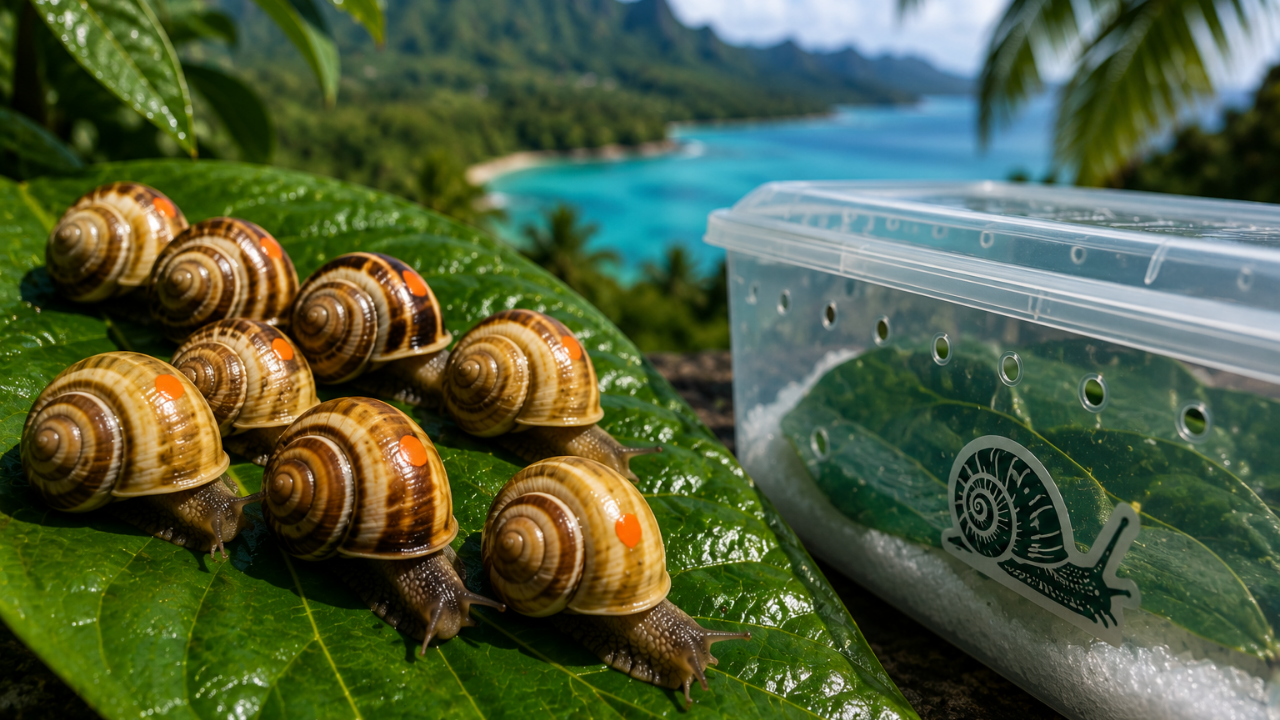
These are not garden-variety pests. These are Polynesian tree snails, specifically genus Partula, once abundant across the high islands of the South Pacific and now functionally extinct in the wild across much of their native range. The survivors live in concrete basements in Michigan, waiting for a homecoming that requires industrial-scale logistical choreography.
Moving five hundred snails five thousand miles from the American Midwest back to the volcanic peaks of Tahiti sounds like an administrative nightmare. It is. Every single individual represents a fragile link in a genetic chain that almost snapped entirely in the late twentieth century, courtesy of a biological control experiment gone horribly wrong.
The Anatomy of a Blunder
To understand why the Detroit Zoo is shipping mollusks across the globe, you have to look back at a textbook case of hubris in agricultural management. In the mid-twentieth century, the giant African land snail was introduced to several Pacific islands as a potential food source. When that project stalled, the giant snails escaped agricultural enclosures and began multiplying into an agricultural plague, stripping crops bare across local farms.
Instead of adopting measured, labor-intensive pest management, agricultural authorities reached for a silver bullet. They imported another snail. Specifically, the rosy wolfsnail, a voracious predator engineered to hunt other gastropods.
The plan possessed a fatal flaw. The rosy wolfsnail did not care much for the giant African land snail, which proved too large and difficult to handle. Instead, the predator systematically hunted the native, slow-reproducing Partula tree snails that inhabited the island canopies. They were naive prey, having evolved in isolation without major predators. Within years, dozens of unique species were hunted into immediate oblivion.
This is the grim reality of anthropogenic extinction. It rarely happens through a sudden cataclysm. More often, it arrives via well-meaning bureaucrats with clipboards and unintended consequences. By the time conservation biologists realized what was happening, the native canopy ecosystems of French Polynesia were rapidly emptying out.
Enter the International Species Information System and a desperate coalition of zoos that realized if they did not scoop up the remaining survivors right then, nobody else would.
Inside the Conservation Engine
Detroit did not just toss a few snails into a terrarium and hope for the best. Saving a micro-endemic species requires replicating an entire micro-climate inside a controlled facility thousands of miles from the equator.
The amphibian and reptile conservation center at the Detroit Zoo houses specialized holding rooms where humidity, temperature, and photoperiod cycles are meticulously controlled. Keepers monitor calcium levels, substrate chemistry, and fungal outbreaks with the obsessive precision of pharmaceutical chemists. One minor swing in ambient moisture can wipe out an entire cohort of juveniles before they reach reproductive maturity.
Genetics complicate the endeavor further. With populations dropping into the dozens during the peak of the crisis, inbreeding depression became an immediate threat. Zoos across North America and Europe formed a cautious, high-stakes breeding network. They exchange individuals like rare currency, tracking lineage spreadsheets to maximize genetic diversity and prevent the accumulation of lethal recessive mutations.
When you look at a tank of Partula snails in Michigan, you are looking at a living archive. Every individual has a pedigree. Every mating pair is calculated. They are living on borrowed time and borrowed acreage, sustained entirely by the institutional stubbornness of institutions that refuse to let a branch of the tree of life simply vanish.
The Long Journey to the South Pacific
Repatriation is where the science hits the tarmac. You cannot simply drop captive-bred invertebrates into a tropical forest and walk away. The habitat that destroyed them decades ago still harbors residual threats, and the captive populations lack the hardiness of generations selected by natural hardship.
Preparing for a trans-oceanic transfer of five hundred head requires navigating layers of international wildlife permits, agricultural inspection protocols, and airline cargo logistics. Snails are sensitive to pressure changes, temperature fluctuations, and chemical residues on shipping containers. They require hand-delivered transport inside specialized climate-controlled luggage, accompanied by curators who monitor their hydration levels during multi-leg commercial flights.
Upon arrival in Tahiti, the repatriation process moves into high gear. Before release, scientists often utilize pre-release predator exclusion zones—massive mesh enclosures erected high in the volcanic canopy where the snails can undergo a multi-generation soft release. These protected pockets shield the naive generations from lingering threats while allowing them to adapt to wild foliage, natural rainfall patterns, and native food sources.
It is a painstaking inch-by-inch recovery model. You give back a few hundred individuals, monitor their survival rates through the wet season, measure egg clutch counts, and adjust the strategy for the next wave.
The Broader Reckoning
The story of the Detroit Zoo and its Pacific snails transcends local zoological success. It serves as a stark litmus test for modern conservation economics and ethics.
We live in an era of mass ecological triage. Habitat destruction moves faster than legislative protection. Climate disruption alters baseline conditions faster than species can adapt. In this environment, institutional breeding programs are no longer cute educational add-ons for weekend visitors. They are the emergency backup hard drives of the biosphere.
Yet, relying on zoos to fix ecosystems broken by human intervention is inherently paradoxical. A captive snail safely breeding in a climate-controlled room in Michigan is a victory, but it is also an indictment. It proves we can engineer synthetic survival while failing to secure natural permanence.
The local ecosystem in Tahiti remains scarred. The invasive predators are still present in the lower underbrush, lurking beneath the canopy leaves, waiting for a careless slip in management protocols. The success of the Detroit initiative does not mean the problem is solved. It means the clock has been reset.
As the crates are unpacked in the humid valleys of French Polynesia and the tiny shells are placed back onto the damp bark of native trees, the stakes are painfully clear. This is not about sentimentality. It is about holding the line against total erasure, one slow, deliberate crawl at a time.