Darkness. Absolute, crushing, ancient darkness.
If you stood inside the Antarctic ice sheet, a mile beneath the surface at the Geographic South Pole, you would experience a silence so profound it has weight. There are no sounds here. No wind, no wildlife, no footsteps. Only the steady, agonizingly slow creep of millions of tons of frozen water grinding toward the coast, a glacier moving in slow motion.
For most of human history, this was an empty void at the bottom of the world. A place where compasses spin madly, where the air burns your lungs with its dryness, and where the temperature plummets low enough to shatter steel.
Yet, beneath this desolate crust, something extraordinary is listening.
Francis Halzen knew it was there, even when everyone else thought he was chasing phantoms. For decades, the Belgian physicist believed that the answers to the universe's most violent cataclysms were not hiding in the light of distant stars, but in the ghostly particles passing straight through our feet without us ever knowing.
Think about how we have always looked at the cosmos. Since Galileo first turned his crude spyglass toward Jupiter, humanity has been creatures of light. We built bigger mirrors, lofted massive beryllium lenses into orbit, and stared into the optical spectrum, capturing photons born billions of years ago. But light lies. Or, more accurately, light gets blocked. Dust clouds, magnetic fields, and dense gas nurseries obscure our view of the universe's engine rooms.
Enter the neutrino.
Neutrinos are the whispers of the cosmos. They are subatomic particles possessing almost no mass, carrying no electrical charge, and traveling through space at nearly the speed of light. Trillions of them are passing through your body right now, courtesy of the sun, exploding stars, and distant galactic cores. They do not care about magnetic fields. They do not care about gas clouds. You could put a lead wall a light-year thick in front of a neutrino, and it would simply slide through as if the wall were empty space.
They are ghosts. And catching a ghost is nearly impossible.
To catch a neutrino, you need something massive. Something impossibly transparent, incredibly dark, and utterly isolated from the noise of human civilization.
You need a cubic kilometer of pure ice.
Imagine taking a high-pressure jet of scalding water and melting your way straight down into the Antarctic glacier, two thousand four hundred meters deep. Imagine lowering a string of high-tech glass globes—each one gleaming like a deep-sea diving helmet—into the molten borehole before the crushing pressure refreezes the water around them solid. Now, multiply that by eighty-six strings. Spread them out across an area the size of Manhattan.
This is IceCube. And it is, without exaggeration, the strangest telescope ever built by human hands.
When a high-energy neutrino from the edge of the known universe finally decides to interact with an atom inside that block of Antarctic ice, it triggers a subatomic collision. A secondary particle, called a muon, is born, streaking forward faster than the speed of light in that medium. As it tears through the ice, it throws off a faint, eerie blue flash known as Cherenkov radiation.
It is the subatomic equivalent of a sonic boom, rendered in ghostly blue light.
The digital eyes of the IceCube sensors catch that flash. They time it down to the nanosecond, creating a vector, a straight line drawn backward through the frozen dark, pointing the finger right back at the cosmic monster that birthed the particle.
For years, skeptics shook their heads. They called it a fool's errand. How could you trust data gathered from deep within a shifting, deforming glacier at the bottom of the earth? How could you separate the faint, miraculous flashes of extraterrestrial messengers from the deafening roar of atmospheric cosmic rays crashing into the upper atmosphere above?
Francis Halzen did not blink. He spent decades refining the concept, rallying hundreds of scientists from around the globe, drilling holes with boiling water in the brutal polar winter, waiting for the universe to speak.
And then, it did.
In September 2017, IceCube caught a high-energy neutrino that had traveled nearly four billion light-years. Within minutes, automated alert systems triggered telescopes across the globe—both on the ground and in orbit. They swung their lenses toward a specific patch of the sky in the constellation Orion.
There, hidden behind a blazing supermassive black hole at the center of a distant galaxy known as a blazar, a cosmic accelerator was actively hurling high-energy particles right at us. For the first time in history, humanity had not just seen the universe; we had heard its heartbeat through the ice.
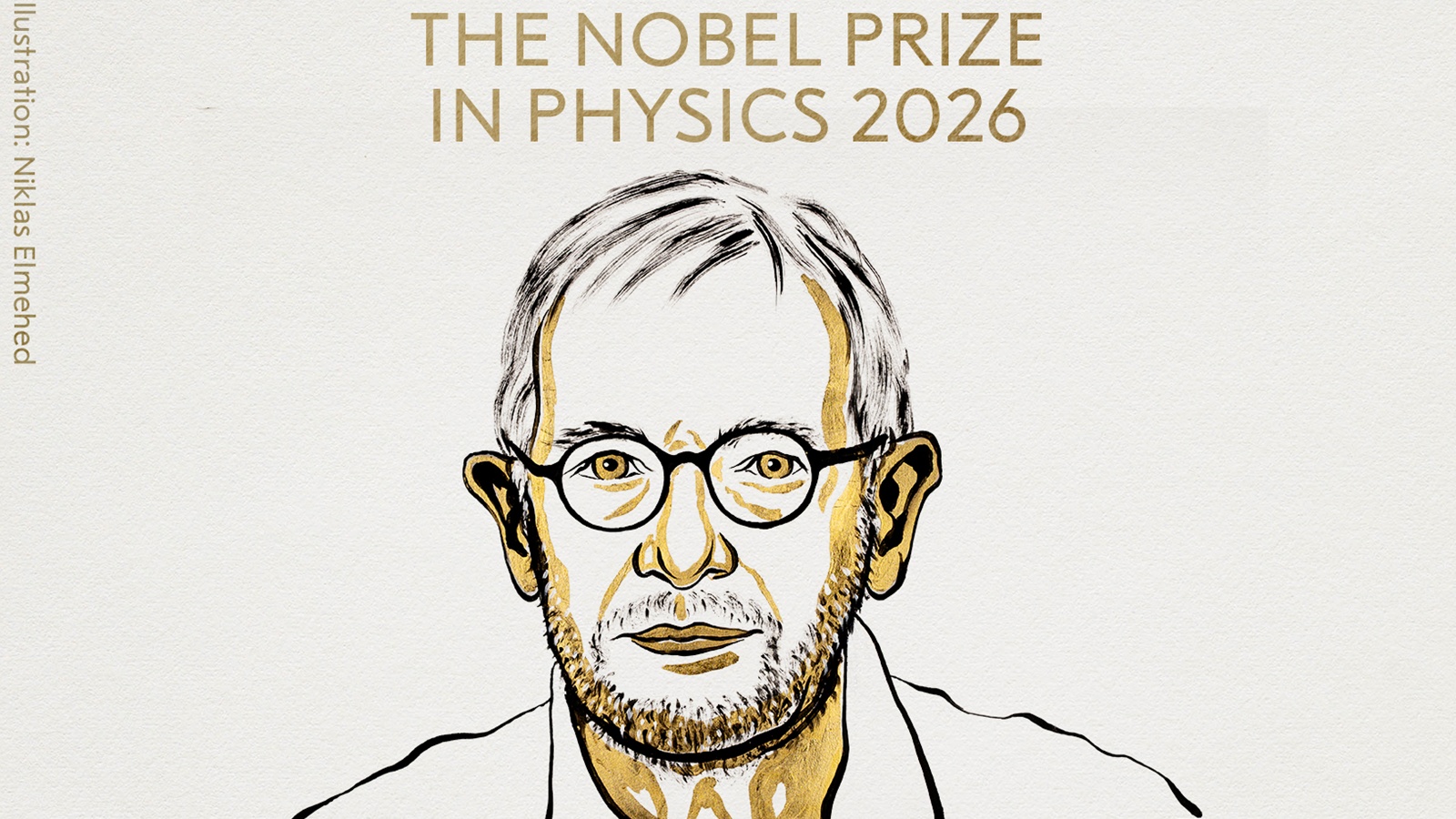
That breakthrough is why the Nobel Prize in Physics for 2026 belongs to Francis Halzen.
It is a victory for stubbornness. It is a validation of the weird, the unconventional, and the wildly ambitious. In an era where funding often flows toward incremental tweaks and safe bets, Halzen’s triumph stands as a monument to what happens when we look where everyone else refuses to look.
We live in a noisy world. We are obsessed with screens, with instant data, with the bright and the obvious. We look up at the night sky and marvel at the pretty pictures sent back by orbiting observatories, mistaking the visible universe for the whole story.
Yet, the true architecture of reality is invisible. It is happening in the dark. It is passing through us right now, silent and indifferent, bearing secrets from the dawn of time.
Deep beneath the Antarctic wind, in a cathedral of ancient ice, the sensors are still waiting. The blue flashes still ignite. And somewhere out there in the blackness, a star is dying, sending out a single, lonely ghost particle to tell us how it happened.