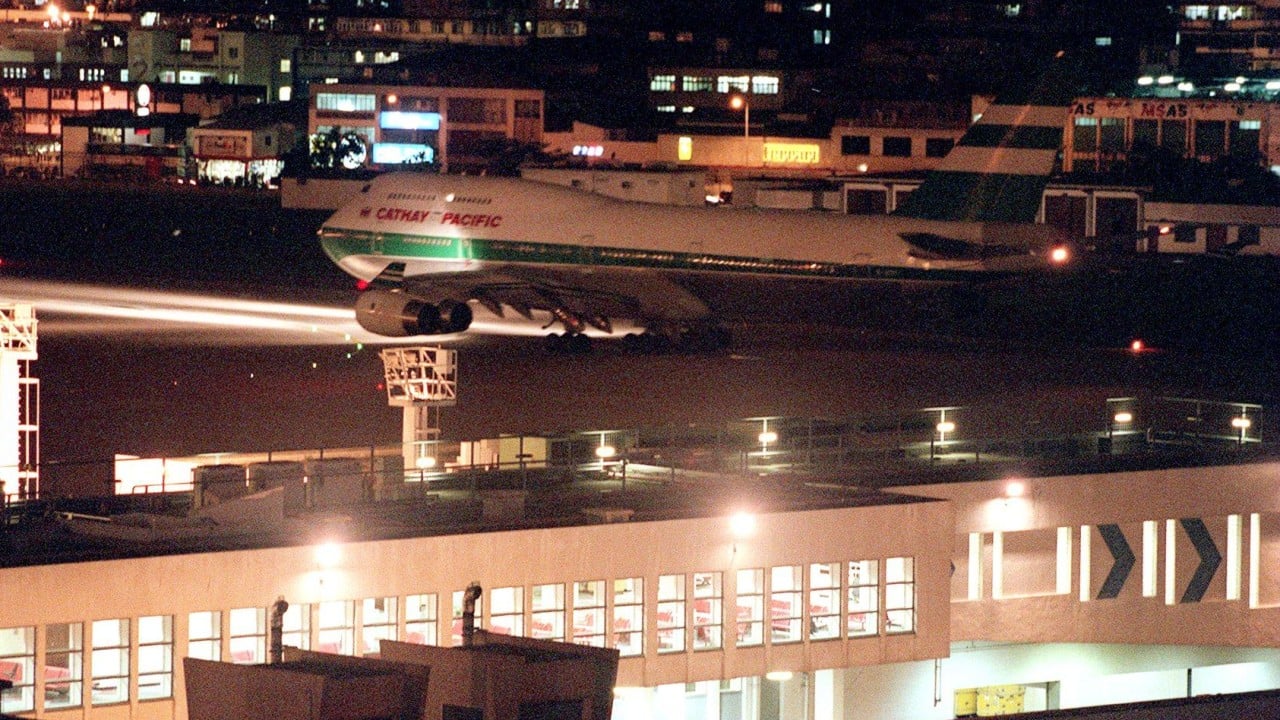
On July 6, 1998, a Cathay Pacific Airbus A340 taxied into the humid night at Kai Tak Airport, lifted its nose, and climbed over the neon-drenched high-rises of Kowloon for the last time. It marked the end of an era. For seventy-three years, this single-runway airport defied geographic logic, forcing commercial jumbo jets to navigate a terrifying, hair-raising descent between residential apartment blocks. The closure of Kai Tak was not merely an upgrade in civil aviation infrastructure. It was a calculated, high-stakes gamble that fundamentally reshaped Hong Kong’s economic sovereignty and signaled the city's transition from a gritty colonial outpost to a hyper-modern global financial hub.
While public nostalgia frequently centers on the legendary "checkerboard turn" and the sheer spectacle of planes skimming rooftops, the true narrative of Kai Tak’s demise lies buried in the ledger books of urban planners and the geopolitics of the 1997 handover. The city did not just outgrow its airport. It outgrew the chaotic, laissez-faire geography that Kai Tak embodied.
The Impossible Geography of Runway Thirteen
Aviation experts still marvel that Kai Tak operated for decades with an astonishingly clean safety record. The structural bottleneck was Runway 13/31, a strip of reclaimed land jutting directly into Kowloon Bay.
To land from the northwest, pilots had to fly straight toward a orange-and-white checkered hill in Kowloon Walled City. At the very last moment, they executed a sharp, forty-five-degree visual turn at an altitude of just under seven hundred feet, all while battling treacherous crosswinds whipped up by the surrounding peaks of New Kowloon.
This maneuver required intense manual precision. Passengers could look out their windows and see residents hanging laundry or watching television inside their high-rise apartments.
But nostalgia obscures a darker logistical reality. Kai Tak was a ticking economic time bomb. By the mid-1990s, the single runway was handling nearly thirty million passengers annually, operating at over double its intended structural capacity. It was the third busiest passenger airport in the world and the first in terms of international cargo. The city was choking on its own success. Air freight forwarders routinely turned away business because there were simply no slots left between midnight and 6:30 AM, a curfew strictly enforced to give over a million deafened residents a few hours of sleep.
The Trillion Dollar Gamble at Chek Lap Kok
The decision to replace Kai Tak was arguably the most ambitious civil engineering project of the twentieth century. The Port and Airport Development Strategy, launched by the colonial government in 1989, proposed moving the entire aviation apparatus to Chek Lap Kok, a remote, mountainous island over twenty miles away.
To achieve this, engineers literally flattened two islands, used the rubble to reclaim nearly four square miles of land from the South China Sea, and constructed a massive high-speed transport network. This network included the Tsing Ma Bridge, which was the world's longest suspension bridge carrying both road and rail traffic at the time.
The political undercurrents were fierce. Beijing viewed the multi-billion-dollar project with deep suspicion, fearing that the departing British administration was draining Hong Kong’s fiscal reserves before the 1997 sovereignty transfer. The colonial government, however, understood that without a twenty-four-hour, multi-runway facility, Hong Kong would lose its logistical crown to rising regional competitors like Singapore’s Changi or Taipei’s Chiang Kai-shek International.
It was a battle for the future of Asian trade. Chek Lap Kok was designed not just to handle the traffic of 1998, but to scale up to over eighty million passengers and millions of tons of cargo. It traded the visceral, intimate charm of Kai Tak for sterile, relentless, industrial-scale efficiency.
The Human Cost of Progress
When the final lights dimmed at Kai Tak, the immediate focus was on the technical triumph of the overnight move. In a single twelve-hour window, an armada of barges, trucks, and support vehicles relocated thousands of tons of ground handling equipment across the territory to ensure the new airport could open the next morning.
Yet, the displacement felt by the community was profound. Kowloon City, the dense neighborhood flanking the old runway, went from being the vibrant, roaring gateway of the city to a quiet, economically depressed pocket overnight.
Dozens of aviation-themed hotels, noodle shops catering to late-night ground crews, and camera stores relying on transit tourists saw their revenues evaporate within months. The signature roar of Rolls-Royce RB211 engines, which had served as the background heartbeat of daily life for generations of Kowloon residents, was replaced by an eerie, unfamiliar silence.
Furthermore, the initial opening of Chek Lap Kok was plagued by software glitches, cargo system failures, and baggage delays that cost the local economy an estimated billions in lost productivity during its first few weeks. It was a harsh reminder that moving the operational soul of a city cannot be achieved simply by flipping a switch.
Reclaiming the Concrete Finger
For over two decades following its closure, the physical footprint of Kai Tak remained a polarizing ghost in Hong Kong’s real estate theater. The prime waterfront land sat largely underutilized, trapped in bureaucratic gridlock and shifting political priorities. Plans swung wildly from cruise terminals and stadium complexes to high-density public housing.
Today, the site is a patchwork of the city’s conflicting identities. A massive cruise terminal sits at the tip of the old runway, looking grand but often struggling to find its commercial footing. Nearby, luxury residential towers rise from the tarmac, selling apartments at premium prices based on the promise of panoramic harbor views, completely detached from the blue-collar, industrial history of the site.
The memory of Kai Tak persists because it represents a version of Hong Kong that no longer exists. It was a time when the city’s limitations were its greatest strengths, when survival required squeezing impossibility out of every square foot of rock and sea. The modern replacement airport at Chek Lap Kok is objectively superior in every measurable metric of safety, volume, and speed. It secured Hong Kong's position as an indispensable node in global supply chains. But in trading the chaotic, terrifying proximity of Runway Thirteen for the distant efficiency of the outer islands, Hong Kong lost a piece of its raw, unmistakable edge.