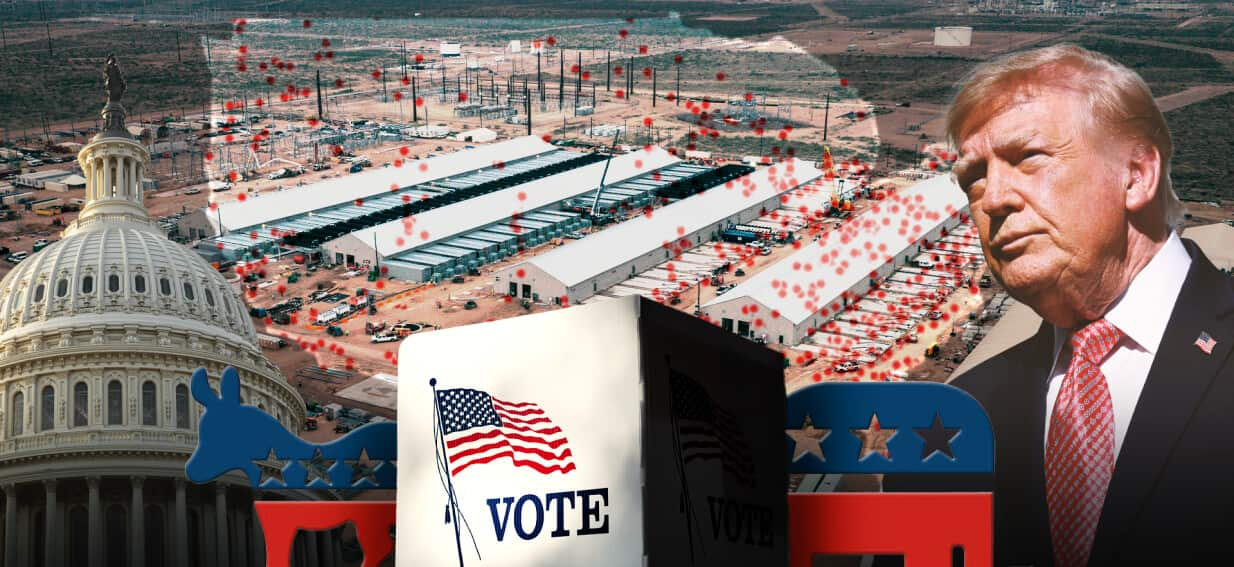
Every political pundit in Washington is patting themselves on the back for discovering the "sleeper issue" of the 2026 midterms. The consensus narrative goes like this: voters got furious about hyperscale AI data centers devouring local water supplies and jacking up monthly utility bills, formed a rare bipartisan rebellion, and swept anti-data-center candidates into office from Ohio to Georgia and Texas.
It makes for a tidy cable-news segment. It is also a massive misreading of both election mechanics and power-grid economics.
Data centers were not the kingmaker of November 2026. They were a convenient, physical scapegoat for a much older, much uglier structural rot in American infrastructure. Worse yet, the political "solution" that voters and incoming governors are celebrating—slapping blanket moratoriums on new server farms—is going to backfire directly onto the exact residential ratepayers it is supposed to protect.
The Myth of the Data Center Wave
Let’s look at the actual political math instead of campaign slogans. Yes, 34 out of 35 local ballot measures restricting data centers passed. Yes, incoming governors like Keisha Lance Bottoms in Georgia and Gina Hinojosa in Texas campaigned hard on pausing new builds, while Sherrod Brown hammered John Husted over data center tax breaks in Ohio.
And yes, exit polling showed more than half of voters claimed data centers were a major factor in their decision.
Ask any veteran pollster what happens when you ask angry voters whether a giant, windowless building owned by a trillion-dollar tech monopoly is ruining their neighborhood. Of course they say yes. Nobody likes staring at a concrete fortress that employs fifty people after construction wraps up.
Attribution error is the oldest trap in political commentary: mistaking a visible symptom for the underlying disease.
The 2026 election was a textbook macroeconomic wave election driven by broad dissatisfaction with the cost of living and a 34 percent presidential approval rating. In Pennsylvania, Governor Josh Shapiro won re-election championing data center development and smart regulation against an opponent who demanded a flat-out moratorium. In dozens of statehouse races, candidates from both parties ran against hyperscalers. When both sides attack the same target, that target isn't deciding the partisan balance of power—it's just absorbing public rage over inflation.
Voters weren't casting ballots against server racks. They were casting ballots against their August electric bills, and politicians handed them a villain with a corporate logo on the front gate.
Why Your Electric Bill Actually Spiked
If you want to understand why residential power rates climbed across the PJM Interconnection and ERCOT grids between 2023 and 2026, stop looking at server halls and start looking at transmission bottlenecks and decades of deferred grid maintenance.
I have sat in utility commission hearings where ratepayer advocates scream about a 500-megawatt AI campus while ignoring the fact that the regional utility spent fifteen years starving its distribution network of upgrades to protect quarterly dividends. The American electrical grid was built for a static, mid-century economy. Today, three massive load drivers hit it simultaneously:
- Domestic manufacturing reshoring: Battery plants, semiconductor fabs, and heavy industrial facilities require massive baseload power.
- Electrification of everything: Heat pumps, EV fleets, and industrial boilers are shifting fossil fuel demand directly onto local distribution lines.
- Retiring baseload generation: Coal and aging nuclear plants went offline faster than intermittent renewables and battery storage could replace their firm capacity.
Hyperscale data centers didn't break the grid; they exposed that the grid was already brittle.
When a utility builds a new high-voltage transmission line or substation to serve an industrial zone, traditional rate structures spread those capital costs across all ratepayers—including you, sitting in your living room running a window AC unit. That cost-shifting mechanism is a regulatory failure, not an engineering inevitability.
What Everyone Gets Wrong About Grid Economics
Here is the counter-intuitive truth that gets buried under NIMBY outrage: under the right tariff structure, hyperscale data centers are the single best tool available to lower residential electricity rates.
Read that again.
Electrical utilities operate on massive fixed costs. Poles, wires, transformers, and substations cost billions to build and maintain regardless of how many kilowatt-hours flow through them. When total electricity demand in a service territory stagnates or shrinks, those fixed costs get divided among fewer kilowatt-hours, forcing your per-unit rate up.
When a massive, steady, 24/7 customer—known in utility jargon as a high-load-factor customer—plugs into the grid, it buys colossal amounts of power around the clock. Unlike residential homes, which spike demand at 6:00 PM on hot summer afternoons and sit nearly idle at 3:00 AM, data centers run flat-out at 90 percent capacity day and night.
The High-Load-Factor Math
Consider how a properly regulated utility rate works when a 1-gigawatt data center comes online:
- Dedicated Infrastructure: Under modern "large-load tariffs" (like those pushed in states such as Ohio and Indiana before the political panic set in), the tech company pays 100 percent of the incremental substation and transmission upgrades required to serve its facility.
- Fixed-Cost Dilution: The data center still pays system-wide distribution and grid maintenance fees on every megawatt-hour it consumes. Because its consumption is enormous and predictable, it absorbs a massive share of the existing grid's fixed overhead.
- Downward Rate Pressure: Every dollar of existing grid overhead paid by a tech giant is a dollar that does not have to be recovered from residential households.
Columbia University’s Center on Global Energy Policy and independent grid analysts like Grid Strategies have modeled this exact dynamic. When large loads are forced to cover their incremental buildout costs via strict tariff walls, they generate tens of billions of dollars in system-wide transmission revenue that actively subsidizes grid modernization for everyone else.
The Moratorium Trap
Now look at what happens when newly elected governors and county boards slap blanket moratoriums on data center construction.
First, you don't stop the grid upgrades that utilities already committed to building for the 191 gigawatts of planned capacity currently sitting in interconnection queues. Utilities have already ordered the transformers, signed the engineering contracts, and begun amortizing the debt. If the data center developer walks away because a county council freezes zoning permits, who gets stuck holding the bag for those stranded transmission assets?
You do. Your state public utility commission will let the utility roll those unrecovered capital costs straight into the general rate base.
Second, moratoriums don't stop AI compute from being built. They just push it across state lines or into deregulated "behind-the-meter" arrangements.
The Behind-the-Meter Loophole
When local governments block grid connections, hyperscalers don't pack up and go home. They buy private natural gas turbines, lease aging power plants directly, or co-locate right next to nuclear reactors, bypassing the public grid entirely.
Think through the consequences of that shift:
- The data center still burns local gas and uses local cooling water.
- The local community gets zero grid upgrades out of the deal.
- The public utility loses a massive anchor tenant that could have helped finance regional transmission resilience.
Worse still, in states that hand out blanket property tax abatements to lure data centers while simultaneously failing to enforce large-load utility tariffs, taxpayers get the worst of both worlds: subsidized corporate real estate and socialized utility costs. Politicians spent the last decade giving away the tax base to win ribbon-cutting ceremonies, and now they are swinging the pendulum to total prohibition to win re-election. Both extremes are economic malpractice.
The Water Panic Is Mostly Theater
Before moving to the solution, we have to dismantle the second half of the anti-data-center talking point: water consumption.
Viral headlines love comparing a data center's daily water draw to the consumption of a mid-sized town. In drought-stricken basins like Maricopa County, Arizona, scrutinizing industrial water rights is completely justified.
In Ohio, Virginia, Georgia, or the Great Lakes region, treating data center cooling as an existential water crisis is pure theater.
- Closed-Loop Systems: Modern AI clusters running high-density liquid cooling (direct-to-chip or immersion) operate on closed-loop circuits. Once the pipes are filled, evaporation is near zero.
- Non-Potable Graywater: Hyperscalers rarely need drinking-quality municipal water. Across Virginia and Texas, facilities increasingly run on treated municipal wastewater (reclaimed effluent) that would otherwise be dumped into rivers.
- The Agricultural Comparison: In almost every U.S. state, agricultural irrigation and aging, leaky municipal water mains waste orders of magnitude more water every single week than the entire American data center fleet consumes in a year.
Politicians focus on data center water usage because banning a server farm is politically painless, whereas telling regional agribusinesses to modernize flood-irrigation systems is political suicide.
What Smart Policy Actually Looks Like
If you are a policymaker, a utility regulator, or a voter who actually wants lower electric bills instead of cheap campaign applause lines, stop demanding moratoriums. Demand structural guardrails that force Big Tech to finance the public grid.
1. Kill All State and Local Tax Abatements Immediately
Hyperscalers do not build a $10 billion campus in Columbus or Atlanta because of a 10-year sales tax exemption on servers. They build there because of fiber-optic backbone proximity, low latency to major population centers, and available land. Tax breaks for data centers are pure corporate welfare. Make them pay full local property and equipment taxes from day one, and route that revenue directly into county school districts and municipal water upgrades.
2. Mandate "Bring Your Own Capacity" Tariffs
Regulators must require any industrial load over 50 megawatts to sign 15-to-20-year take-or-pay power contracts. Under this structure, the tech company pays for the dedicated transmission lines and new generation capacity needed to serve it, whether it uses the power or not. If the AI bubble pops tomorrow and the servers go dark, the tech company—not the residential ratepayer—pays off the stranded utility debt.
3. Force Curtailment Participation
Data centers can shift non-urgent AI model training runs in milliseconds. Utilities should make interconnection contingent on mandatory demand-response: during the 50 hottest or coldest hours of the year when the public grid approaches peak stress, the data center automatically drops its grid draw by 30 to 50 percent and switches to on-site battery storage or backup generation. That single rule eliminates the need to build billions of dollars in rarely used "peaker" power plants.
4. Ban Potable Water for Evaporative Cooling
Make it a hard statutory rule: zero municipal drinking water for cooling towers. Require closed-loop liquid cooling or 100 percent reclaimed graywater infrastructure paid for by the developer.
The Honest Trade-Off
There is a real downside to this approach, and anyone pretending otherwise is selling you something.
If states enforce strict take-or-pay utility tariffs, kill tax breaks, and mandate curtailment, the breakneck pace of AI infrastructure construction will slow down. Smaller, speculative data center developers—the middlemen who lock up land and utility queue spots just to flip them to Microsoft, Meta, or Google—will go bankrupt. Some projects will pack up and move to deregulated energy markets or international jurisdictions with looser rules.
Good. Let the speculators wash out. A slower, self-financed, grid-strengthening buildout beats a taxpayer-subsidized boom-and-bust cycle every single time.
The voters who rebelled in November 2026 were right to be furious about rising utility bills and secretive corporate land grabs. They just let politicians aim their anger at the wrong target. Stopping data centers won't fix a brittle, under-invested electrical grid—it will just guarantee you keep paying for it all by yourself.