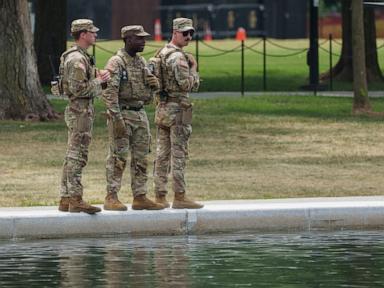
The lazy consensus across the media landscape this week is predictable. A Washington, D.C. man blasts the "Imperial March" from Star Wars at National Guard troops patrolling his neighborhood. He gets arrested. He sues. The District cuts a five-figure settlement check. Cue the standard triumphant choruses from civil liberties groups celebrating another victory for the First Amendment.
They are missing the entire point.
This settlement is not a win for free speech. It is a terrifying indicator of how municipal governments use taxpayer money to sweeping constitutional overchecks under the rug, ensuring that the actual legal boundaries of modern protest remain dangerously undefined. By settling, Washington D.C. didn't learn a lesson; they bought a non-disclosure agreement on police accountability.
The Illusion of a First Amendment Victory
The mainstream narrative frames this as a classic David versus Goliath story. Man uses weaponized pop culture to mock state power, state overreacts, justice prevails. But let's look at the mechanics of how municipal litigation actually functions.
When a city settles a civil rights lawsuit, it almost never admits fault. The check written to the plaintiff is not a penalty; it is a line-item operational expense. For a major city budget, a $50,000 or $100,000 settlement is couch change. It is cheaper to pay off an aggrieved citizen than it is to litigate a case through discovery, trial, and the inevitable appeals process.
More importantly, settlements create zero legal precedent.
If you want to protect free speech, you need case law. You need a federal judge issuing an opinion that explicitly states: "Blasting satirical music at military personnel in a public forum is protected speech, and arresting someone for it violates clearly established law." That opinion becomes a shield for the next protester. A settlement agreement does nothing of the sort. The police department's internal manual remains unchanged. The officers involved face no systemic retraining. The status quo is preserved, funded by the local taxpayer.
The Weaponization of Noise Ordinances
The core mechanism used by law enforcement in these scenarios is almost always the "disturbing the peace" or "unreasonable noise" statute. These laws are inherently vague, and that vagueness is a feature, not a bug.
I have spent years analyzing municipal code enforcement, and the pattern is unvarying. Selectively enforced ordinances are the primary tool for viewpoint discrimination. If a resident plays loud music to celebrate a local sports victory, officers drive past with a wave. If that same resident plays loud music to criticize a political apparatus, the exact same decibel level suddenly becomes a criminal infraction.
Consider the baseline mechanics of a standard noise ordinance. Most require a showing that the sound was "unreasonably loud" or "disturbed the comfort" of a reasonable person. This introduces a subjective standard that practically invites police officers to substitute their personal discomfort or offense for an objective legal violation.
When the state deploys armed troops or heavily militarized police forces to civilian streets, it intentionally alters the public forum. To argue that citizens must maintain a polite, quiet environment around that deployment is an absurdity. Protest is designed to disrupt. It is designed to be uncomfortable. By focusing on the musical choice here—the dark irony of John Williams' score—the public misses the structural danger: the state still maintains the infrastructure to arrest you first and let the city's lawyers sort out the financial fallout later.
Why the "Qualified Immunity" Loophole Wins Again
To understand why this settlement is a net-loss for systemic reform, we have to look at the doctrine of qualified immunity. Established by the Supreme Court in cases like Harlow v. Fitzgerald, qualified immunity protects government officials from liability in civil lawsuits unless their conduct violates "clearly established statutory or constitutional rights of which a reasonable person would have known."
To prove a right is "clearly established," a plaintiff usually has to point to an existing judicial opinion with nearly identical facts.
By settling this case before a definitive judicial ruling, the District of Columbia effectively prevented the creation of that "clearly established" standard for this specific type of modern, auditory protest. The next time a citizen uses a Bluetooth speaker to satirize law enforcement, the officers can make the arrest, claim they didn't know it was unconstitutional because there is no specific binding case law on Star Wars music, and invoke qualified immunity.
The loop repeats. The city settles again. No structural progress is ever made.
Stop Celebrating Cash, Demand Verdicts
The conventional wisdom tells activists to take the money and run. Litigation is exhausting, expensive, and risky. But we need to be clear-eyed about what that choice means for the broader civic health.
When civil rights lawsuits turn into predictable financial transactions, the constitutional right at stake becomes commodified. The government essentially buys a license to violate your rights, pricing the cost of the infraction directly into their annual legal defense budget.
Imagine a corporation that repeatedly pollutes a river because the regulatory fine is lower than the cost of upgrading their filtration systems. We would not call those fines a victory for environmentalism. We would call it the cost of doing business. That is exactly what municipal civil rights settlements have become: the cost of maintaining an aggressive, unchecked policing apparatus.
If we want to stop the erosion of the public square, the strategy must change. We need plaintiffs who refuse the payout. We need legal funds backed by donors who are willing to bankroll cases all the way to the appellate level, forcing courts to explicitly strip qualified immunity from officers who use discretionary ordinances to silence critics.
The Darth Vader case shouldn't be a feel-good story about a quirky protester getting paid. It should be a wake-up call that the state has successfully figured out how to buy its way out of constitutional accountability. Stop looking at the size of the check and start looking at the lack of the precedent.
Don't celebrate the settlement. Demand the trial.