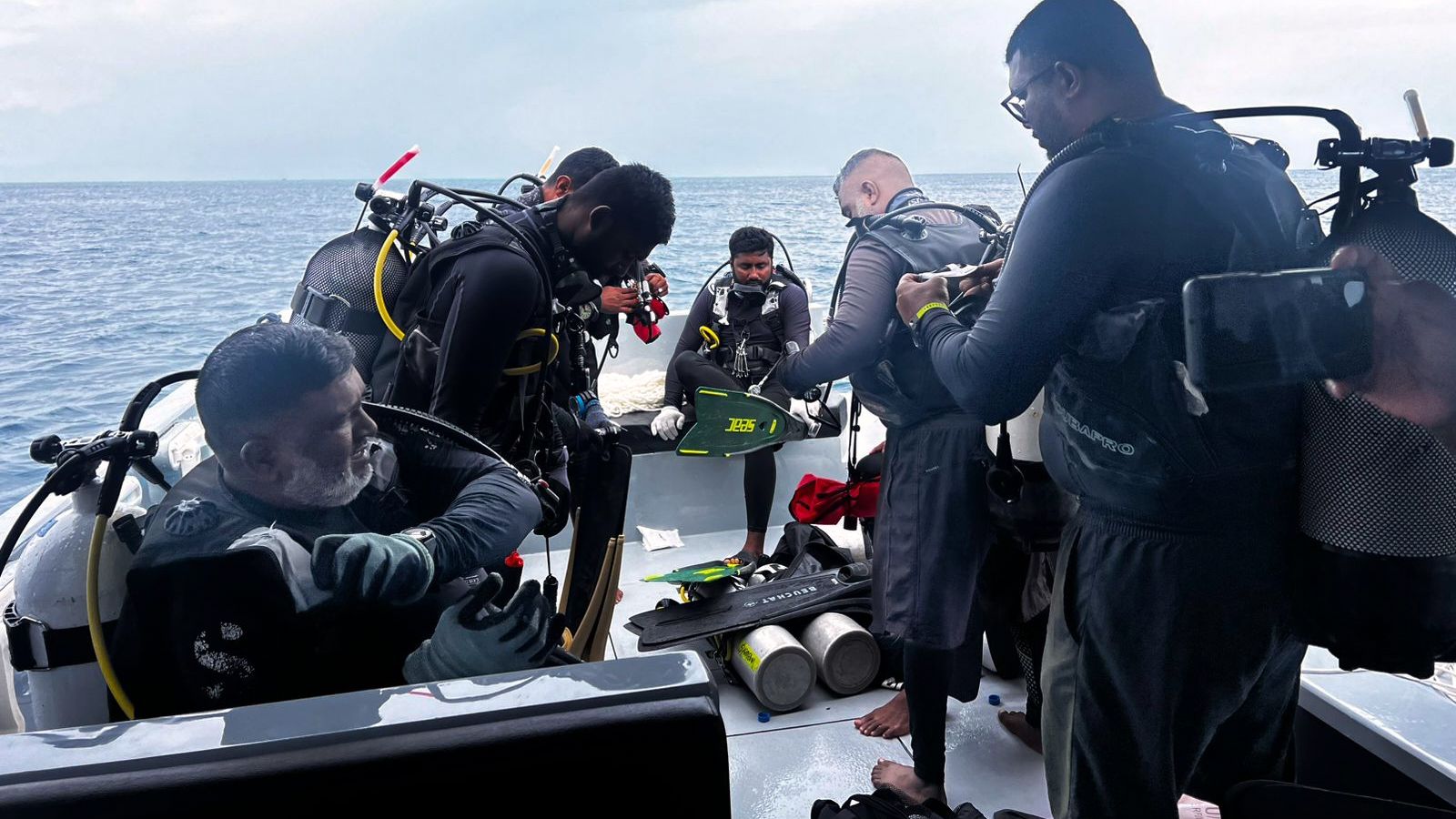
The water at seventy meters is not blue. It is a thick, bruising purple that feels heavy against the glass of a diving mask. Down here, the sun is no longer a source of warmth; it is a pale, flickering memory filtered through millions of tons of ocean. Most tourists visit the Maldives for the postcards. They want the neon-white sand, the overwater bungalows, and the shallow reefs where turtles glide through water as clear as gin.
But there is another Maldives. It exists in the vertical drops, the sheer limestone walls that plunge into the crushing depths of the Indian Ocean. It is a world of absolute silence, save for the rhythmic, metallic hiss of a regulator and the thudding of your own heart.
To understand why experienced divers journey into this twilight zone, you have to understand the pull of the unknown. It is the same instinct that drives mountaineers up K2 or astronauts into the void. It is the desire to stand where no human has stood before. But the ocean does not tolerate hubris. When things go wrong in the deep, they do not go wrong in a rush of adrenaline and panic. They go wrong with a quiet, terrifying slow-motion inevitability.
The recent release of the first photographs from the deep-sea cave where a team of Italian divers lost their lives has forced the diving community to confront a grim reality. These images do not just show a geographic feature. They reveal a psychological trap.
The Architecture of a Shadow
The cave system sits far past the limits of recreational diving. To get there, you cannot rely on a single tank of compressed air. You need mixed gases, trimix blends of helium, nitrogen, and oxygen carefully calibrated to keep the human brain functioning under immense atmospheric pressure.
Imagine breathing through a straw while an anvil rests on your chest. That is the physical sensation of depth.
The photographs reveal a narrow, jagged aperture in the reef wall. It looks less like a geological formation and more like a wound. Inside, the limestone walls are coated in a fine, ghostly silt. This silt is the greatest enemy of the cave diver. In an enclosed space, a single careless kick of a fin can stir up a cloud so dense that your high-powered dive light becomes useless, reflecting back off the suspended particles like high beams in a midnight blizzard.
Suddenly, up and down lose their meaning. The exit vanishes.
But the physical structure of the cave is only half the danger. The true peril of the Maldives deep is invisible. It is a phenomenon known to divers as inert gas narcosis, or more poetically, the rapture of the deep. At seventy meters, the nitrogen in a standard breathing mix becomes highly intoxicating. It mimics the effects of heavy alcohol consumption. Fear evaporates. Caution is replaced by a warm, dangerous euphoria. Divers have been known to pull the regulators from their mouths to offer them to passing fish.
When you combine a complex, silt-heavy cave system with the mental fog of severe narcosis, the margin for error shrinks to zero.
The Physics of Forgetting
To comprehend the stakes of deep-sea exploration, consider a hypothetical diver named Marco. He is not a novice. He has logged thousands of hours in the water. He knows the tables, the decompression stops, and the equipment inside out.
Marco descends along the reef wall. The light fades from turquoise to sapphire, then to that ominous purple. He reaches the cave entrance. His dive computer ticks down the minutes. In the deep, time is your scarcest resource. You cannot simply swim to the surface if something goes wrong. If you ascend too fast, the nitrogen dissolved in your blood bubbles out like shaking a bottle of champagne, causing agonizing pain, paralysis, or death. You are effectively trapped by physics.
He enters the cavern. The beauty is haunting, alien.
Then, a minor complication occurs. Perhaps his pressure gauge catches on a protrusion of rock. Perhaps his buddy swims slightly too close, and a fin strike triggers a silt-out. Within seconds, the crystal-clear water turns to liquid mud.
In this moment, the human brain undergoes a massive chemical shift. The euphoria of narcosis instantly curdles into acute panic. The heart rate spikes. A high heart rate means breathing increases, consuming the limited gas supply at an alarming velocity. The instinct is to climb, to get out, to breathe the air above. But the ceiling of the cave blocks the sky, and even if it did not, the decompression obligation demands that Marco stay down, waiting out the clocks while his gas runs dry.
The newly released photographs of the site show the tight restrictions and the deceptive offshoots of the cave. It becomes chillingly clear how easily a team, even one composed of elite divers, could lose their bearings in the dark.
The Cost of the Frontier
The dive community is a small, tight-knit global family. When an accident like the one in the Maldives occurs, the shockwaves travel fast. It sparks an agonizing debate that happens after every high-altitude disaster or deep-ocean loss.
Why do we go?
The answers are rarely satisfying to those who keep their feet on solid ground. The Maldives government and international diving organizations have tightened regulations, restricting access to these extreme depths for commercial operators. Yet, the black-water caverns will always draw those who possess a certain kind of curiosity.
The tragedy of the Italian expedition was not a failure of equipment or a lack of skill. It was a stark demonstration of the ocean’s absolute indifference to human capability. The sea does not hate us, but it does not love us either. It merely exists under its own set of immutable physical laws.
Those photographs of the cave entrance, silhouetted against the dim, distant light of the upper ocean, serve as a monument. They remind us that the earth still holds places that are fundamentally hostile to human life, places where we are only ever temporary, fragile visitors.
The equipment has been recovered. The logs have been analyzed. The data points tell a story of pressures, depths, and gas mixtures. But the true story remains down there, in the purple dark, where the water is heavy and the silence is absolute.