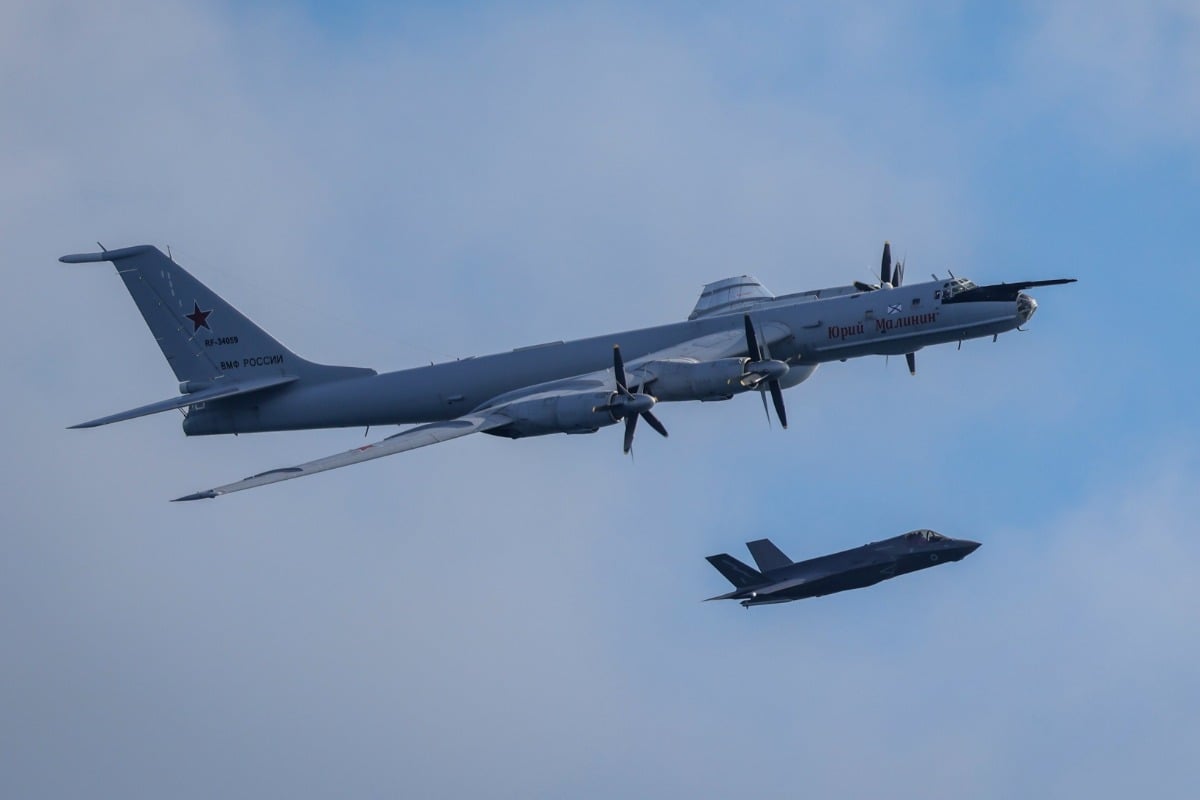
Royal Air Force Typhoon fighters recently scrambled from Scotland to intercept Russian Tu-142 maritime patrol aircraft shadowing a British carrier strike group in the North Sea. While Whitehall officials framed the encounter as a routine demonstration of defensive vigilance, the incident underscores a more volatile reality. These close-quarters aerial encounters are no longer just diplomatic posturing. They have evolved into calculated intelligence-gathering missions targeting the Royal Navy's flagship vulnerabilities during a period of acute structural strain for the British military.
The Kremlin is not trying to start a war in the North Sea. It is mapping the acoustic, electronic, and operational signatures of the UK's high-value naval assets.
The Anatomy of an Intercept
When a Russian Tu-142—known to NATO as the Bear-F—dips into the UK's flight information region without a filed flight plan or active transponder, it triggers a highly choreographed response. Quick Reaction Alert (QRA) crews at RAF Lossiemouth move from standby to airborne in under ten minutes.
The public sees the resulting cockpit photographs. What they do not see is the invisible duel of sensors playing out across the electromagnetic spectrum.
The Tu-142 is not a bomber; it is a dedicated submarine hunter and electronic intelligence platform. When it flies close to a British carrier strike group, its crew is not looking for a dogfight. They are deployed to drop sonobuoys, monitor naval communications, and record the radar signatures of the escorting Type 45 destroyers.
For the RAF pilots, the mission requires extreme discipline. They must get close enough to visually identify the aircraft and escort it away from sensitive airspace, but they must do so without revealing the full capabilities of their own radar and electronic warfare systems. It is a balancing act executed at 400 knots.
Testing a Hollowed Out Fleet
The timing of these maritime incursions is rarely accidental. Russia tracks the deployment cycles, maintenance backlogs, and structural weaknesses of Western militaries with meticulous care.
The Royal Navy has faced persistent questions regarding its surface fleet availability. Escort ships, particularly the Type 45 destroyers tasked with protecting the carriers from aerial threats, have historically suffered from propulsion issues in warmer waters and lengthy maintenance overhauls. When a British carrier puts to sea, it requires a protective bubble of air defense destroyers, anti-submarine frigates, and supply vessels.
The Escort Shortage
- Type 45 Availability: The UK possesses only six dedicated air defense destroyers, with multiple hulls frequently sidelined for upgrades or repairs.
- Allied Dependency: To field a complete carrier strike group, the UK frequently relies on American, Dutch, or French warships to plug gaps in its defensive screen.
- The Subsurface Threat: Russian cruise-missile submarines operating from the Northern Fleet regularly attempt to slip through the Greenland-Iceland-UK (GIUK) gap, forcing the RAF to split its focus between high-altitude intercepts and maritime patrol missions.
By pushing long-range aviation assets into the North Sea, Moscow forces the UK to demonstrate its operational readiness. Each scramble burns through airframe hours on aging fighters and stretches the logistics chain. It is a strategy of attrition by attrition of focus.
The Cold Logic of Aerial Escapes
Western defense analysts frequently dismiss these encounters as vintage Cold War theater. That view is dangerously outdated. During the original Cold War, rules of engagement were deeply understood by both sides, and communication channels between Moscow and London were direct and tested.
Today, those guardrails are frayed. The danger of a mid-air collision or a miscalculation by a stressed pilot is higher than it has been in decades.
Consider the 2022 incident over the Black Sea, where a Russian Su-27 fighter released a missile near an RC-135 Rivet Joint reconnaissance aircraft. Moscow claimed it was a technical malfunction; British intelligence suggested it was a misinterpretation of commands from the ground. If a similar incident occurs in the crowded airspace above the North Sea during a carrier deployment, the political pressure to escalate would be immense.
Russia uses these flights to evaluate the reaction times of integrated NATO air defenses. They track which radar stations activate, how quickly the RAF hands off tracking duties to Scandinavian allies, and how closely the naval vessels coordinate with land-based air command centers.
The Resource Crunch Behind the Rhetoric
While politicians praise the bravery of QRA crews, defense economists point to a grimmer reality. The continuous operational tempo is draining the UK's defense budget.
Every hour a Typhoon spends escorting a Russian patrol plane is an hour taken away from complex combat training. The specialized fuel, maintenance turnarounds, and pilot fatigue add up to a significant financial burden on an air force that has seen its total hull numbers shrink over successive defense reviews.
The UK's maritime patrol capability is also rebuilding after a self-inflicted decade-long gap. The retirement of the Nimrod fleet in 2010 left the UK blind to underwater threats in its own backyard until the purchase of American-made P-8A Poseidon aircraft. These assets are now based alongside the Typhoons at Lossiemouth, making that single base the undisputed linchpin of northern European maritime security—and a prime target for foreign surveillance.
The Northern Flank Shifts
The strategic geography of the North Sea changed permanently with the accession of Finland and Sweden into NATO. The Baltic Sea is now effectively a NATO lake, which increases the strategic value of the North Sea and the Arctic passages for Russia's Northern Fleet based in Murmansk.
As Russia finds its surface fleet increasingly restricted in other theaters, its reliance on long-range aviation and advanced submarines to project power outward has intensified. The North Sea is the highway to the Atlantic. If the Royal Navy cannot securely control its home waters without triggering emergency scrambles every week, its ability to project power globally remains an expensive illusion.
The intercepts will continue because they work. They cost Russia very little, they provide invaluable intelligence on Western electronic signatures, and they keep the British military permanently on the defensive in its own home waters.