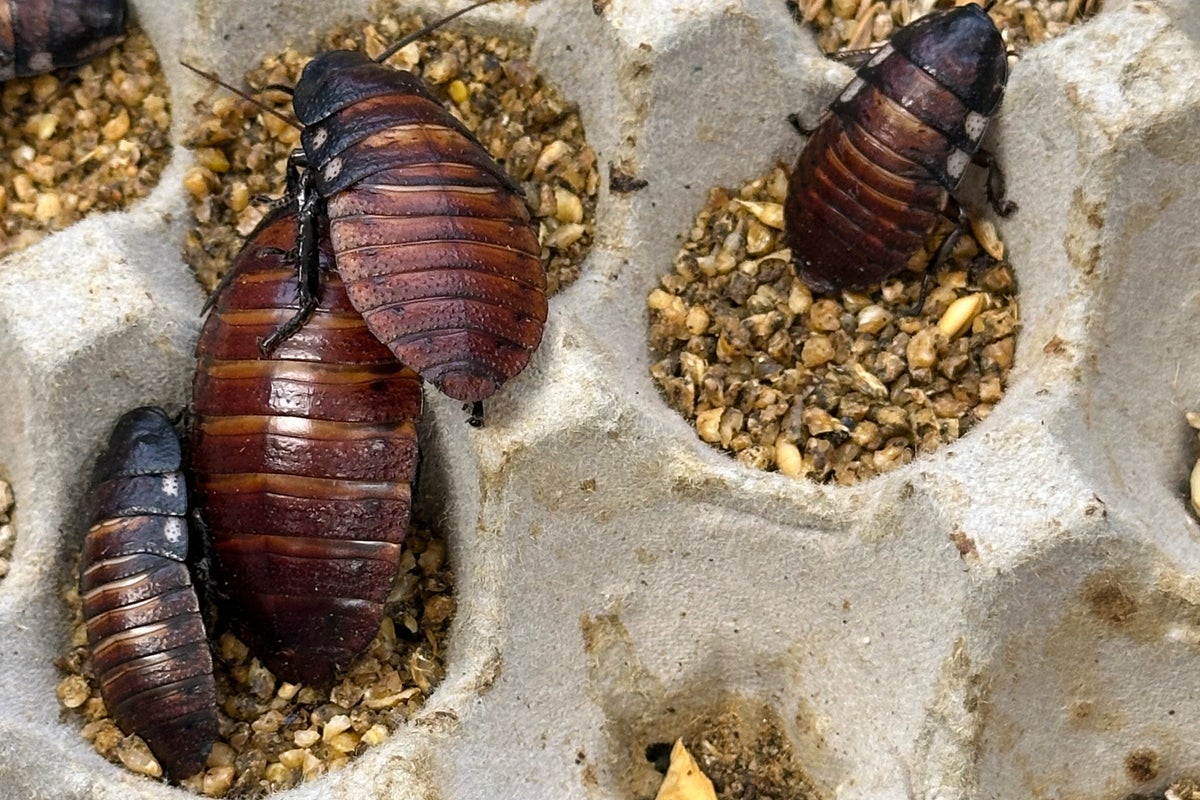
The human ear is remarkably bad at detecting a single insect. A solitary scratch inside a drywall panel is easily dismissed as the house settling, or the wind playing tricks against the siding. But when you multiply that scratch by one hundred thousand, the sound changes. It becomes a heavy, rhythmic hiss. It sounds exactly like a tide coming in over dry pebbles.
When the Australian Federal Police crossed the threshold of a nondescript suburban property in the quiet sprawl of New South Wales, that hiss was the first thing that hit them. It wasn't the heat, though the Australian summer sun was baking the corrugated iron roof. It wasn't even the smell, which carried the sharp, ammonia tang of a million tiny lives confined to plastic bins. It was the collective friction of four hundred thousand legs scraping against polypropylene.
This was the largest live insect seizure in the history of Australian law enforcement. The final count stopped just north of 100,000 live cockroaches.
To the average citizen reading the morning headlines, the news was a localized freak show, a bizarre blip in the police blotter to be laughed at over morning coffee before being forgotten. But to the biosecurity officers who stood shoulder-to-shoulder with the police officers that morning, the discovery was a terrifying glimpse into a shadow economy that thrives precisely because it makes our skin crawl.
The Economics of a Nightmare
We are conditioned to think of smuggling in cinematic terms. We expect bricks of white powder hidden in false bottoms of shipping containers, or rare, exotic birds sedated and stuffed into PVC pipes. Nobody prepares for the reality of mass-market entomology.
Consider the mathematics of the modern exotic pet trade. Across Australia and the globe, a quiet subculture has exploded. Reptile hobbyists, tarantula breeders, and keepers of rare amphibians all require one fundamental resource to keep their prized possessions alive: high-quality, high-protein live feed. The common German or American cockroach that infests urban kitchens is useless here; they are vectors for disease and lack the nutritional density required by a prize-winning bearded dragon.
Instead, the market demands specific, specialized species. Some breed slowly. Others require precise tropical humidity to survive. When local supply chains cannot meet the demands of a booming pet industry, the black market fills the void.
A single specialized breeding colony can fetch thousands of dollars on underground forums and encrypted messaging apps. When you scale that up to 100,000 specimens, you are no longer looking at a weird hobbyist who let things get out of hand. You are looking at a highly lucrative, unregulated commercial enterprise operating entirely in the dark.
The suspect at the center of the New South Wales raid—let us call him Julian, a composite of the insular, hyper-focused individuals who populate this hidden industry—did not view his cargo as a plague. To Julian, the rows of stacked, ventilated blue tubs were a living bank account. Every twitching antenna was a fraction of a cent; every successful hatch was pure profit. He had optimized his life around the care and keeping of a horde that most people would burn their houses down to avoid.
The Invisible Threat to the Bush
The real danger of Julian’s operation was not that his livestock would escape into the neighboring kitchens, though the local residents would surely have rioted had they known what was breathing behind those brick walls. The true threat was ecological sabotage.
Australia is an island continent defined by its isolation. Its ecosystems are fragile clocks, finely tuned over millions of years of evolutionary solitude. When an invasive species enters this ecosystem, it doesn't just find a niche. It acts like a sledgehammer.
Imagine a scenario where a non-native, highly aggressive insect species breaks containment in rural Australia. Unlike the native wood cockroach, which plays a vital role in breaking down leaf litter and recycling nutrients back into the ancient, nutrient-poor Australian soil, an introduced species has no natural predators. It consumes everything. It outcompetes the local fauna for resources. Within three seasons, the local lizard populations begin to starve because their traditional food source has been wiped out. The birds that feed on the lizards disappear next.
The dominoes fall quickly.
"Biosecurity isn't about protecting us from bugs," a senior environmental officer remarked under the condition of anonymity during the aftermath of the bust. "It's about protecting the entire landscape from collapsing under the weight of human greed."
The sheer logistics of the bust required an unprecedented level of cooperation between traditional law enforcement and agricultural scientists. Police officers accustomed to handling domestic disputes or drug raids found themselves wearing heavy-duty hazmat suits, carefully sealing the lids of specialized breeding containers to ensure not a single pregnant female could slip into the dry grass outside.
The Psychological Drift
How does someone end up living with 100,000 cockroaches? It is a question that requires us to look past our instinctual revulsion and examine the strange ways human obsession can warp reality.
Nobody wakes up one morning and decides to become a cartel boss for vermin. It starts with a single terrarium. It starts with the fascination of watching a lifecycle unfold in a glass box on a desk. You buy a few pairs to breed your own feed and save a few dollars at the local pet store.
Then, you realize you're good at it.
You learn the exact balance of protein density in the feed to maximize egg production. You discover how to manipulate ambient temperature to trick the insects into a perpetual state of spring breeding. The boxes multiply. The spare bedroom becomes the insect room. The garage is surrendered next.
Suddenly, the human world outside begins to recede. The constant, low-level hiss of the tubs becomes a comfort rather than a horror. You begin to see the beauty in the iridescent sheen of a carapace, the ruthless efficiency of their survival mechanisms. You stop seeing them as pests and start seeing them as a masterpiece of biological engineering.
But the law does not care about biological fascination. The Australian Quarantine Act is clear, rigid, and unforgiving. The introduction or mass cultivation of unregulated biological material carries penalties that rival major narcotics trafficking.
The Clean Room
The final act of the largest insect bust in Australian history did not take place in a dramatic courtroom showdown or a high-speed car chase. It took place in the sterile, white-tiled laboratory of a government biosecurity facility.
The 100,000 cockroaches could not be released. They could not be sold. They could not even be donated to zoos or research institutions due to the unknown pathogens they might have been carrying from their unregulated breeding conditions.
They had to be destroyed.
The process was methodical, quiet, and grim. Large industrial freezers were wheeled in to receive the tubs. At sub-zero temperatures, the frantic, collective hiss of the colony began to slow. The movement became sluggish. The legs stopped scraping against the plastic. One by one, the hundred thousand secrets stopped moving.
When the last tub was emptied into the incinerator, the silence in the room was absolute.
We live our lives under the assumption that the world is entirely under our control, that our cities and suburbs have successfully pushed the wild chaos of nature out past the perimeter fence. But every so often, the curtain is pulled back. We are reminded that just a few miles down the road, in a ordinary house with a manicured lawn and a sedan parked in the driveway, someone might be sitting in the dark, listening to the tide come in.