The leather of the wingback chair is cracked, worn smooth by decades of quiet friction. In the corner of the study, a grandfather clock ticks with a heavy, predictable rhythm. To George, a retired high school history teacher who has spent forty years explaining the mechanics of the American republic to distracted teenagers, that clock used to sound like the Constitution itself. Steady. Self-correcting. Relentless.
Lately, though, the ticking just sounds hollow.
George represents a specific, vanishing breed of American. He believes in things that cannot be seen or touched. He believes in institutional gravity. He believes that the architecture of a nation relies entirely on unwritten rules, the unspoken agreements between the powerful and the powerless that keep the whole magnificent machine from flying apart.
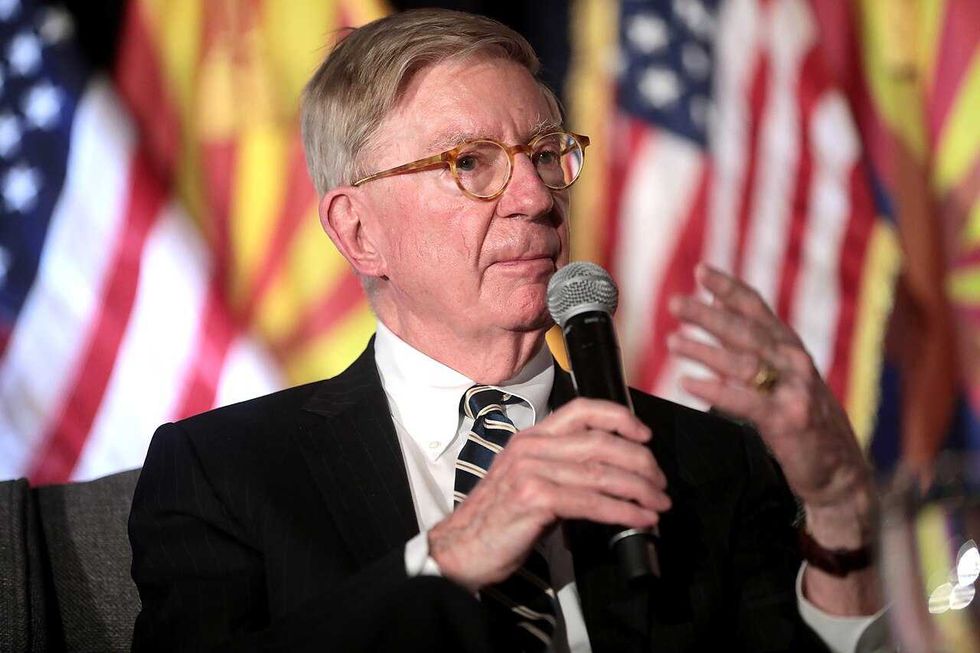
When a nation begins to fracture, it does not happen all at once with a cataclysmic blast. It happens in the quiet spaces. It happens when the words we use to describe our shared reality begin to lose their meaning. This is what the veteran commentator George Will captured when he looked at the political horizon and issued a warning that felt less like a standard political op-ed and more like a eulogy: the American apparatus is displaying the classic, structural vulnerabilities of a failed state, and the re-entry of Donald Trump into the highest office threatens to accelerate the rot.
To understand what Will means, we have to look past the loud, tribal warfare of cable news. We have to look at how a state actually fails.
The Illusion of Strong Walls
Imagine a bridge. To the casual driver, the bridge is solid because its concrete pillars are thick and its steel cables are taut. But an engineer knows the truth. The bridge stands because of things you cannot see from the driver's seat: the microscopic tension balances, the soil compaction beneath the riverbed, and the assumption that every bolt was forged to a precise, uncompromised standard.
A failed state is not defined by a lack of buildings, weapons, or wealth. It is defined by the sudden, catastrophic evaporation of trust in those invisible standards.
Consider a hypothetical citizen—let us call her Elena. She lives in a city where the traffic lights still turn green, the police cars still patrol the streets, and the banks still open at nine o'clock every morning. On the surface, the state is functioning perfectly. But Elena knows that if she gets into a car accident with the mayor’s nephew, the police report will be altered. She knows that if she wants her business permit approved before the winter freeze, a small envelope of cash must find its way into the desk drawer of a mid-level clerk.
Elena lives in a failed state. The outer shell is intact, but the core has been hollowed out by cynicism. Power is no longer a temporary lease granted by the public; it is a shield used to protect the tribe and punish the outsider.
The terrifying insight of modern political analysis is that America is mimicking this exact trajectory. The crisis is not that our economy is weak or that our military is fragile. The crisis is that we are losing the ability to trust the referee. When the executive branch treats the Department of Justice not as an independent guardian of the law, but as a private law firm hired to settle personal grievances, the concrete of the pillar begins to turn to dust.
The Weight of the Gavel
For generations, the true genius of the American experiment was the peaceful transfer of power. It was an act of profound, radical humility. A leader, possessing the keys to the most formidable military apparatus in human history, would look at an unfavorable tally of paper ballots, pack their bags, and walk away.
That act required a shared belief in a story. The story said that the office belongs to the people, and the person occupying it is merely a temporary custodian.
But stories are fragile. They can be broken by repetition.
When the narrative shifts from "I lost a hard-fought contest" to "The system is fundamentally rigged against us," the entire psychological foundation of the republic shifts with it. The danger of a second Trump term, through the lens of institutional conservatism, is not necessarily the specific policies or the executive orders. It is the normalization of suspicion. It is the psychological conditioning of millions of citizens to believe that any institutional outcome they dislike must inherently be the product of a conspiracy.
Think about what happens to a society when that belief becomes default.
If the courts are always corrupt when they rule against you, if the elections are always stolen when your candidate loses, and if the free press is inherently the enemy of the people, then there are no referees left on the field. There is only raw, unmitigated power. The political arena stops being a place of debate and becomes a Roman colosseum.
The Quiet Cost
George sits at his desk, looking at a textbook from 1994. The pages describe the checks and balances, the three branches of government acting like a tripod, each leg leaning against the others to find a perfect, stable equilibrium. He wonders how he would teach that lesson today without his voice cracking.
The real tragedy of our current political moment is the exhaustion. Normal, everyday people—the ones who do not post political rants on social media, the ones who just want to raise their kids, pay their mortgages, and live a quiet life—are simply tuning out. They are experiencing a profound, bone-deep fatigue born from a decade of non-stop existential crisis.
This withdrawal is exactly how failed states solidify their grip.
When the decent, moderate majority decides that the public square is too toxic to enter, they leave the keys to the extremists. The space where compromise used to happen is replaced by a vacuum, and nature abhors a vacuum. It is filled instead by anger, by vengeance, and by the transactional politics of the mob.
We are learning, in real time, that the institutions we thought were made of granite are actually made of glass. They require constant, careful handling. They require leaders who are willing to sublimate their own egos to the majesty of the office they hold. Without that reverence, the presidency becomes just another weapon in a cultural civil war, a tool to reward friends and destroy enemies.
The grandfather clock in the study continues to tick. The sound is still there, but the air feels heavier now. The question hanging over the nation is not whether we can survive another policy debate or another legislative battle. The question is whether we can survive the slow, steady poisoning of the well from which we all must drink.
The true test of a civilization is not how it behaves when it is winning. It is how it handles the loss. If we lose the capacity to accept defeat with grace, we lose the very thing that separates a republic from a kingdom. And once that boundary is crossed, the road back is long, dark, and entirely uncharted.