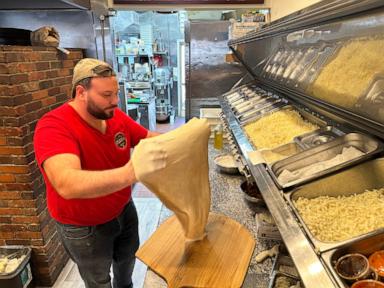
Walk into any neighborhood joint in Brooklyn or Queens at seven in the morning. The air is thick with the scent of toasted malt, charred flour, and boiling water. You hear the rhythmic thwap of dough hitting a wooden peel. You feel the sudden blast of dry, searing heat when the oven door swings open.
This is the sensory DNA of New York City. For generations, the baseline of a New Yorker's diet has been forged in these ovens. A perfect bagel—blistered on the outside, dense and chewy within. A slice of pizza so structurally sound you can fold it lengthwise without the crust snapping or turning to mush. We treat these foods as cultural sacraments. We boast that it is the local tap world-class water that makes them impossible to replicate anywhere else. Building on this idea, you can also read: The Mirror's Ledger and the Science of Starting Over.
But there is a quieter, less romantic ingredient hiding in the flour.
State lawmakers are currently pushing a piece of legislation that could fundamentally alter the chemistry of the city’s iconic doughs. The bill targets a series of common food additives, most notably potassium bromate and azodicarbonamide. To food scientists, they are oxidizing agents and dough conditioners. To bakers, they are the invisible workhorses that ensure a loaf of bread rises uniformly, stays soft on the shelf, and tolerates the brutal mechanical stretching of commercial kitchens. Analysts at Cosmopolitan have shared their thoughts on this situation.
To health advocates, they are a ticking clock.
The looming ban has sparked a quiet panic among traditional bakers, mid-sized distributors, and pizza parlor owners who wonder if the classic New York bite can survive a forced chemical makeover. Yet, beneath the anxiety lies a deeper, darker realization: the shortcuts we took to make our daily bread cheaper and more resilient might be costing us our health.
The Invisible Engine of the Perfect Rise
To understand why a chemical ban threatens the local bakery, you have to understand what happens inside a mass of dough.
Flour is alive with proteins, specifically gliadin and glutenin. When water meets flour and human hands begin to knead, these proteins bond to form gluten. Think of gluten as a microscopic web of tiny rubber bands. As yeast consumes sugars, it releases carbon dioxide gas. The gluten web traps these gas bubbles, allowing the dough to inflate like millions of microscopic balloons.
In an ideal world, developing a strong, elastic gluten network takes time. It requires hours, sometimes days, of slow fermentation in a cold room.
But modern commerce does not like to wait.
Decades ago, industrial baking discovered a shortcut in potassium bromate. It is an oxidizing agent. When mixed into flour, it accelerates the strengthening of the gluten network. It makes the rubber bands tougher, more flexible, and capable of holding massive amounts of gas.
The result is a dough that rises higher, yields a lighter crumb, and maintains an aggressive crispiness in the oven. It allows a bakery to churn out thousands of bagels a day without waiting for the slow, agonizing magic of traditional fermentation. Potassium bromate turns a temperamental art form into a predictable, high-speed assembly line.
Azodicarbonamide, often referred to as ADA, performs a similar trick. It bleaches the flour to a pristine white and improves dough elasticity. If you have ever eaten a fast-food bun that felt unnervingly pillowy and perfectly symmetrical, you have experienced the work of ADA.
For half a century, these compounds have been the silent partners in the American baking industry. They are cheap. They are highly effective. And they are completely invisible to the average consumer who just wants a quick slice on their lunch break.
The Price of Speed
The problem is that these chemicals do not always disappear when the oven timer dings.
In theory, the intense heat of a commercial baking oven is supposed to completely convert potassium bromate into potassium bromide—a harmless byproduct. When the oven temperature is calibrated perfectly, and the baking time is long enough, the chemical reaction runs to completion. Nothing dangerous remains.
But theory rarely survives the chaos of a Friday night rush in a crowded pizzeria.
If the oven temperature drops slightly, or if a baker pulls a pie sixty seconds early to satisfy an impatient line of customers, the chemical reaction stalls. Residual potassium bromate stays behind in the crust.
The International Agency for Research on Cancer classifies potassium bromate as a possible human carcinogen. Laboratory studies have consistently shown that when rats ingest the chemical, it triggers tumors in the kidneys and thyroid. It damages DNA. It disrupts cellular structures. Because of these findings, the additive has been banned in the European Union, the United Kingdom, Canada, Brazil, and even China for years.
American consumers, however, have continued to eat it.
The Food and Drug Administration approved potassium bromate long before the modern framework for evaluating food safety existed. Under a decades-old grandfather clause, it remained on the market, safe from aggressive regulatory scrutiny, while the rest of the developed world phased it out.
Consider what happens next when a state like New York decides to break away from federal stagnation. The proposed ban forces a confrontation between the efficiency of industrial food production and the raw reality of public health. It asks a painful question: how much risk are we willing to swallow for the sake of convenience?
The Chaos of the Clean Label
For a small bakery operating on razor-thin margins, the elimination of these additives feels less like a health triumph and more like an existential threat.
Imagine a multi-generational bakery in the Bronx. They buy their flour by the literal ton. Their recipes have been passed down through three owners, calibrated to the exact behavior of commercial bromated flour. If you suddenly strip that stabilizer out of their supply chain, the dough changes. It becomes stickier. It tears more easily under the heavy hands of the night-shift bakers. The bagels don't hold their plump, rounded shape when dropped into the boiling water bath; they flatten out, looking deflated and unappealing on the display shelves.
To compensate, bakers cannot simply cross out an ingredient. They have to reinvent their entire workflow.
They must invest in alternative enzymes, like ascorbic acid (vitamin C), which can help strengthen dough but lacks the sheer, forgiving horsepower of potassium bromate. They must extend their fermentation times, which means buying more refrigeration space, which means paying higher electricity bills in a city where commercial real estate is priced by the square inch.
The cost of compliance will inevitably trickle down to the paper bag handed across the counter. The three-dollar bagel or the four-dollar slice of cheese pizza—already inflated by supply chain disruptions—could climb even higher.
This is the hidden friction of regulatory progress. The people who advocate for the ban are completely right about the science of human health. The bakers who fear the ban are completely right about the economics of survival. Both truths exist simultaneously, grinding against one another in the tight quarters of the neighborhood kitchen.
A Return to the Slow Craft
Yet, the anxiety surrounding the ban overlooks a profound historical irony.
Before the advent of industrial chemical additives, New York city already made the best bagels and pizza crusts in the world. The legendary texture that defined the city’s culinary reputation was built entirely on time, water, and skill.
True artisan bakers view the potential ban not as a crisis, but as a long-overdue correction.
When you rely on chemical dough conditioners, you are using a synthetic crutch to bypass the natural development of flavor. A dough that sits in a cold cellar for twenty-four hours develops complex organic acids. These acids naturally relax the gluten, making it extensible, while simultaneously generating deep, nutty, yeast-forward flavors that no chemical additive can replicate. The slow process creates a crust that is naturally crisp, deeply blistered, and remarkably easy on the human digestive tract.
The chemical shortcuts did not create the classic New York bite. They merely allowed us to mimic it at a massive scale, using cheaper flour and faster turnaround times.
The transition away from bromated flour will undoubtedly cause friction. Supply chains will stall. Flour millers will have to re-engineer their commercial blends for the New York market. Some legacy recipes will have to be abandoned and rewritten from scratch through weeks of trial and error.
But the shift also offers a strange kind of catharsis. It forces an industry that has spent decades racing toward hyper-efficiency to stop, look backward, and remember how the craft worked before the lab coats took over the kitchen.
The Taste of the Future
Change is rarely comfortable, especially in a city that worships its own culinary myths. We like our institutions untouched. We want the pizza place we frequented as children to taste exactly the same when we take our own kids there twenty years later.
But culture is not static, and neither is the food that sustains it.
The coming months will decide the fate of the state's flour supply. If the legislation passes, the white clouds of dust settling over New York’s mixing bowls will look identical to the flour used for the last fifty years. The ovens will still glow orange in the pre-dawn dark. The peels will still slide across the stone decks.
The texture might shift, ever so slightly. A crust might require a fraction more chew. A bagel might lose a millimeter of its unnatural loft.
But as the morning sun hits the pavement, and the lines begin to form outside the screen doors of a thousand tiny shops, the city will keep eating. Only this time, the smoke rising from the brick ovens will carry away the last remnants of a chemical compromise we never should have made in the first place.