The rain over Genoa on the morning of August 14, 2018, was relentless. It was the eve of Ferragosto, the major summer holiday when Italy collectively pauses, packs its bags, and heads for the sea. Families were squeezed into hatchbacks piled high with beach umbrellas, suitcases, and inflatable rafts. They were singing along to the radio, thinking of the Mediterranean, arguing gently about navigation, or simply watching the windshield wipers struggle against the downpour.
Below them, the city hummed with its usual industrial grit. Above them loomed the Morandi Bridge. You might also find this related article insightful: The Real Strategy Behind India's Massive Grid Alignment with Nepal.
For decades, this massive concrete structure was more than just a bypass. It was a monument to postwar Italian ingenuity, a towering ribbon of prestressed concrete designed by the celebrated engineer Riccardo Morandi. It spanned a mile across the Polcevera river bed, suspended over railway tracks, factories, and apartment buildings. It was a physical manifestation of progress.
Then, at 11:36 AM, the sky fell. As highlighted in latest articles by Associated Press, the results are widespread.
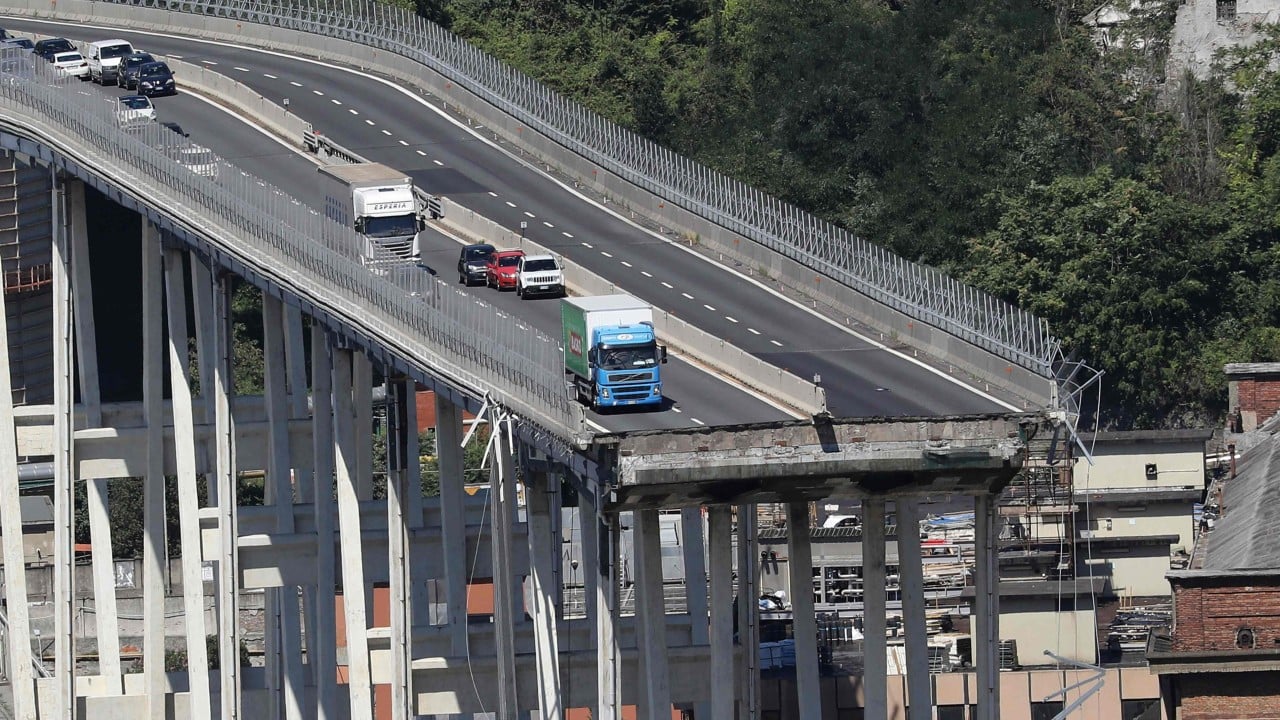
A section of the bridge, measuring over two hundred meters, suddenly gave way. It did not just crumble; it dissolved. Tons of steel and concrete plummeted into the gray void below, dragging dozens of cars and three heavy trucks down into a ruin of twisted metal.
Forty-three people died.
The Anatomy of a Warning
To understand how a bridge falls, you have to understand how it lives. Concrete seems eternal, but it is actually a slow-moving liquid frozen in time, constantly battling gravity, weather, and the salt-laden wind blowing off the Ligurian Sea. Morandi’s design was unique, relying on concrete-sheathed stay cables. The concrete was supposed to protect the inner steel tendons from rust.
It did the opposite.
Behind the smooth, gray facades, moisture trapped inside the concrete sleeves began to eat away at the steel. For years, the bridge was crying out for help. It was a slow, invisible decay, hidden from the eyes of the families driving across it every day, but glaringly obvious to those whose job it was to look.
In the corporate offices of Autostrade per l'Italia (Aspi), the company responsible for maintaining the nation’s highways, the bridge was not just a public utility. It was a line item.
Consider the math of corporate survival. Every euro spent on reinforcing a crumbling pier or injecting protective grout into a corroding cable is a euro that cannot be distributed to shareholders. When maintenance is viewed strictly as an expense rather than a moral obligation, risk assessment undergoes a subtle, toxic mutation. The danger is no longer the collapse itself; the danger becomes the cost of prevention.
For years, internal reports flagged structural anomalies. Experts warned of the risk of corrosion. Yet, the work was delayed, scaled back, or simply kicked down the road. It was a classic gamble against probability. Bridges do not just fall down, the logic went. Until they do.
The Man in the High Office
In the center of this systemic failure stood Giovanni Castellucci.
As the chief executive of Autostrade per l'Italia, Castellucci was one of Italy’s most powerful corporate figures. He was a man accustomed to sleek boardrooms, high-stakes negotiations, and the clean, bloodless language of executive summaries. Under his leadership, the highway operator was a highly profitable machine.
But a corporation is not an abstract entity. It is a collection of human decisions.
During the massive, multi-year trial that followed the disaster, prosecutors painstakingly painted a picture of a corporate culture that systematically prioritized profit margins over public safety. They presented evidence of falsified safety reports, ignored warnings, and a calculated effort to minimize maintenance budgets.
The defense argued that the collapse was an unpredictable, catastrophic event—a force majeure triggered by extraordinary weather and hidden structural defects that no one could have reasonably foreseen. They tried to frame Castellucci as a distant executive, insulated from the day-to-day engineering decisions.
The court did not agree.
When the verdict was handed down in Genoa, the courtroom was silent. Castellucci was sentenced to twelve years in prison. Several of his former colleagues and executives received lesser sentences, while others were acquitted. For the families of the victims, the sentences offered a grim, incomplete form of justice.
No number of years in a cell can patch the hole left in a family.
The Weight of the Aftermath
To truly comprehend the human cost of this negligence, we must look away from the courtrooms and the corporate offices. We must look at the mud.
In the days following the collapse, rescue workers climbed through a mountain of wet, jagged concrete. They worked in silence, listening for voices, but finding mostly quiet. They found a family of three, their car crushed flat. They found a young couple on their way to a holiday in Nice. They found truck drivers who were just trying to finish their shifts before the holiday.
For the survivors, the trauma did not end when the dust settled. The neighborhood surrounding the bridge was evacuated, its residents displaced, their lives severed. A scar was sliced directly through the heart of Genoa.
The Morandi Bridge has since been demolished and replaced by a sleek, white structure designed by the famed Genoese architect Renzo Piano. The new bridge, named Genova San Giorgio, is beautiful. It is equipped with robots that constantly slide along its underbelly, scanning for the tiniest hint of wear. It is bathed in light, carrying forty-three tall sails—one for each of the lives lost.
But the new bridge is also a monument to what should have been.
The Illusion of Safety
We live in an era of invisible infrastructure. We trust the water flowing from our taps, the planes flying overhead, and the bridges beneath our tires without a second thought. We have to. Modern civilization is built on a foundation of blind trust in experts, regulatory bodies, and corporate stewards.
The Genoa trial was not just about punishing a single executive or a group of negligent managers. It was a trial about the breaking of that fundamental social contract.
When we drive across a bridge, we are placing our lives in the hands of people we will never meet. We assume that the engineers who built it, the inspectors who check it, and the executives who manage it value our lives more than their bottom line. When that assumption is proven wrong, the entire structure of society begins to feel fragile.
Twelve years in prison is a long time for an aging executive. But it is a fraction of the lifetimes stolen on that rainy August morning.
The true tragedy of the Morandi Bridge is that it was not an act of God. It was not a sudden, freak accident. It was a slow, deliberate accumulation of small compromises, deferred maintenance, and closed eyes. It was a disaster written in ink on corporate ledgers long before it was written in blood on the pavement of Genoa.
As the new San Giorgio bridge stands resilient against the Ligurian winds, it serves as a silent, soaring reminder of the heavy, undeniable weight of responsibility. Some cracks can never be mended.