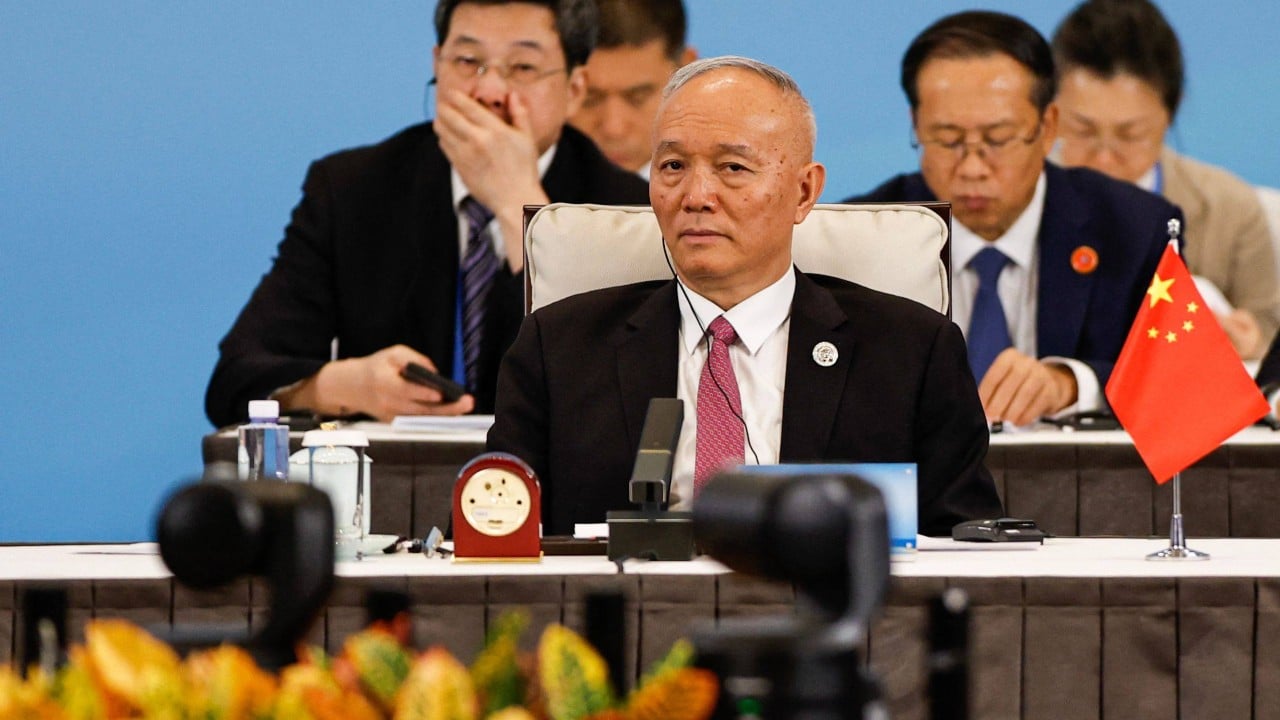
The appointment of Cai Qi as the president of the Central Party School breaks with recent institutional precedents to establish a concentrated matrix of administrative, doctrinal, and organizational authority under a single official. Cai—already a member of the seven-man Politburo Standing Committee, first-ranked member of the Secretariat, and Director of the General Office—now commands the premier apparatus for cadre training and ideological production. This consolidation reduces the internal friction inherent in multi-actor governance systems, effectively creating an unmediated transmission belt between the General Secretary and the execution arms of the Chinese Communist Party (CCP).
To evaluate the strategic weight of this structural shift, the appointment must be analyzed through three operational dimensions: the collapse of institutional separation of powers, the mechanisms of cadre optimization ahead of the 15th Five-Year Plan, and the maximization of political alignment across the party bureaucracy.
The Structural Overlap Matrix
The architecture of the CCP historically relies on a functional division of labor among top leaders to prevent operational bottlenecks and maintain internal checks. By layering the presidency of the Central Party School onto Cai’s existing offices, the leadership has engineered an unprecedented concentration of functional portfolios.
[General Secretary / National Security Commission]
                        │
                        ▼
                  [Cai Qi Portfolio]
     ┌──────────────────┼──────────────────┐
     ▼                  ▼                  ▼
[General Office]   [Secretariat]   [Central Party School]
(Administrative    (Personnel &    (Ideological & Cadre
  Gatekeeping)      Execution)         Indoctrination)
The systemic implications of this overlap emerge across three specific pillars:
- The Administrative Gate: The General Office. As Director of the General Office, Cai functions as the de facto chief of staff to the General Secretary. This role commands document flows, security protocols, agendas, and direct access to the core leadership.
- The Execution Engine: The Secretariat. As the first-ranked member of the Secretariat, Cai oversees the day-to-day implementation of Politburo directives and coordinates the sprawling party bureaucracy.
- The Doctrinal Factory: The Central Party School. By assuming the presidency of this institution, Cai takes direct control of the intellectual molding, ideological evaluation, and evaluation criteria of mid-to-senior-level cadres.
The historical baseline underscores the anomaly of this arrangement. Previously, the school's leadership was held by Chen Xi, who simultaneously led the Central Organization Department but sat outside the Politburo Standing Committee. Before Chen, the post was typically held by the high-ranking Secretariat member who did not concurrently manage the operational mechanics of the General Office.
The current configuration removes these bureaucratic handoffs. The official who dictates the daily schedule and paper flow of the top leader is now identical to the official who oversees the ideological vetting of the provincial officials competing for advancement.
The Cadre Optimization Function
The timing of this appointment coincides with the launch of China’s 15th Five-Year Plan (2026–2030). The execution of this macroeconomic and industrial policy depends on minimizing agency costs—the divergence of interest between the central leadership in Beijing and provincial or local implementers.
The Central Party School is not merely an academic venue; it functions as a highly sophisticated human capital filter. By placing Cai at the helm, the center enforces a strict production function for administrative advancement.
The institutional mechanics operate as an optimization algorithm:
$$Inputs \rightarrow \begin{cases} \text{Ideological Orthodoxy Vetting} \ \text{Policy Execution Competence} \end{cases} \rightarrow Output: \text{Strategic Alignment}$$
This mechanism guarantees that local economic strategies do not deviate from central mandates. In periods of economic transition or structural adjustment, local officials often face a trade-off between local fiscal stability and central regulatory compliance.
Controlling the Central Party School allows the center to recalibrate the incentives of these officials during their mandatory training rotations. Ideological alignment is transformed from an abstract requirement into a quantifiable metric for promotion, directly managed by the individual who handles the paperwork of the Politburo.
Strategic Constraints and Succession Realities
While this consolidation maximizes short-term execution capability, it introduces distinct structural vulnerabilities into the party architecture.
The first limitation is the human capital bottleneck. No matter how efficient an individual official’s staff may be, the simultaneous management of national security coordination, administrative gatekeeping, secretariat execution, and ideological training concentrates operational risk. If a single node in a command structure is overburdened, the velocity of decision-making can degrade under crisis conditions.
The second limitation relates to succession dynamics. Historically, the presidency of the Central Party School served as a grooming ground for future general secretaries; both Xi Jinping and Hu Jintao occupied this position prior to ascending to the top office. However, Cai’s demographic profile alters this trajectory. At 70 years old, his tenure represents an institutional holding pattern rather than a succession runway.
The appointment signals that the primary objective of the current leadership is the absolute fortification of the existing power structure rather than the immediate preparation of a next-generation successor. By placing a trusted, career-aligned loyalist at the head of the cadre training system, the center ensures that the selection and cultivation of future leaders remain tightly insulated from factional competition.
The structural play deployed here is defensive and consolidative. Rather than using the Central Party School to elevate a rising star, the leadership has used it to lock down the ideological apparatus, closing any remaining gaps between policy formulation, administrative gatekeeping, and bureaucratic socialization.