The morning does not break so much as it presses down.
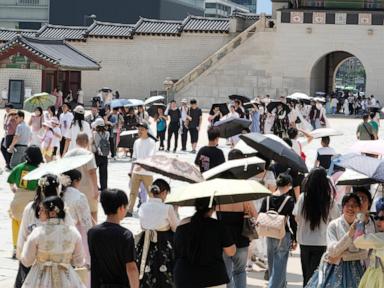
Before the sun clears the jagged skyline of Tokyo or the sprawling concrete veins of Seoul, the air already carries a weight that feels physical. It is July, and the urban heat island effect has stopped being an architectural footnote and started acting like an invisible furnace. Asphalt retains yesterday's fury. High-rise glass towers bounce the rising radiation back onto the streets below. Millions of people step outside their air-conditioned apartments and instantly gasp, feeling as though they have walked into a closed-door oven.
This is not a regular summer.
Across Japan and the Korean Peninsula, extreme weather events have shattered historical ceilings. Thermometers in inland valleys have routinely crested forty degrees Celsius, turning familiar neighborhoods into meteorological flashpoints. To read a dry weather report is to see cold numbers: 40.2 degrees in one prefecture, emergency hospitalizations numbering in the thousands across another, livestock stress alerts flashing red from rural cooperatives. But numbers do not sweat. Numbers do not faint on a crowded subway platform during rush hour.
Consider what happens next.
Imagine a hypothetical resident, Kenji, a seventy-two-year-old retired clerk living alone in a cramped third-floor walk-up in eastern Tokyo. The building faces west, capturing the brutal afternoon sun through single-pane glass. Kenji remembers summers from his childhood as warm, lazy stretches punctuated by the rhythmic chirping of cicadas and evening breezes off the water. Those summers are gone. They belong to a different climate era.
Today, Kenji's apartment is a heat trap. He turns on the electric fan, but it merely shuffles the thick, stifling air around the room like soup. He hesitates to run the air conditioner continuously. The monthly utility bills have crept upward, a terrifying fixed cost on a fixed pension. So he waits. He waits until his head throbs and his mouth turns dry. By the time a neighbor knocks on his door after noticing his mail uncollected, Kenji is disoriented, suffering from acute heatstroke.
He is not alone. Thousands of elderly citizens across East Asia face this agonizing daily calculus. To cool down is to risk financial strain. To stay hot is to risk organ failure.
The crisis extends far beyond human vulnerability. Step outside the city limits, driving past the suburban fringe into the agricultural heartlands of South Korea and the lush valleys of rural Japan, and the toll shifts from human bodies to the silent suffering of animals.
Dairy cows in Tochigi Prefecture stand listless in open-air barns, panting heavily, their milk production plummeting by up to thirty percent as metabolic stress takes over. Farmers install industrial misters and high-powered industrial fans, running them day and night. Water troughs must be replenished constantly with cool water, yet the water itself warms within minutes under the relentless glare. Pigs in confinement facilities suffer similarly; extreme heat triggers reproductive failure and respiratory distress, threatening regional food supply chains at their most foundational level.
Even the wildlife is changing its habits. Crows in Tokyo parks linger desperately around public fountains, soaking their wings, while mountain macaques retreat deep into shaded ravines, abandoning their usual foraging routes.
Why is this happening with such ferocious consistency?
The answer lies in a convergence of planetary disruptions. Persistent high-pressure systems have stalled over the western Pacific, acting like a lid on a boiling pot. Global baseline temperatures have risen, meaning that a heat wave today starts from a much higher floor than it did three decades ago. Furthermore, rapid urbanization has replaced cooling forests and agricultural wetlands with heat-absorbing concrete and steel.
We built our modern civilization for a climate that no longer exists.
Our cities are monuments to thermal retention. Every paved parking lot, every glass skyscraper, and every combustion engine radiates waste heat into an already overloaded atmosphere. When a massive high-pressure dome parks itself over the region, these artificial microclimates turn lethal.
Governments scramble to respond. Tokyo and Seoul have enacted emergency protocols, designating thousands of public facilities as cooling shelters—air-conditioned community centers and libraries where citizens can seek temporary refuge. Public service announcements blare across television networks and smartphone emergency alerts, urging people to hydrate continuously, avoid strenuous outdoor labor, and check on elderly neighbors.
Yet these measures are band-aids on a gaping wound.
A cooling shelter cannot save a farmer's collapsing harvest. An emergency text alert cannot lower the ambient temperature of a poorly insulated apartment building where vulnerable families live. The structural mismatch between our built environment and our changing reality grows wider with every passing season.
There is an eerie silence to severe heat waves. Unlike typhoons or earthquakes, which announce themselves with crashing waves, tearing winds, or violent shaking, extreme heat arrives quietly. It creeps into bedrooms, settles over nursing homes, and bakes the soil without breaking a single window. It is an assassin of attrition.
As the sun finally dips below the horizon in Seoul, casting an orange haze over the Han River, the relief is illusory. The concrete has absorbed too much energy to release it quickly. Nighttime temperatures refuse to drop below thirty degrees, offering no metabolic recovery for bodies strained by the day's abuse.
Tomorrow, the sun will rise again. The thermometers will climb. The cycle will repeat.
We are standing at a historic crossroads, forced to rethink how we build, how we cool, and how we protect the most vulnerable among us before the seasonal normal becomes permanently uninhabitable.
A lone stray cat rests flat against the shaded side of a stone wall, its sides heaving, waiting for a wind that refuses to blow.