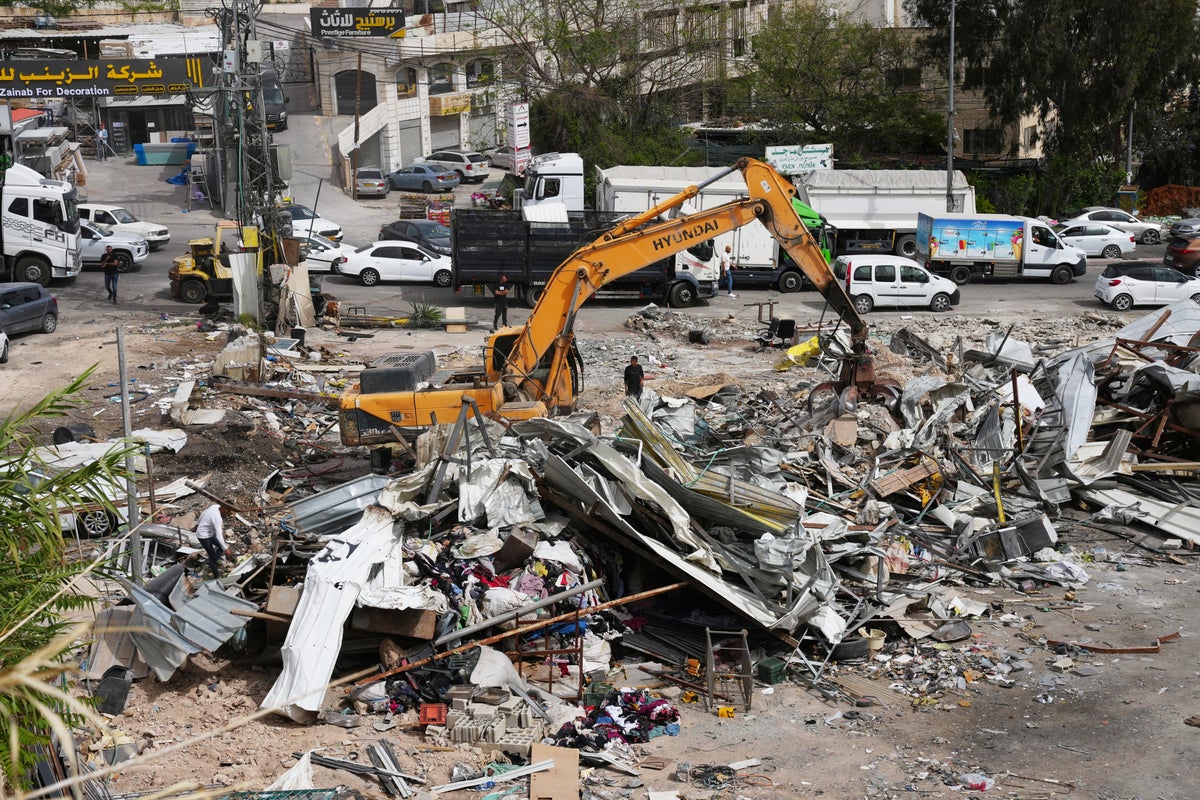
The metal doesn't go quietly. When a bulldozer’s teeth meet the corrugated steel of a storefront, the sound is a jagged, high-pitched scream that echoes off the gray cinderblock walls of the Shuafat refugee camp. It is a sound the shopkeepers in East Jerusalem have learned to recognize long before the machines actually arrive.
Abu Mohammed stands on the perimeter of the dust cloud, his hands deep in the pockets of a dusty charcoal jacket. For thirty years, his reality was measured in square meters of shelf space and the rhythmic chime of a bell above a door that no longer exists. He sold hardware—nails, hammers, lengths of PVC pipe. He sold the literal building blocks of a neighborhood that has spent decades trying to cement its own right to stay put.
By midday, his life’s work is a pile of twisted rebar and pulverized limestone.
This isn't just about a road. The official blueprints call it a "settlement-linked infrastructure project," a sterile phrase that suggests progress, transit, and efficiency. To the city planners, these dozens of shops were obstacles on a map, red lines that needed to be erased to facilitate the flow of traffic between Jerusalem and the expanding settlements of the West Bank. But maps are flat. They don't capture the smell of strong cardamom coffee that used to waft from the bakery next to Abu Mohammed’s store, or the way the school children used to huddle under his awning when the winter rains turned the streets into slick, muddy rivers.
The Geometry of Displacement
Under international law, the status of East Jerusalem remains one of the most contested hectares of dirt on the planet. Yet, on the ground, the contest is decided by heavy machinery and municipal permits. The Israeli authorities maintained that these structures—nearly thirty of them in this single sweep—were built without the necessary paperwork.
Imagine the bureaucracy of a dream. In East Jerusalem, obtaining a building permit is often described by residents as a mathematical impossibility. Statistics from various human rights organizations suggest that while the population grows, the percentage of permits granted to Palestinian residents remains a fraction of what is needed. When you cannot get a permit to build, but your family is growing and your children need shoes, you build anyway. You build on hope and the prayer that today won't be the day the yellow machines come.
The road project in question is designed to connect the Anatot settlement to Jerusalem’s main arteries. It is a bypass. In the most literal sense, it is designed to allow one group of people to move over, under, or around another group without ever having to look them in the eye.
The Invisible Stakes of a Storefront
A shop in a refugee camp is more than a place of commerce. It is an anchor. In Shuafat, where the unemployment rate hovers like a permanent storm cloud, a storefront represents the difference between self-sufficiency and total dependence on aid. When a shop is demolished, the economic ripple effect touches everyone from the wholesaler in Ramallah to the teenager who earned a few shekels delivering crates.
Consider the butcher who worked three doors down from Abu Mohammed. He didn't just sell meat. He held the credit for half the mothers on the block. He knew who was struggling and who could pay at the end of the month. When the walls fell, that ledger of communal trust vanished into the rubble.
The "illegal" label used by the municipality acts as a legal anesthetic. It numbs the public to the human cost. If something is illegal, its destruction is framed as a restoration of order. But in the narrow, overcrowded alleys of Shuafat, order is a luxury that few can afford. The camp was originally established in the 1960s to house refugees; it has since morphed into a dense urban pressure cooker, walled off from the rest of Jerusalem by the separation barrier.
The Weight of the Rubble
As the sun begins to dip behind the concrete wall, the workers move in to clear the largest chunks of debris. The residents are left to pick through the smaller remains. Abu Mohammed finds a singed ledger and a handful of brass hinges. They feel heavy in his palm, weighted with the gravity of a man who has suddenly lost his place in the world’s ledger.
The road will eventually be paved. It will be smooth, black, and efficient. Commuters will zip through the landscape at eighty kilometers per hour, their windows rolled up, their air conditioning humming, oblivious to the fact that they are driving over the ghosts of thirty small businesses. They won't see the hardware store. They won't smell the bakery. They won't know the name of the man who stood in the dust and watched his history be loaded into the back of a dump truck.
The silence that follows a demolition is the loudest part of the process. It is a thick, choking quiet that settles over the neighborhood once the engines are turned off. It is the sound of a community holding its breath, wondering which red line on the map will be erased next.
Abu Mohammed turns away from the ruins. He walks toward his home, his boots caked in the white powder of his own walls. He doesn't look back. There is nothing left to see but the horizon, and even that is being partitioned, one brick and one road at a time.