Concrete does not usually dream. It sits heavy, gray, and utility-driven, poured into foundations to hold up the predictable weight of offices and apartment blocks. Yet, standing on the edge of Hong Kong's northern frontier, you get the distinct sense that the earth itself is holding its breath.
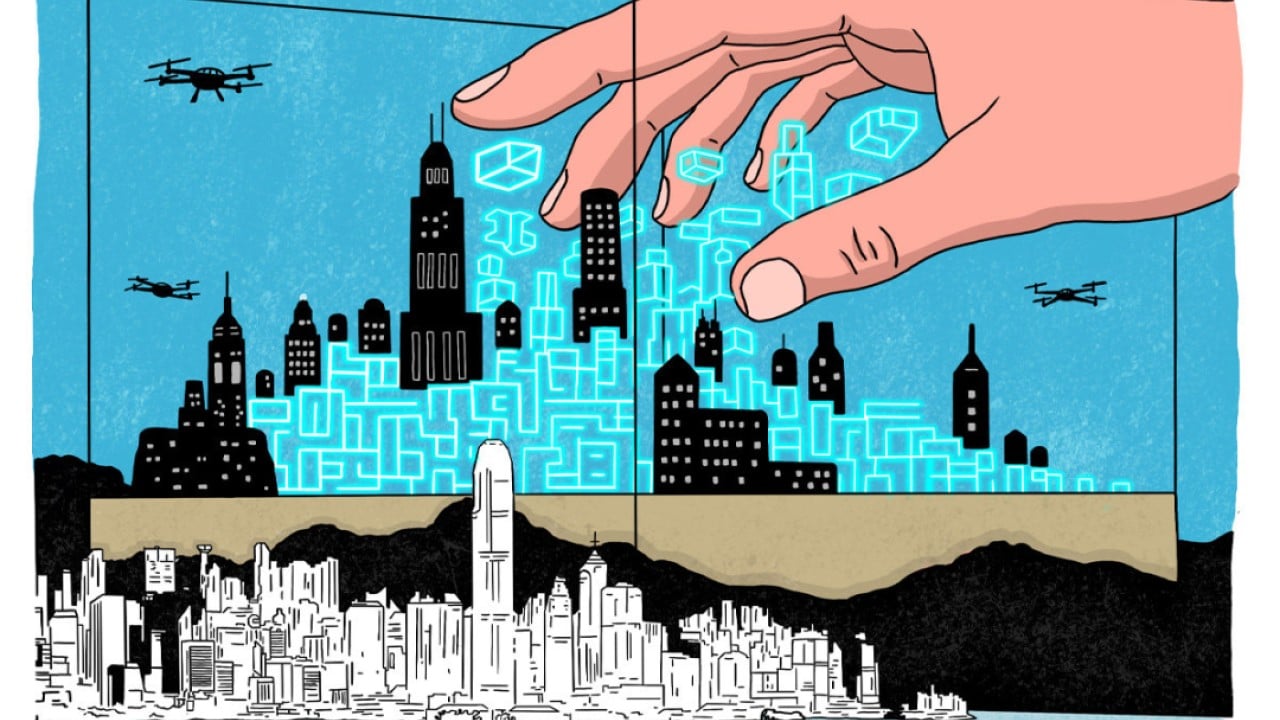
Dust rises from construction sites where hills are being carved away to make room for something entirely unprecedented. This is the Northern Metropolis. On paper, it is a massive infrastructure blueprint spanning nearly three hundred square kilometers, designed to house millions and bridge the physical and economic gap between Hong Kong and the booming tech heartlands of mainland China.
Numbers tell one version of the story. Billions of dollars. Decades of planning. Millions of square feet of commercial space.
People tell the real one.
Consider Mei, a thirty-two-year-old software architect who currently spends two hours every morning squeezing onto a packed commuter train, her laptop balanced precariously on her knees. Her life is partitioned by border checkpoints and transit schedules. To her, the Northern Metropolis is not a zoning map or a government white paper. It is the possibility of walking to work. It is the chance to live in a neighborhood where her apartment does not cost half her monthly income just for the privilege of proximity to the city center.
When we talk about urban planning, we tend to sanitize it. We use terms like spatial optimization and cross-border integration. We forget that cities are organic creatures built out of human desperation and human ambition.
What is happening in the north of Hong Kong right now shares a strange, pulsating DNA with what happened across the border in Shenzhen four decades ago. Shenzhen did not start as a glittering tech utopia filled with towering glass monoliths and billionaire founders. It started as a swampy fishing village handed a blank check by history. It was an experiment. A place where the rules were rewritten because the old ones simply did not work anymore.
The Northern Metropolis is attempting a similar psychological and structural pivot. For generations, Hong Kong's identity was defined by its verticality—building higher and higher on a shrinking island because there was nowhere else to go. The frontier was treated as a barrier, a hard stop at the edge of civilization.
Now, that barrier is being erased.
Innovation rarely happens in comfortable rooms with perfect lighting. It happens at the friction points. When different legal systems, different currencies, and different corporate cultures rub against each other, sparks fly. That friction is precisely what the planners are banking on. They want to create a living laboratory where a researcher in Hong Kong can test a prototype in a lab in Shenzhen before lunch, bridging the gap between world-class academic research and ferocious, lightning-fast manufacturing capability.
Walk through the designated innovation zones on a Tuesday afternoon, and you will feel the strange tension of the transition. Right now, it looks like chaos. Heavy machinery churns up red dirt. Temporary barriers block old country roads. Farmers whose families have worked these northern plots for generations watch the bulldozers reshape their ancestral horizons with expressions that mix resignation with cautious curiosity.
Change is rarely polite. It arrives with noise and dust.
Yet, look closer at the blueprint, and you notice an obsession with something other than mere concrete efficiency. There are plans for wetland conservation zones running parallel to high-density tech hubs. There is an acknowledgment that if you build a machine for humans to live in, you cannot sacrifice the very things that keep humans sane.
This is where the spirit of experimentation truly lives. Not just in the silicon chips or the biotech laboratories slated for the new industrial parks, but in the audacity of asking whether a hyper-dense metropolis can reinvent its own center of gravity.
For decades, the city's pulse beat strictly around Victoria Harbour. Every major financial institution, every cultural landmark, every vital artery pointed toward the water. The north was an afterthought, a quiet expanse of rural villages, brownfield sites, and border checkpoints.
Shift the center.
That is the hidden stroke of genius in the plan. By deliberately pulling the economic and residential focus northward, the city is forcing a re-evaluation of its own identity. It is declaring that the future will not be constrained by geography or historical habit.
Night falls quickly over the construction sites. The floodlights snap on, cutting sharp geometric beams through the haze. Cranes silhouette against the dark sky, moving with slow, deliberate grace, stacking tomorrow piece by heavy piece.
Down on the road, Mei catches the late bus home, staring out the window at the flashing lights of the frontier. She is tired from a long week, but as she watches the distant glow of the northern development zones, her expression shifts. She isn't just looking at construction. She is looking at her own future, being poured into the earth just waiting to set.