The morning air over the Detroit River smells faintly of scorched rubber, cheap diesel, and the stubborn humidity of a July that refuses to break.
Standing on the roof of a three-story brick warehouse in Southwest Detroit, you can hear the low, rhythmic thrum of the Ambassador Bridge. It is a steady, mechanical heartbeat that has dictated the rhythm of this border town for nearly a century. Trucks—tens of thousands of them every single day—crawl across that aging suspension span like ants carrying heavy crumbs. They idle in long, smoking lines that choke the residential streets below with exhaust, painting the porch railings of neighborhood homes with a fine, greasy film of soot.
Just a mile downriver, a different shape dominates the sky.
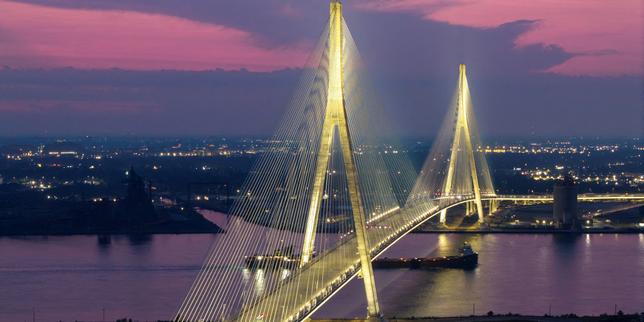
It is a monumental sweep of steel and pale concrete. Two massive towers lean gracefully toward each other, holding up the longest cable-stayed main span of any bridge in North America. It is the Gordie Howe International Bridge. It is finished, or agonizingly close to it, looking like a monument to human ambition dropped squarely into the industrial basin of the Midwest.
And yet, nothing moves across it.
The gates are shut. The toll plazas sit empty, their pristine white lane markers gleaming under the merciless sun like teeth in a skull. The bridge is a ghost before it has even lived.
To understand why this billion-dollar marvel remains trapped behind chain-link fences and armed guards, you have to look past the gleaming engineering diagrams. You have to look at the invisible lines drawn on maps, the ancient rivalries of corporate boardrooms, and the way international borders have transformed from simple checkpoints into friction points for a nervous global economy.
The Weight of a Single Steel Cable
Bridges are supposed to connect people. That is their entire reason for existing. They are physical declarations that separation is an error easily corrected by gravity, tension, and a few thousand tons of rebar.
Yet the Gordie Howe Bridge was born out of bitter division.
For decades, the Ambassador Bridge held a lucrative monopoly on the commercial crossing between Detroit and Windsor. Owned by the billionaire Moroun family, that older bridge was a cash cow funneling a massive share of the trade between the United States and Canada. Every car part, every crate of fresh produce, every chassis loaded with raw steel heading from Ontario factories to American assembly lines had to pay a toll to cross private property suspended over international waters.
Monopolies do not go gently into the night.
When governments finally decided enough was enough—when the delays, the crumbling infrastructure, and the sheer vulnerability of relying on a single, privately controlled bottleneck became a national security risk for both countries—they proposed a radical solution. Build a publicly owned rival. Name it after Gordie Howe, the legendary hockey player who traded a fierce, bruising physicality on the ice for a quiet, enduring grace.
It took years of legal trench warfare just to break ground. The owners of the old bridge fought back with lawsuits, ballot initiatives, and multimillion-dollar public relations campaigns. They argued the new bridge was unnecessary. They argued it would ruin neighborhoods. They spent fortunes trying to keep the concrete from ever being poured.
And yet, the towers rose anyway. Piece by massive piece, workers bolted the sky together. By all accounts of physics and structural engineering, the bridge works.
So why are the trucks still sitting in traffic on the old span?
The Irony of the Open Market
Commerce loves a border until the border becomes a weapon.
We live in an era where politicians love to talk about supply chain resilience. They stand behind polished podiums and promise to bring manufacturing home, to secure our borders, to insulate our economies from foreign shocks. But the reality on the ground is messier.
(Note: The following scenario illustrates the administrative gridlock currently plaguing cross-border projects through a composite narrative of logistics operators.)
Imagine Sarah, a logistics coordinator for an automotive supplier just outside Windsor. Every morning at four o'clock, her phone buzzes with updates from drivers stuck in the customs queue. A single missing stamp on a manifest can turn a twenty-minute border crossing into a four-hour ordeal.
Sarah does not care about geopolitics. She cares about a just-in-time delivery schedule where a thirty-minute delay at an assembly plant in Ohio can shut down a multi-million-dollar production line.
She looked at the Gordie Howe Bridge with hope. She thought it would double her capacity, slice her transit times in half, and clear the air over the neighborhoods flanking the river.
Instead, she watches the calendar flip through months of administrative limbo.
The delay is no longer about pouring concrete. The structural work is largely done. The delay is a dizzying bureaucratic maze of customs integration, staffing agreements between federal agencies in Washington and Ottawa, security clearance protocols, and legal wrangling over approach roads and local property rights.
It turns out that building a bridge across a river is easy compared to synchronizing two sovereign nations' administrative machinery.
Trade tensions between the United States and Canada have a way of seeping into every joint and rivet of public infrastructure. When political rhetoric turns toward protectionism, technical coordination slows down. Permits stall. Officials become hesitant to sign off on final inspections without an extra layer of political cover. Everyone is waiting for someone else to take the first step, terrified of stepping into a crossfire of shifting tariffs, security mandates, and electoral politics.
The Quiet Cost of Waiting
Back on the roof in Southwest Detroit, the wind picks up, carrying the distant metallic screech of a freight train.
Down on the street, people live in the shadow of the old bridge's traffic jam. Children walk to school past lines of idling diesel trucks. Homeowners replace their air filters twice as often as people living just three miles inland. They were promised that relief was coming. They were told that the new crossing would divert commercial traffic away from residential arteries and onto dedicated highway connections designed to handle the heavy load.
Every month the opening date slips, those promises turn brittle.
The tragedy of the Gordie Howe Bridge is not that it was poorly engineered. It is an engineering masterpiece. The tragedy is that we have built a physical bridge for the twenty-first century while remaining trapped in twentieth-century habits of political friction and bureaucratic turf wars.
Borders are supposed to be lines where two worlds meet and shake hands. Too often, they have become scars where energy is wasted, where mistrust is institutionalized, and where monumental achievements are left standing in silence while the old, broken ways grind on simply because they are familiar.
The sun dips lower behind the Detroit skyline, casting long, sharp shadows across the idle deck of the great bridge downriver. The cables gleam softly in the fading light, taut and ready, holding up an empty road that waits for permission to change the world.