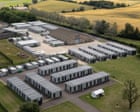
The wind across the tarmac at the former RAF Wethersfield base does not care about policy. It is a sharp, biting thing that sweeps across the flat Essex countryside, whistling through rusted chain-link fences and rattling the corrugated metal of old military barracks. For decades, this place housed soldiers, machines, and the heavy machinery of national defense. It was built for isolation. It was designed to keep the outside world out.
Now, it is meant to hold people who have nowhere else to go.
When the British government announced plans to bypass ordinary local planning permissions to house thousands of asylum seekers on redundant military sites, the decision was framed as a logistical triumph. A victory of efficiency. Streamlined. Cost-effective.
But efficiency looks very different depending on which side of the razor wire you stand.
To the charities, human rights lawyers, and local communities watching the transformation of these bases, the plans feel less like a solution and more like an act of profound arrogance. They see a system choosing containment over care, opting to hide a human crisis behind the high walls of old airfields rather than fixing a broken bureaucracy.
Consider a young man who has crossed continents to escape the collapse of his home. He has survived the predatory networks of human traffickers, the terror of a capsized dinghy in the English Channel, and the exhausting, dehumanizing waiting game of the asylum system. When he finally reaches what he believes is safety, he is loaded onto a bus. The urban centers fade away. The shops, the libraries, the ordinary rhythms of civilian life vanish. The bus pulls through a guarded gate into a barren, windswept military compound miles from the nearest town.
The psychological toll is immediate. For someone fleeing conflict, persecution, or military violence, being placed back into a military environment is a cruel irony. The barbed wire, the communal barracks, and the omnipresent security guards do not signal safety. They signal detention. They echo the very cages they risked everything to escape.
The government argued that using these sites—including Wethersfield and the former RAF Scampton in Lincolnshire—was necessary to end the £6 million-a-day bill for housing asylum seekers in hotels. It was presented as a common-sense alternative. Yet, the rush to implement the policy meant stripping away the standard checks and balances that protect both the migrants and the towns that receive them.
By using emergency planning powers known as Class Q, the Home Office bypassed the usual consultation processes. Local councils were left in the dark. Health authorities were caught off guard. It was a top-down directive, dropped onto rural communities with little warning and even less preparation.
Rural infrastructure is fragile. A small village near a former airbase relies on a single GP surgery, a volunteer-run post office, and a bus service that runs three times a day if the weather is good. Dropping two to three thousand traumatized, vulnerable adults into that ecosystem creates a friction that helps no one. It isolates the asylum seekers from the legal aid, mental health support, and community charities they desperately need to navigate their claims. It leaves local residents feeling ignored and anxious, fostering a resentment that is entirely preventable.
The real problem lies elsewhere. The hotel bill is not the disease; it is merely a symptom. The true crisis is the catastrophic backlog in processing asylum claims. The machinery of the state has slowed to a crawl. Files gather dust. Decisions that used to take months now take years. People are left in a agonizing state of limbo, forbidden from working, forbidden from putting down roots, trapped in a bureaucratic void.
Shuffling bodies from hotels to old airfields does nothing to speed up the pens of the caseworkers. It merely changes the scenery of their confinement. It turns an administrative failure into a visible, spatial segregation.
Human beings are not freight. They cannot be neatly filed away in redundant government property until it is convenient to deal with them. When we treat them as logistical problems to be managed through isolation, we lose something fundamental. We lose the ability to see them as individuals with names, histories, and futures.
A shadow falls across the concrete runway as the afternoon light fades. The gates remain shut. In the distance, the lights of a small Essex village flicker to life, warm and connected, while the old airbase sits alone in the dark, holding its breath.