The pediatrician’s office smells like cold vinyl, stale construction paper, and the faint, unmistakable tang of isopropyl alcohol. It is a room designed for waiting.
On a Tuesday morning in November, Maya sat on that crinkling paper table with her fourteen-month-old son, Leo. He was busy trying to peel an old sticker off his sneaker, completely oblivious to the quiet storm brewing in public policy, in federal health briefings, and inside the very schedule dictating why he was holding out his small, dimpled arm.
For decades, the standard childhood immunization timeline has operated like an intricate, highly calibrated clockwork. Generations of parents walked into rooms just like this one, trusting a synchronized rhythm of shots designed to shield infants during their most vulnerable months of life. It was dense. It was compressed. It packed multiple antigens into single visits to build a wall of immunity before a child ever set foot in a daycare or a playground.
Then came the mandate from Washington.
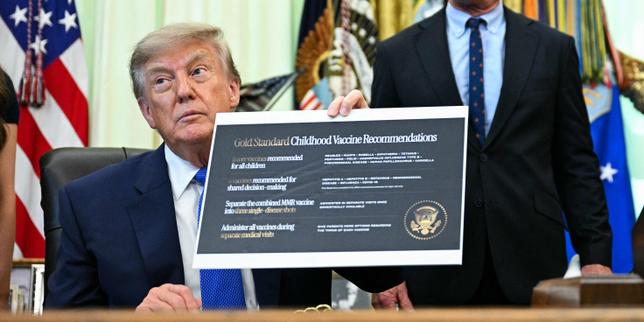
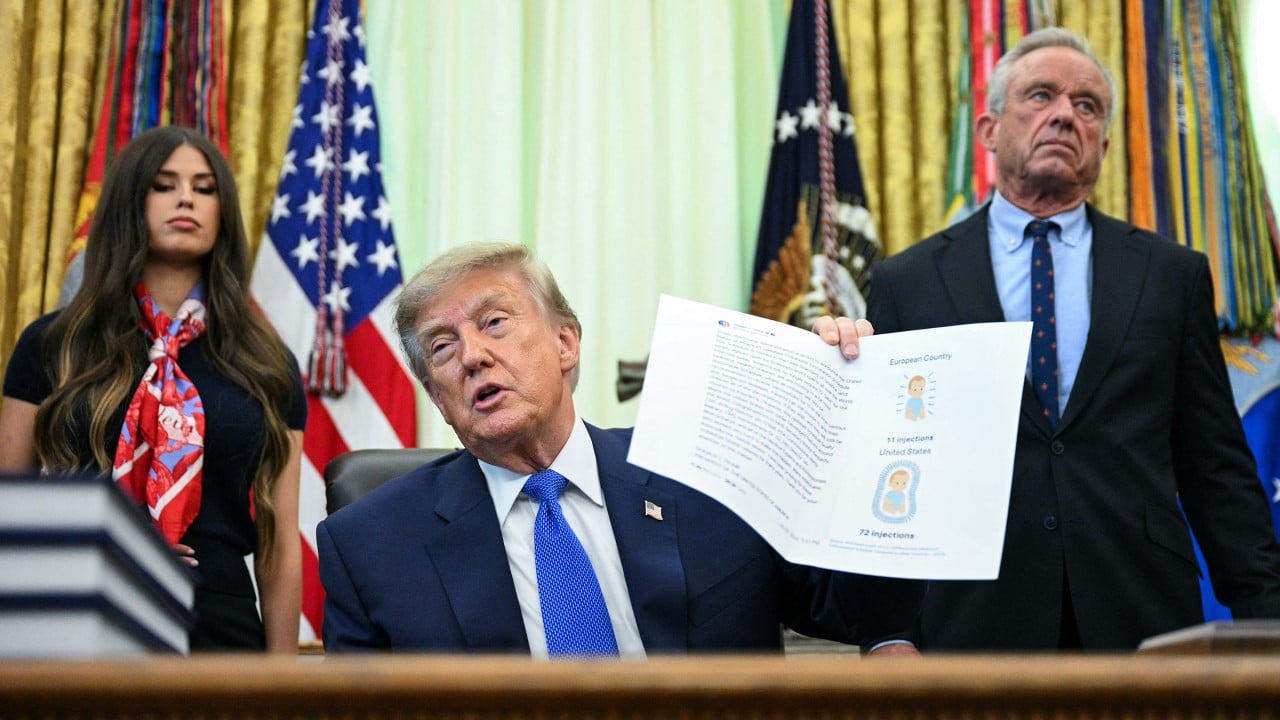
Under a newly adjusted federal direction spearheaded by Donald Trump, that tight, synchronized clock is being pulled apart. The directive orders health agencies to rewrite the childhood vaccination schedule, fundamentally shifting away from the tightly clustered appointments of the past toward a spaced-out timeline. The argument from the administration rests on a populist appeal to parental caution, suggesting that spacing out doses might somehow lighten an infant's biological load.
To understand why this shift rattles public health experts, you have to look past the political podium and stare directly at the biology of a newborn.
Imagine an ancient fortress built on a coastal cliff. Every spring, incoming tides bring invaders. The builders of the fortress do not wait until the ships are battering the wooden gates to build the stone walls. They construct them early, rapidly, and all at once, because an incomplete fortification is no fortification at all.
Infants enter a world teeming with pathogens—bacteria and viruses that do not wait for a toddler to turn three, or five, before they strike. Pertussis, measles, Haemophilus influenzae type b. These are not abstract vocabulary words on a medical chart. They are ruthless opportunists. The compressed vaccine schedule was never designed to be convenient; it was engineered to match epidemiological urgency. It hit hard and fast during the narrow window when maternal antibodies faded and the infant’s own adaptive immune system was just coming online.
When you space those doses out over years instead of months, you leave wide windows of vulnerability.
Maya looked down at Leo’s chart. Her pediatrician, a man with tired eyes and twenty years in practice, flipped through the pages with a heavy sigh.
"The science hasn't changed," the doctor said, keeping his voice low so as not to startle the toddler. "Our immune systems handle thousands of environmental antigens every single day just by breathing and eating. Vaccines are a tiny fraction of that. But perception is a powerful thing. Once fear enters the room, logic has to fight twice as hard to stay seated."
The tension between political intervention and clinical consensus is nothing new, but altering the delivery mechanism of preventive medicine carries profound downstream effects. Critics of the rewrite point to a dangerous reality: hesitation feeds on complexity. When a schedule becomes longer, more confusing, and drawn out over a child’s entire early childhood, compliance drops. Parents miss appointments. Life gets busy. A delayed shot easily morphs into a forgotten shot.
And history teaches us what happens when those gaps widen.
Herd immunity is not a political slogan. It is a fragile biological shield. When vaccination rates dip even a fraction of a percent below critical thresholds, ancient diseases do not just knock on the door—they kick it down. We saw it with measles outbreaks in communities where skepticism took root. We have watched localized drops in coverage turn minor exposures into public health emergencies.
The administration’s order frames this as giving parents more choices, more control, more breathing room. But biological pathogens do not care about parental convenience. They operate on exponential math.
Consider what happens next in a community practicing extended spacing. A toddler goes to preschool at age three, partially immunized under a slow-roll schedule designed to appease anxiety rather than align with viral transmission rates. They encounter a pathogen that the old schedule would have neutralized a year and a half prior. The body scrambles. The infection takes hold.
Back in the exam room, Maya pulled Leo’s velcro shoe back into place. She thought about the endless internet rabbit holes she had scrolled through at two in the morning, the competing voices, the sea of conflicting noise disguised as research. It is terrifying to be a parent trying to protect a child in an era where public health has become a partisan battlefield. You want to do the right thing. You desperately want to make sure you are not harming the very life you created.
That vulnerability is precisely what populist health policies exploit. They take complex, invisible fears and offer a simple, seductive narrative: Slow down. Take a breath. Less is more.
Except, in the microscopic wars fought inside an infant's bloodstream, less is often just an invitation.
The nurse walked back in, holding a small tray with a sterile alcohol swab and a tiny syringe. The metal glinted under the fluorescent light. Maya tightened her grip on her son’s small hand, feeling the rapid, rhythmic beat of his pulse against her palm. She looked at the doctor, searching his face for a final reassurance, a tether to certainty in a shifting world.
The clock on the wall ticked forward, indifferent to the orders coming out of Washington, unconcerned with the political tides, measuring only the relentless passage of time and the quiet urgency of defense.