If you expected a sleepy Essex coastal town to suddenly transform into the center of a national political reckoning, you haven't been paying attention. The recent Clacton by-election gave us a 90-centimeter-long ballot paper, a record-breaking thirty-four candidates, and a surreal runner-up finish for a man dressed as an intergalactic rubbish bin.
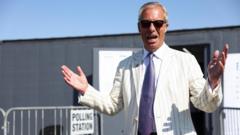
Yet, when the dust settled at the Clacton leisure centre, Nigel Farage walked away with the seat again. The numbers shifted slightly, but the underlying political reality stayed completely frozen.
Let's look at what actually happened. Farage triggered this contest himself to deflect from a lingering storm over a financial gift. Every other major political party chose to boycott the circus, leaving a vacuum that filled rapidly with eccentric independents and protest candidates.
The Boycott That Broke Normal Politics
When major parties run away from a contest, democracy gets weird. Labour and the Conservatives sat this one out, branding the whole affair a vanity project. That left Farage to campaign against a crowded field of thirty-four hopefuls, including Count Binface—the satirical creation of comedian Jon Harvey—who managed to secure over nine thousand votes.
Voter turnout plummeted to forty-four percent. People weren't energized. They were exhausted.
Farage pulled in 22,239 votes, taking sixty-three percent of the total share. On paper, that looks like a dominant endorsement. But context matters. Without the mainstream opposition splitting or engaging local attention, and with a significantly lower turnout than the previous general election, the raw vote count barely budged from his initial 2024 victory. He gained roughly a thousand ballots, but lost the competitive tension that defines a real test of public approval.
What Clacton Residents Actually Face
Away from the media vans and the eccentric candidates holding up the longest ballot paper in British history, the town itself deals with the same old structural hurdles. Investment remains slow. Public services feel stretched. Local infrastructure struggles to keep pace with demographic shifts.
Politicians love using Clacton as a sounding board for national culture wars. They treat the high street like a television studio. The residents I've spoken with are tired of being treated like props in a political soap opera. They want functioning local services, jobs that pay local bills, and an MP who shows up where the votes are counted instead of ducking off to a private festival event.
By skipping the actual count over purported security concerns—claims swiftly disputed by local council and police authorities—Farage signaled a disconnect between his national media strategy and his local obligations.
The Real Fallout of the Contest
Did anything actually change? No.
The parliamentary standards watchdog still has active questions to answer regarding political funding. The Reform UK leader still holds his seat. The town still faces deep-rooted economic challenges that a stunt election cannot solve.
If you are trying to read the tea leaves for national momentum, look past the inflated percentage shares. When an election features a candidate dressed as a space warrior coming in second place because everyone else stayed home, you are watching theatre, not a shift in the political landscape.
Ignore the spin. Watch what happens when the committee rooms open and the real administrative work resumes. That is where the actual story lives.