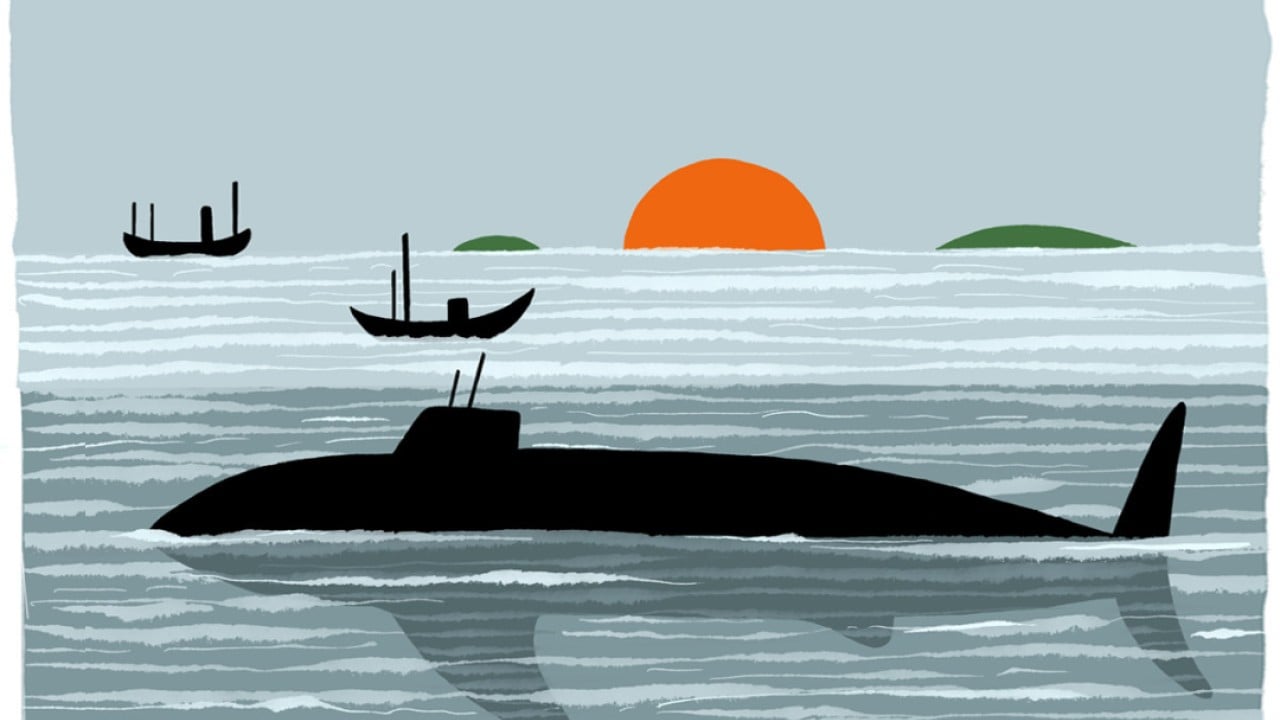
The People’s Liberation Army Navy conducted a full-range test of a submarine-launched ballistic missile on July 6, 2026, firing from the South China Sea into a designated impact zone 7,200 kilometers away in the South Pacific Ocean. Mainstream geopolitical commentary routinely misinterprets this event as a binary indicator of regional instability or a simple display of political posture. These analyses rely on qualitative assessments of state intent rather than the immutable physics of strategic delivery platforms, geographical constraints, and architectural interdependencies. Evaluating the mechanics of this operation reveals a calculated shift in strategic calculus rather than an isolated training exercise.
Understanding the strategic reality requires breaking down the physical constraints of sea-based nuclear forces into two core components: payload mechanics and platform survivability.
The Mechanics of Full Range Trajectories
Previous Chinese submarine-launched ballistic missile (SLBM) tests typically relied on lofted trajectories. Firing a missile at a steep, near-vertical angle allows the reentry vehicle to remain within domestic land borders or enclosed coastal waters like the Bohai Sea while simulating high-velocity environments. The July 6 test discarded this template in favor of a minimum-energy trajectory across international open waters.
This shift introduces specific structural variables that cannot be replicated via simulation or lofted testing.
- Atmospheric Reentry Thermal Stress: A full-range trajectory alters the angle of approach as the warhead reenters the atmosphere. The thermal protective tiling must endure prolonged aerodynamic drag and heat accumulation over thousands of kilometers. This structural test validates the physical integrity of the warhead casing under true operational conditions.
- Three-Stage Propulsion Separation: The transition between solid-propellant stages requires precise timing. Firing at a standard operational arc allows telemetry assets to measure the exact velocity changes during stage separation under normal gravitational and atmospheric resistance curves.
- MIRV Deployment Dynamics: If the asset tested was the newer JL-3 rather than the legacy JL-2, it carries the capacity for Multiple Independently Targetable Reentry Vehicles. Deploying multiple dummy payloads over a full operational distance requires the post-boost vehicle to execute complex mid-course maneuvers that a lofted path compresses artificially.
The choice of target area—approximately 300 kilometers east of Tonga—establishes a baseline range of at least 7,200 kilometers. If executed from a Type 094 nuclear-powered ballistic missile submarine operating within the protected bastion of the South China Sea, a missile with this range brings parts of the western continental United States within striking distance. Upgrading to the full 10,000-kilometer capability of the JL-3 expands this envelope to encompass the entire North American continent without requiring the submarine to cross the first island chain.
The Bastion Concept and Geographical Friction
The fundamental value of an SLBM lies in its survival probability, which provides a nation with a credible second-strike capability. Western naval strategy often evaluates submarine operations through the lens of open-ocean blue-water patrolling. The People’s Liberation Army Navy operates under entirely different geographical realities.
The Western Pacific is defined by narrow maritime chokepoints. Passing through the Miyako Strait, the Bashi Channel, or the Luzon Strait exposes a submarine to dense networks of underwater acoustic arrays, maritime patrol aircraft, and attack submarines operated by the United States and its regional allies. To mitigate this vulnerability, the military architecture relies on a "bastion strategy" in the South China Sea.
+-------------------------------------------------------+
|                 THE SOUTH CHINA SEA BASTION           |
|                                                       |
|  [Mainland China Air/Missile Defense Umbrella]         |
|         |                                             |
|         v                                             |
|  Surface Fleets & Deep Water Trenches                 |
|         |                                             |
|         v                                             |
|  [Type 094 / 096 SSBNs Firing JL-2/JL-3 SLBMs]        |
|         |                                             |
|         +---> Full-Range Trajectory (7,200km+)        |
|               Overflying Philippines -> South Pacific |
+-------------------------------------------------------+
This strategy transforms an enclosed body of water into a heavily defended sanctuary. The northern and deep-water central portions of the South China Sea provide sufficient depth for strategic submarines to hide, while the surrounding airspace and surface layers are saturated with land-based anti-ship missiles, radar installations, and fighter aircraft.
The structural trade-off of this approach is range restriction. Firing from a coastal sanctuary means the missile must possess a longer range to reach equivalent targets compared to a submarine patrolling deep in the mid-Pacific. The July 6 test demonstrates that the physical range requirements of the bastion strategy have been met. The system no longer requires risky transit into open waters to establish deterrence.
Notification Shortfalls and Escalation Risks
The international friction surrounding this event stems directly from operational opacity rather than the physical launch itself. While traditional land-based ICBM tests by major powers often follow rigid notification timelines to prevent early-warning radar systems from misinterpreting a test as a surprise first strike, the protocol used on July 6 deviated from these norms.
China provided only a few hours of advance notice to the United States and Japan, alongside roughly 23 hours of notice to Australia regarding the impact zone. Beijing remains outside the Hague Code of Conduct against Ballistic Missile Proliferation, choosing instead to handle notifications via ad-hoc bilateral channels.
This compressed notification window introduces critical risks into the regional security matrix.
- Early Warning Misinterpretation: Space-based infrared sensors detect the thermal bloom of an SLBM launch within seconds. Without days of prior coordination and technical parameter sharing, defensive command structures must rapidly determine if the trajectory threatens domestic territory or forward-deployed forces.
- Overflight Complications: The trajectory from the South China Sea to the South Pacific required the missile to overfly portions of the Philippines. Firing strategic assets over sovereign foreign nations without explicit, transparent coordination creates political friction and raises the possibility of intercept calculations by regional actors.
- Precedent Scaling: Routinizing full-range tests in international open waters without adopting standard verification frameworks means future launches will inherently carry higher baseline tension, reducing the decision-making windows for regional command centers during periods of heightened diplomatic friction.
The Technological Modernization Vector
The launch cannot be evaluated in isolation from China's broader nuclear trajectory. The Department of Defense estimated that China possessed more than 600 operational nuclear warheads by mid-2024, with projections scaling past 1,000 by 2030. The maturation of the sea-based leg completes a highly survivable nuclear triad alongside modern mobile land-based launchers and upgraded bomber assets.
The technical choice between the JL-2 and JL-3 defines the immediate operational capability of the fleet. The current backbone relies on six Type 094 submarines. If the test successfully validated the integration of the longer-range JL-3 onto these hulls, it represents a rapid expansion of strike options. If the test was a validation flight for the next-generation Type 096 submarine currently under development, it signals the impending deployment of a quieter, harder-to-detect maritime strike asset.
The primary limitation of this expanding network is not the engineering of the missiles, but the underlying command, control, and communication architecture. Maintaining continuous, secure communication with submerged ballistic missile submarines requires extensive very-low-frequency radio networks and satellite relays capable of surviving an electronic warfare environment. Testing the physical flight path of the missile is only half of the equation; verifying that the command chain can reliably order such a strike from a protected domestic bastion under simulated combat conditions is the less visible, more critical milestone achieved during this operation.
Regional security dynamics are no longer governed by simple platform-versus-platform comparisons. The integration of long-range maritime strike vectors into a broader network of space observation, electronic warfare, and anti-access capabilities alters the operational requirements for every actor in the Indo-Pacific. Rather than relying on assumptions of stability, strategic planning must adapt to a reality where the capability to strike distant targets from protected coastal waters is a fully demonstrated operational fact.