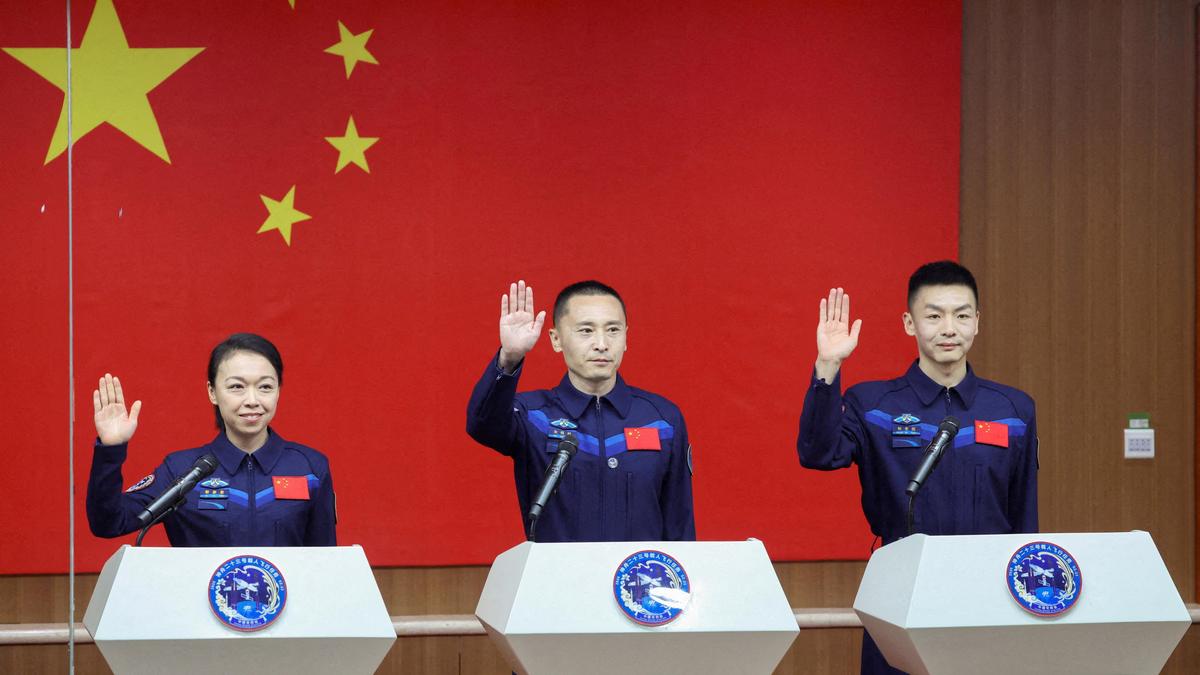
The mainstream media is treating China’s announcement of a year-long space station mission and a 2030 lunar landing as a terrifying geopolitical shift. They see a new space race. They see a direct threat to Western dominance in orbit.
They are looking at the wrong map.
The lazy consensus among defense analysts and tech journalists is that long-duration low-Earth orbit (LEO) stays are the ultimate stepping stone to deep space. The narrative says that sending an astronaut to the Tiangong space station for 365 days is a necessary, linear progression toward putting boots on the Moon by 2030.
It isn't. It is an expensive detour.
While the press panics over Beijing’s orbital calendar, anyone who has spent time analyzing aerospace logistics knows the truth. China is executing a 20th-century playbook in a 21st-century world. They are building a carbon copy of Apollo-era goals and Soviet-era endurance runs. They are investing heavily in hardware that will be obsolete before the first lunar boot-print is made.
The real race is not about who plants a flag first. It is about mass-to-orbit economics. By focusing on vanity milestones instead of reusable architecture, China is setting itself up for a spectacularly expensive dead end.
The Myth of the Year-Long Milestone
Let's dissect the premise. The China Manned Space Agency (CMSA) claims that keeping a taikonaut aboard Tiangong for a year is vital for studying the long-term physiological effects of microgravity for deep space travel.
This ignores decades of aerospace history.
Valery Polyakov spent 437 days straight aboard the Mir space station in the mid-1990s. Scott Kelly spent nearly a year on the International Space Station (ISS) a decade ago. We already possess mountains of data on bone density loss, muscular atrophy, radiation exposure, and fluid shifts in microgravity.
We know the human body degrades in space. We know that resistive exercise devices and specialized diets mitigate some of this damage, but not all. Sending a human to sit in LEO for 12 months in 2026 does not unlock new scientific frontiers. It simply replicates a Russian experiment from thirty years ago.
More importantly, a lunar mission does not require a one-year stay in microgravity. A transit to the Moon takes three days. A surface stay might last a week or two for early missions. Even a sustained lunar base operates under partial gravity (about one-sixth of Earth's), which presents an entirely different physiological profile than the total weightlessness of Tiangong.
If the goal is truly a 2030 moon landing, allocating resources, launch windows, and tracking infrastructure to a year-long LEO marathon is an operational distraction. It drains the exact engineering talent and budgetary capital needed to solve the far harder problems of lunar descent and surface survival.
The Wrong Questions About the New Space Race
Look at any major news outlet coverage of this announcement and you will see the same public questions repeated ad nauseam. The premise of these questions is fundamentally flawed.
Is China overtaking the United States in space capabilities?
This question assumes that space capability is measured by the height of your rocket or the date of your launch. If you measure capability by the ability to execute highly scripted, state-funded, non-reusable missions, then China is matching the historical milestones of NASA.
But that is the wrong metric. True space capability in the current era is measured by launch cadence and cost per kilogram.
The United States is currently launching thousands of tons of payload into orbit annually, driven largely by commercial reuse. China's Long March rockets, including the Long March 10 being developed for the lunar push, are still predominantly expendable systems. Building a massive, non-reusable rocket to send two humans to the Moon once or twice a year is a financial black hole. It does not create a sustainable orbital economy. It creates a series of very expensive photo opportunities.
Will the Tiangong station replace the ISS?
Yes, logistically, as the ISS approaches its planned retirement at the end of the decade, Tiangong may be the only fully functional state-run national lab left in LEO. But this assumes that a state-run national lab is still the optimal way to do orbital research.
Commercial habitats are already under development. The future of LEO is not state-funded diplomacy hubs; it is commercial industrial parks. China is inheriting an empty throne. They are taking over the lease on a conceptual model of space exploitation that the rest of the world is actively transitioning away from.
The Economic Reality of the Long March 10
To get to the Moon, China is relying on a dual-launch strategy. One Long March 10 rocket launches the lunar lander; another launches the crewed spacecraft. They rendezvous in lunar orbit, descend, do the work, and come home.
This looks functional on paper. It avoids the immediate need to build a single, monstrous rocket like Saturn V or the Space Launch System (SLS). But let's look at the systemic drag of this approach.
Imagine a scenario where a commercial logistics company decides to ship goods across the ocean, but their ships can only be used once. Every time a delivery is made, they scuttle the vessel and build a new one from scratch. That company would go bankrupt in a month, regardless of state subsidies.
That is the current state-backed lunar model. The sheer volume of precision machining, rare earth metals, and highly skilled labor consumed by throwing away multi-stage rockets for every single mission limits the cadence. You cannot build a lunar economy on two flights a year. You cannot secure a strategic foothold if every trip requires a massive chunk of your national tech budget.
I have spent years analyzing the cost structures of modern aerospace ventures. The capital expenditure required to maintain a standing army of engineers just to manufacture expendable hulls is staggering. The moment a fully reusable heavy-lift system becomes operational and drives the cost of mass-to-orbit down by an order of magnitude, every expendable program on Earth instantly becomes a museum piece.
China's 2030 plan is locked into an expendable architecture. They are optimizing a horse and buggy while the internal combustion engine is being tested down the street.
The Hidden Downside of the Contrarian Reality
Let’s be intellectually honest. There is an argument to be made for China’s slow, deliberate approach.
Because the CMSA is an arm of the People's Liberation Army, it does not suffer from the political whiplash that cripples Western space programs. They do not change their entire strategic direction every four to eight years based on a presidential election cycle. They set a 20-year roadmap and they execute it with brutal consistency.
This consistency allows them to avoid the wild cost overruns and sudden cancellations that have plagued Western aerospace for decades. Their supply chains are entirely domestic, meaning they are insulated from international sanctions or geopolitical leverage.
But this stability is a double-edged sword. The lack of political disruption also means a lack of internal disruption. There is no mechanism within a state-directed, military-run space program to abandon a failing or obsolete line of development in favor of a radical new technology. No mid-level engineer at the China Academy of Launch Vehicle Technology can stand up and say, "The Long March 10 is an economic dead end; we need to scrap it and go fully reusable right now."
The bureaucratic momentum ensures that they will march precisely, orderly, and on schedule right into an obsolete technological paradigm.
Stop Looking at Flags, Start Looking at Fuel
If you want to understand who will dominate the cislunar economy in the 2030s, stop counting the number of days astronauts spend floating in space stations. Stop tracking the dates of scheduled flag drops.
Look at the infrastructure that survives the mission.
A successful lunar architecture requires three things:
- High-cadence, low-cost transport to LEO.
- Orbital refueling architecture to bypass the tyranny of the rocket equation.
- In-situ resource utilization (ISRU) to produce water and propellant on the lunar surface.
China’s current public roadmap for 2030 addresses the first point poorly through expendable rockets, touches on the second with basic docking maneuvers, and largely punts on the third until much later.
A year-long stay on Tiangong does absolutely nothing to solve the problem of cryogenic fuel boil-off in deep space. It does nothing to advance automatic precision landing in the rugged terrain of the lunar south pole. It is a management metric designed to show progress to a political committee that likes clean, easily understandable milestones.
The Brutal Truth
The upcoming year-long mission to Tiangong is not a threat. It is a confession.
It is proof that China is still chasing the ghosts of the old Cold War space race, playing a game of visibility rather than utility. They are building a legacy system with immense precision and undeniable national pride, but it remains a legacy system.
When that Chinese taikonaut steps onto the lunar surface in 2030, it will be a historic television moment. The flags will wave. The speeches will be written. But behind the theater, the math will remain unyielding. If it costs billions of dollars to put those boots on the ground for 48 hours, the mission is a failure of modern engineering, not a triumph.
True dominance belongs to whoever builds the highway, not whoever drives the first car into the ditch.