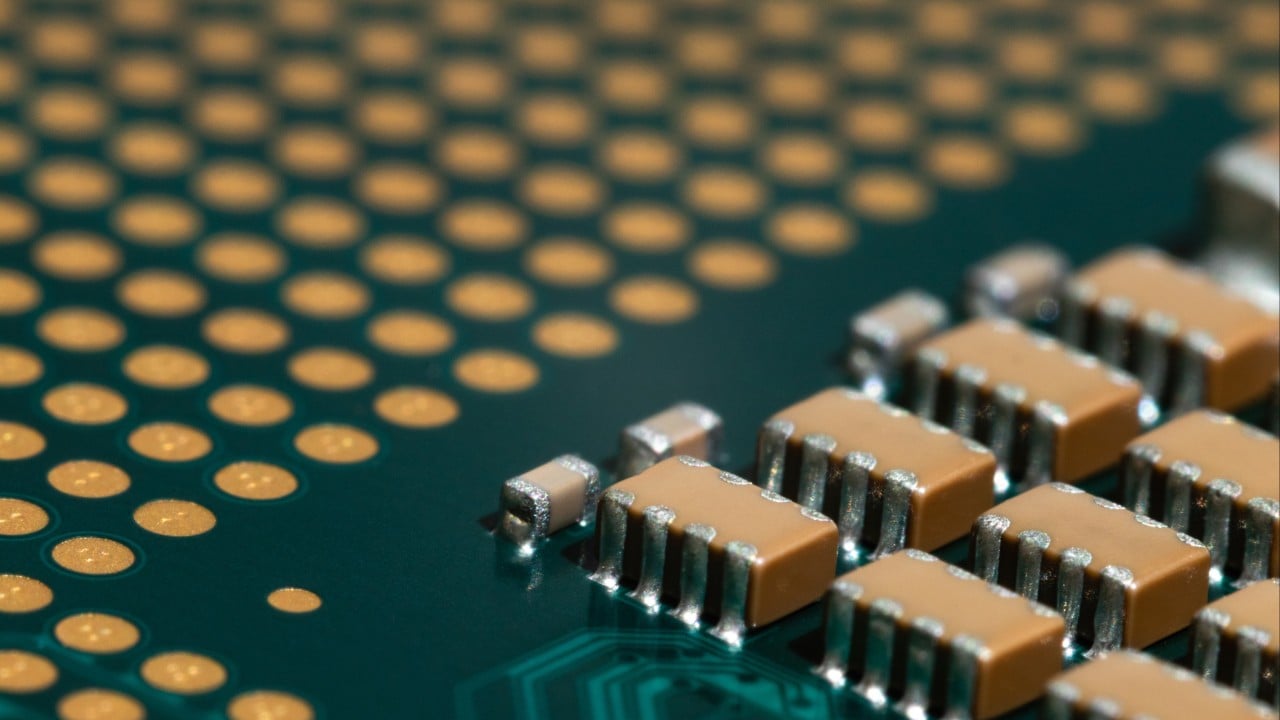
The global electronics supply chain runs on passive components you rarely think about. Multilayer ceramic capacitors, or MLCCs, act as the steady heartbeat of every circuit board, regulating electrical currents across smartphones, electric vehicles, and high-performance servers. They are cheap, tiny, and consumed by the trillions.
For decades, Japanese and South Korean manufacturers controlled this space. Giants like Murata Manufacturing and Samsung Electro-Mechanics dictated terms, pushed technical limits, and reaped the highest margins.
That playbook is changing.
Driven by the artificial intelligence explosion and the intense power requirements of modern hardware, the top-tier players are leaving their old territory behind. They are abandoning consumer-grade, low-to-mid-tier MLCC production. They want the high-margin, high-reliability business of AI data centers and automotive powertrains. This migration has opened a massive backdoor for Chinese electronic component manufacturers, who are capitalizing on the vacuum to claim a market they were previously locked out of.
The Trillion Component Shift
A standard smartphone uses around 1,000 MLCCs. A modern electric vehicle needs close to 30,000. But the real frenzy is happening in infrastructure. A single high-end AI server can swallow up to 28,000 advanced capacitors. If you scale that up to a full server rack environment, like Nvidia's latest architecture architectures, the volume and value skyrocket.
The market size for MLCCs used strictly in AI servers is projected to reach $6.1 billion by 2030, climbing from $1.4 billion in 2025. That represents an astonishing 34% compound annual growth rate.
Murata, which holds roughly 40% of the overall global MLCC market, has revised its revenue forecasts upward as its factories hit maximum capacity. Samsung Electro-Mechanics reported its component division factory utilization rates hit 99%.
When your production lines are completely choked with backlogs for components destined for ultra-profitable AI accelerators and high-voltage automotive systems, you stop caring about cheap consumer goods. You stop fighting over the fractional pennies on components meant for mid-range smartphones, home appliances, and budget laptops.
That's where domestic Chinese manufacturers stepped in.
How China Built a Ten Percent Beachhead
Historically, Chinese hardware brands relied entirely on imports from Japan, South Korea, and Taiwan for reliable IT-grade passives. Local alternatives were viewed as inferior, prone to failure under thermal stress, or incapable of achieving the extreme layers required for high capacitance in small footprints.
The pandemic-era supply crunches and subsequent geopolitical push for domestic hardware substitution altered that dynamic. Chinese component builders like Guangdong Fenghua Advanced Technology, Chaozhou Three-Circle Group, and Eyang Technology rapidly expanded their footprints.
Data shows that Chinese MLCC makers captured 10% of total global revenue in the second half of 2024. That is up from a meager 6% in 2019. It doesn't sound like market dominance, but in a sector where multi-billion-dollar scale is everything, a four-percentage-point swing represents billions of components diverted to local supply lines.
Chinese smartphone brands have realized they can use domestic suppliers as massive financial leverage. By qualifying local alternatives for standard, low-voltage power loops, they force historical premium suppliers to lower their prices or walk away. Most of the time, the foreign giants are simply walking away because their capacity is better utilized elsewhere.
The Vulnerability in the Middle Market
This migration isn't without serious risk for the traditional tech leaders. Samsung Electro-Mechanics, for instance, has historically relied on the Chinese market for about 40% of its total revenue. Losing the baseline, high-volume consumer tier in China leaves them exposed if the AI or automotive sectors hit a sudden speed bump.
Samsung's current strategy is an aggressive pivot to balance this exposure. The company has moved rapidly to secure a 40% market share in the specific sub-segment of MLCCs tailored for AI servers, closely trailing Murata's 45%. CEO Chang Duckhyun noted that automotive-grade components have scaled to 15% of their total MLCC intake, with targets set higher as high-voltage vehicle architectures expand globally.
The global high-voltage MLCC market alone is expected to hit $11 billion by 2029, growing at 22% annually. For the top-tier players, the math is simple: focus on the $4,320 worth of high-performance components inside an advanced server rack rather than fighting over a handful of low-margin parts inside a budget handset.
The Technical Ceiling for Local Alternatives
The underlying question is whether Chinese component manufacturers can follow the incumbents upmarket, or if they will remain trapped in the lower-margin commodity tier.
Achieving the precision required for high-reliability environments is exceptionally difficult. A high-end MLCC consists of hundreds of microscopic ceramic and metal layers stacked precisely within a footprint as small as a grain of sand. If the ceramic material has the slightest impurity, or if the layer thickness varies by nanometers, the component short-circuits under stress.
Right now, companies like Chaozhou Three-Circle possess roughly 2.1% of the total global market by value, primarily because their product catalog skews toward older, larger footprints like the 1005 or 0402 sizes. The cutting-edge sub-0201 micro-capacitors remain heavily guarded by Japanese intellectual property and specialized material supply chains.
However, discounting Chinese engineering velocity is a mistake. Local firms are investing heavily in material sciences, specifically in ultra-fine barium titanate powder formulations, which is the foundational chemical needed to challenge Japanese dominance in high-capacitance parts.
Practical Realities for Hardware Procurement
If you operate a business managing hardware procurement or electronic manufacturing services, this market schism forces an immediate tactical choice. You cannot treat the MLCC market as a monolith anymore.
- Audit your component footprints: For standard consumer designs or non-critical sub-circuits, domestic Chinese alternatives are now mature, highly cost-effective, and provide an excellent buffer against supply chain bottlenecks.
- Qualify secondary sources immediately: Relying purely on legacy Japanese suppliers for basic components leaves you vulnerable to their capacity reallocations. When Murata shifts production lines to service an automotive or AI client, lead times for standard industrial parts can spike unexpectedly.
- Isolate your premium dependencies: Accept that for high-temperature, high-voltage, or mission-critical computing loops, you remain wedded to Murata, Samsung, or TDK. Lock in long-term supply agreements for these specific high-value nodes now, because the AI supercycle is consuming global factory capacity at an unprecedented rate.
The commodity price shifts occurring at major electronics hubs like Shenzhen's Huaqiangbei indicate that price volatility across all tiers will continue through the decade. The gap between cheap, high-volume passives and high-spec industrial components is widening into a permanent structural divide.