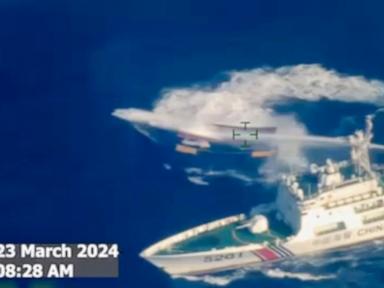
Paper victories don't usually cause international standoffs a decade after they are signed. Yet here we are. On July 12, 2026, a coalition of 14 nations, including the United States, the United Kingdom, Japan, and the Philippines, issued a sweeping joint statement. The message was clear. The landmark 2016 Permanent Court of Arbitration ruling that completely dismantled Beijing's sweeping maritime claims is final, legally binding, and definitive.
If you have been tracking the constant collisions, water cannon attacks, and high-stakes military standoffs in the Pacific, you might wonder why a ten-year-old piece of paper from The Hague still dominates global headlines. It matters because China has spent the last ten years trying to pretend it never happened, while the rest of the world is using it as the ultimate legal anchor to prevent a total military takeover of one of the planet's most critical trade routes.
The joint statement represents a coordinated pushback against what these nations describe as destabilizing and coercive actions. Signatories include Australia, Canada, New Zealand, Germany, Italy, Romania, Slovenia, and the Baltic states of Estonia, Latvia, and Lithuania. This is not just a regional spat anymore. It is a global standoff.
What the 2016 Ruling Actually Changed
To understand why this coalition is digging in its heels, you have to look at what the 2016 arbitral tribunal actually decided. The case started back in 2013. The Philippines finally had enough after Beijing effectively seized Scarborough Shoal following a tense maritime face-off. Manila took the fight to the Permanent Court of Arbitration under the United Nations Convention on the Law of the Sea, known widely as UNCLOS.
China flatly refused to participate in the proceedings. They claimed the court had no jurisdiction. But the tribunal went ahead anyway, and when the final verdict dropped on July 12, 2016, it was a total wipeout for Beijing.
The court ruled that China’s famous "nine-dash line"—the sweeping boundary line Beijing used to claim historic rights over roughly 80 percent of the South China Sea—was completely fabricated under international law. The tribunal noted that while Chinese fishermen had historically used the waters, there was zero evidence that China had historically exercised exclusive control over them. Under UNCLOS, which China signed and ratified back in 1996, maritime rights are derived from land features, not ancient map lines.
The court also took a look at the actual features in the water. It ruled that none of the tiny reefs and sandbars in the Spratly Islands could legally be classified as true islands capable of sustaining human habitation or economic life. Because they are just rocks or low-tide elevations, they cannot generate a 200-nautical-mile Exclusive Economic Zone. That meant features like Mischief Reef and Second Thomas Shoal fall squarely within the exclusive economic zone of the Philippines. Beijing was found to have violated Philippine sovereign rights by building artificial islands and interfering with local fishing and energy exploration.
Why Beijing Is Firing Water Cannons in 2026
China’s response to the 2016 ruling has been a masterclass in aggressive denial. The Chinese embassy in Manila recently doubled down, declaring the award illegal, null, and void. They claim the ruling cannot alter the historical and factual basis for Chinese sovereignty.
Because Beijing cannot win the legal argument, it has spent the last decade trying to win the physical argument. If you look at the daily reality in the West Philippine Sea, the conflict has shifted from diplomatic cables to raw physical intimidation.
We are seeing a massive surge in gray-zone tactics. China uses its coast guard and a massive fleet of maritime militia—essentially state-directed fishing vessels weaponized for bullying—to swarm contested areas. They are not using missiles, but they are using military-grade lasers to blind Philippine crews, using powerful water cannons to rip apart the upper structures of supply boats, and executing dangerous blocking maneuvers that cause high-seas collisions.
The goal is simple. Beijing wants to make it so dangerous and exhausting for the Philippines to access its own EEZ that Manila eventually gives up.
The Secret Stakes In the Disputed Waters
This conflict is not just about a few lonely, half-submerged reefs. It is about money, energy, and global supply chains.
- Shipping Lanes: Over three trillion dollars in global trade passes through the South China Sea every single year. It is the maritime highway connecting Asia to Europe and the Middle East. If China successfully turns these international waters into its own domestic lake, it gains a chokehold over global commerce.
- Fisheries: The South China Sea accounts for roughly ten percent of the world's total fish catch. It provides food security and livelihoods for tens of millions of people in Southeast Asia. Chinese swarming tactics have devastated local fishing communities, forcing them out of their traditional waters.
- Oil and Gas: The seabed beneath these waters holds massive untapped energy reserves. Estimates suggest there are billions of barrels of oil and trillions of cubic feet of natural gas waiting to be extracted. The 2016 ruling gave the Philippines the exclusive right to exploit these resources within its EEZ, but Chinese intimidation has made commercial drilling virtually impossible without military escort.
The Western Coalition Tightens Its Stance
The inclusion of non-Asian countries like Germany, Italy, and the Baltic states in the 2026 joint statement shows a major shift in international diplomacy. European nations realize that a breakdown of international law in the Pacific directly undermines security everywhere else. If a large nation can simply ignore an international tribunal and rewrite borders through sheer physical force, the entire rules-based global order fractures.
The United States has stepped up its rhetoric and its physical presence. Both the previous Biden administration and the current Trump administration have made it clear that the 1951 US-Philippines Mutual Defense Treaty is ironclad. Washington has warned Beijing that an armed attack on Filipino public vessels, aircraft, or armed forces—including its coast guard—anywhere in the South China Sea will trigger a US military response.
This puts the world on a knife-edge. A single miscalculation during a water-cannon incident at Second Thomas Shoal could escalate into a direct military confrontation between two nuclear-armed superpowers.
What Happens Next
The international community is running out of diplomatic options, but the 14-nation coalition has laid out a clear framework for containing the crisis. You can expect a few immediate actions on the horizon.
First, expect more multilateral maritime patrols. The US, Japan, Australia, and the Philippines have already begun conducting joint transits through the South China Sea to demonstrate freedom of navigation. More European nations will likely join these exercises to prove that these waters remain international space.
Second, the Philippines will continue to document and expose Chinese actions publicly. Manila's strategy of embedding journalists on supply missions has stripped away Beijing's ability to hide its gray-zone tactics from the global public.
Finally, keep an eye on ASEAN. The Association of Southeast Asian Nations has been trying to negotiate a binding Code of Conduct with China for years. The 2026 joint statement puts pressure on Southeast Asian capitals to ensure that any future code is fully aligned with UNCLOS and the 2016 ruling, rather than a watered-down agreement that legitimizes Beijing's expansion. The legal battle was won a decade ago. The fight to enforce it is happening right now.