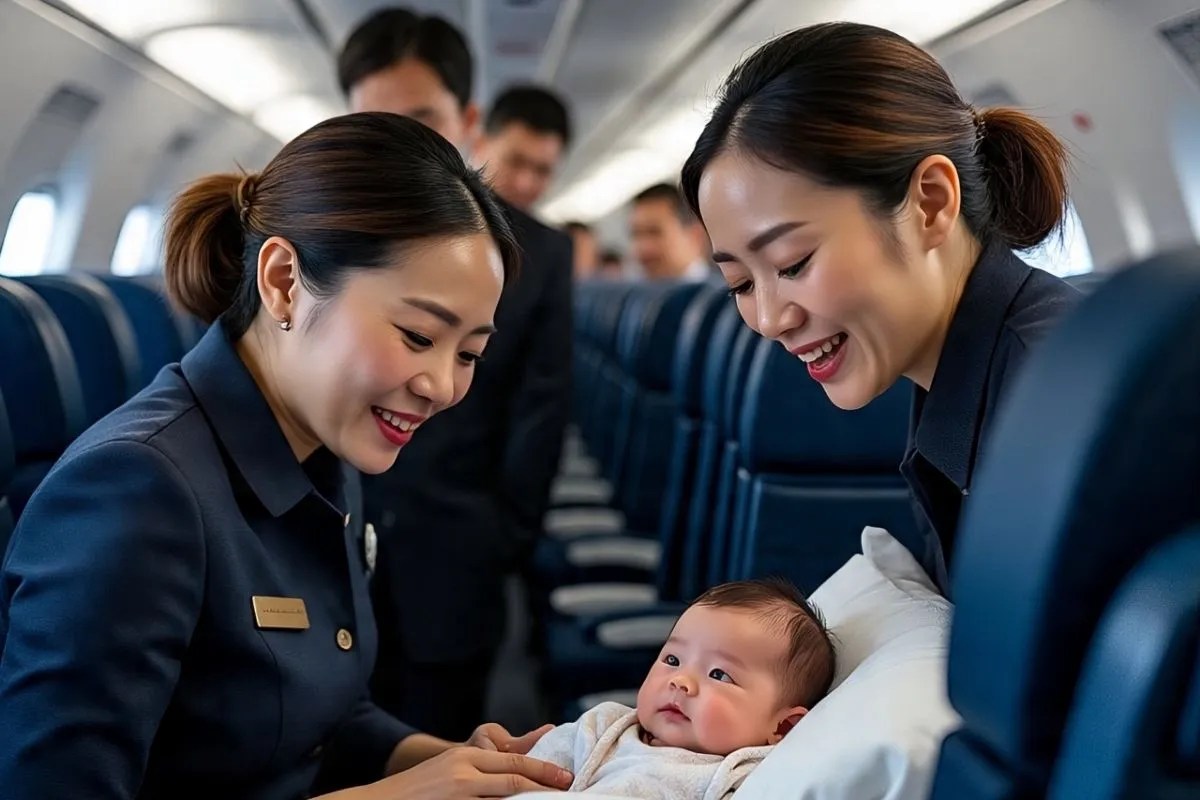
The hum of the engines at thirty-five thousand feet is usually a lullaby for the restless. It is a steady, mechanical drone that masks the sound of ice clinking in plastic cups and the rustle of safety manuals. But for a woman named Amina—let us call her that for the sake of the story—this hum became a frantic backdrop to the most terrifying hour of her life. She was somewhere over the Atlantic, suspended in the ink-black void between continents, when the first contraction ripped through the thin fabric of her travel plans.
Birth is messy, loud, and grounded. Aviation is sterile, calculated, and detached. When the two collide, the result is a legal and emotional storm that defies the neat lines drawn on our world maps. Amina didn’t care about international maritime law or the Chicago Convention when the flight attendants cleared a row of seats in economy. She cared about the grip of her husband’s hand and the sound of a cry that shouldn't have been heard for another three weeks. If you found value in this post, you should check out: this related article.
When that cry finally came, it wasn't just a new life entering the world. It was a legal enigma entering a jurisdiction that didn't technically exist.
The Invisible Geometry of the Sky
Most of us view the sky as a vast, open playground. To a lawyer specializing in international air space, it is a complex grid of invisible fences. When a baby is born on a flight, the first question isn't about the child's health—it's about the coordinates. For another look on this development, check out the latest coverage from National Geographic Travel.
There are two primary philosophies that dictate who we are the moment we take our first breath. The first is Jus Soli, or the right of the soil. This is the American way. If you are born on U.S. land, or in U.S. territorial waters, or indeed in U.S. airspace, you are a citizen. Period. It is a gift of geography.
But then there is Jus Sanguinis, the right of the blood. Most of Europe and Asia follow this path. In these jurisdictions, your birthplace is irrelevant; what matters is the DNA in your veins. You are who your parents are. If Amina was flying from London to Paris on a French-registered plane, and she herself was a citizen of Morocco, the dirt—or air—beneath her wouldn't grant her child a passport. The bloodline would be the only anchor.
The Sovereignty of the Aluminum Tube
Consider the metal shell of the airplane itself. Under the 1961 Convention on the Reduction of Statelessness, a birth on a ship or aircraft is often treated as if it occurred in the country where the vessel is registered.
This creates a surreal reality. Imagine a Boeing 777 registered in Norway flying over the heart of Brazil. A child born in seat 14B is, for a fleeting moment, a resident of a floating piece of Oslo. If Brazil doesn't recognize birthright citizenship for those just passing through its clouds, and the parents’ home country has restrictive laws, that Norwegian registration becomes the child's only shield against statelessness.
It sounds like a loophole. It feels like magic. Yet, it is a desperate legal patchwork designed to ensure that no human being begins their life as a ghost without a country.
The High-Altitude Lottery
The stakes are higher than a simple blue or red passport cover. We are talking about the right to work, the right to vote, and the right to return to a place you call home.
I once spoke with a man who had been a "sky-born" baby in the late seventies. He grew up with a birth certificate that listed longitudinal and latitudinal coordinates instead of a city and state. To a border agent, those numbers are a headache. To him, they were a badge of cosmic coincidence. He lived his life as a citizen of the United States because he was born over a cornfield in Kansas, even though his parents were non-citizens on their way to a new life.
Had that plane been delayed by two hours, or had the pilot pushed the throttle a bit harder, he might have been born over international waters. In that scenario, he would have defaulted to his parents' nationality. His entire life—his education, his career, his sense of identity—hung on the wind speed and the timing of a contraction.
When the Clouds Clear
Airlines generally hate this. They aren't equipped for it. The "doctor on board" call is the stuff of nightmares for pediatricians who haven't seen a delivery room since med school. Beyond the medical risk, the logistics are a nightmare. Does the plane divert? Who pays for the fuel dump? Who handles the paperwork when the flight lands in a third country that wasn't the destination or the origin?
In many cases, the child is granted the nationality of the parents regardless of where the plane was. Most countries want to keep things simple. But if the parents are refugees, or if they come from a nation that is currently in a state of collapse, the "right of the soil" in the sky becomes the only tangible asset that child owns.
The tragedy of the modern world is that we have mapped every inch of the earth but have left the sky as a gray zone. We treat the atmosphere as a transit corridor, a non-place where we wait to become ourselves again once we land. But life doesn't pause at thirty thousand feet. It persists. It forces its way into the world, indifferent to the fact that it is currently traveling at five hundred miles per hour.
The Weight of the Passport
We often take our citizenship for granted. It is the background noise of our existence. But for the child born in the clouds, citizenship is a hard-won prize. It is a document that proves they exist in a world that demands a "place of birth" on every form.
Amina’s child eventually received a passport. It wasn't easy. There were months of back-and-forth between embassies, a dizzying array of stamps, and a birth certificate that remains a conversation starter at every security checkpoint.
But look closer at that child. They represent something the rest of us have forgotten. They are a reminder that the borders we fight over, the walls we build, and the soil we claim as sacred are entirely invisible from above. From the cockpit of that plane, there are no lines on the ground. There is only the curve of the earth and the thin, fragile layer of air that keeps us all alive.
The next time you look out of an airplane window at the clouds below, remember that somewhere in that vast expanse, a life might be beginning. It is a life that starts in the "in-between," belonging to everyone and no one at the same time. It is a human story that no legal code can ever fully capture.
The child of the sky doesn't see a map. They see an open horizon. Perhaps there is a lesson in that for those of us with our feet planted firmly on the ground.