The map on the wall of a dusty command bunker in Tehran is never quiet. Lines of red and blue light bleed across borders, connecting capitals that have spent centuries locked in a volatile dance of suspicion and brief, uneasy truces. In this room, borders are not just ink on paper. They are tripwires.
Recently, a voice from the Iranian parliament cut through the usual diplomatic static with the raw edge of genuine alarm. A senior lawmaker stood before his peers and blasted a rising alignment between Saudi Arabia, Pakistan, and Türkiye. To the outside observer, it reads like dry diplomatic wire copy. Another pact. Another handshake in a gilded ballroom. Another bureaucratic communiqué translated from Farsi, Arabic, and Urdu.
Listen closer.
Underneath the rhetoric lies a fundamental reshaping of how power flows across the ancient crossroads of Asia and the Middle East. Security is currency. And right now, the exchange rate is shifting.
To understand why a murmur in Islamabad or Ankara sends shockwaves through Tehran, you have to step away from the podiums and walk the streets where history is actually lived. Imagine a young merchant in the grand bazaar of Isfahan, running calloused fingers over hand-woven carpets. He does not study defense memorandums. He does not track troop deployments or mutual defense clauses. But he feels the cost of every missile test, every sanctions package, and every sudden alignment of regional giants in the price of flour, the stability of his currency, and the heavy, quiet dread that settles over his dinner table when the evening news flickers on.
For decades, the security architecture of the region resembled a fragile puzzle. States eyed their neighbors with suspicion, forming temporary coalitions born of convenience rather than shared destiny. Iran, proud of its Persian heritage and singular geopolitical trajectory, has long viewed foreign-backed military entente on its borders as a tightening noose.
When Saudi wealth, Turkish manufacturing power, and Pakistani military muscle begin to lock gears, the geometry changes. This is not merely an exchange of pleasantries. It is the consolidation of a trilateral axis that brings together the financial weight of Riyadh, the sophisticated drone and defense technology of Ankara, and the nuclear-armed conventional might of Islamabad.
Consider what happens when these three forces begin to harmonize their training, intelligence sharing, and defense procurement.
To Tehran, this looks uncomfortably like a wall being built.
Yet, looking at this only through the lens of threat misses the human impulse driving it. Nations, much like people, seek shelter when the weather turns cold. The shifting sands of global alliances, the unpredictable posture of Western superpowers, and the constant, bleeding friction of proxy conflicts have left regional capitals searching for anchors. Riyadh wants strategic depth to secure its massive economic transformation projects. Ankara seeks to project influence across its historic Ottoman backyard while safeguarding its southern borderlands. Islamabad navigates economic turbulence by cementing ties with wealthy Gulf patrons and long-standing regional partners.
Everyone is hedging their bets.
And that is where the danger lives. In international relations, when one nation builds a fence to keep the storm out, its neighbor invariably assumes the fence is made of bayonets pointing inward.
The Iranian lawmaker's public condemnation was not just a political maneuver for domestic consumption. It was a flare shot into the dark sky. It was an admission of a nightmare scenario: becoming geopolitically isolated while traditional rivals stitch together a pan-regional security umbrella that bypasses Persian influence entirely.
History is littered with the wreckage of pacts born from mutual anxiety. When alliances form primarily out of what nations fear rather than what they love, the margin for error shrinks to the thickness of a razor blade. A miscalculated border clash, a misunderstood naval exercise in the Arabian Sea, or a cyber incident traced back to one of these allied capitals could cascade through the system with terrifying speed.
There are no neutral observers left in this theater.
Every citizen from the Mediterranean coast to the Hindu Kush is a stakeholder in this quiet consolidation of power. We are watching the redrawing of invisible lines that will dictate trade routes, fuel prices, and the likelihood of peace for a generation.
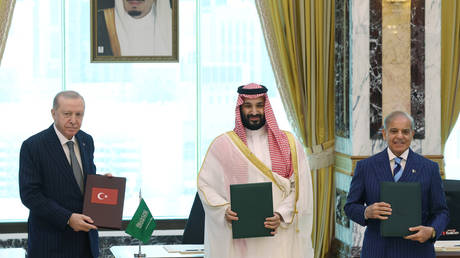
The diplomats will smile for the cameras. They will sign the documents on mahogany tables, flanked by forest green flags. They will speak of stability, cooperation, and mutual respect.
But back in the bunker, the red and blue lights keep blinking. The map keeps changing. And the human cost of these grand designs remains, as it has always been, deferred to the people who never got a vote on where the walls should go.