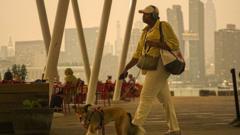
A toxic, orange-grey shroud has settled over the heart of North America. More than 850 wildfires are tearing through the Canadian wilderness, sending thick plumes of particulate-laden smoke across the border to choke major American cities from Detroit to New York. Tens of millions of people are breathing hazardous air, public events are being cancelled, and local officials are scrambling to distribute face masks. This is not a temporary freak weather event. It is the predictable outcome of a broken forestry strategy, systemic underfunding, and an ecological crisis that ignores international borders.
The immediate crisis is staggering in its geographic scale. As northwest winds push the smoke plume south, cities like Detroit, Minneapolis, and Toronto have repeatedly registered the worst air quality on the planet. On the ground in Ontario, the situation has turned desperate. In remote areas near Armstrong, wildland fires have cut off escape routes, forcing members of the Namaygoosisagagun First Nation to flee across lakes by boat under a sickly yellow sky. The community of Collins has been virtually erased by the flames. A viral video captured the terrifying reality of a Canadian National freight train running through a gauntlet of active flames, its crew trapped in a literal wall of fire before being rescued.
Yet, as Americans are told to stay indoors and keep their windows shut, a deeper friction is igniting. There is a growing, uncomfortable truth that neither Washington nor Ottawa wants to fully confront: the current approach to managing the continent's forests is completely unsuited for the climate realities of the late 2020s.
The Great Borderline Blame Game
Air pollution has always been an awkward diplomatic issue, but the current wildfire crisis is pushing relations to a boiling point. In Michigan, Republican lawmakers have taken the unusual step of sending an open letter directly to Canadian Prime Minister Mark Carney. Their message was blunt, expressing exhaustion that American citizens are suffering the consequences of Canadian forest management failures for yet another year.
"A year has passed, the season has come around again, and nothing has changed except that our patience has run out," the letter stated.
This frustration is understandable to anyone coughing through a hazy morning commute in Detroit or Boston. It is also fundamentally simplistic. Forest management is easy to criticize from a legislative office in Lansing, but the physical reality of the Canadian boreal forest defies easy solutions.
Canada contains roughly nine percent of the world’s forests. The vast majority of this land is remote, virtually inaccessible by road, and sparse. Suggesting that Canadian fire crews can simply suppress every blaze that ignites across millions of square kilometers of dense, dry timber is a fantasy. For decades, the prevailing strategy has been one of modified response: letting remote fires burn because they are part of a natural ecological cycle.
But that policy was designed for an era that no longer exists. Today, a historic El Niño pattern has turned the boreal forest into a tinderbox. Winter snowpacks are melting earlier, summer temperatures are shattering records, and prolonged droughts have sucked the moisture out of the forest floor. When a fire starts now, it does not just clear out undergrowth; it consumes entire ecosystems, burning so hot and deep into the soil that traditional suppression methods are useless.
The Illusion of Preparedness
When a major environmental crisis hits, governments like to announce funding packages and express solidarity. Behind the scenes, however, the infrastructure required to fight these fires is quietly buckling.
Wildfire fighting is grueling, dangerous, and seasonal work. Across Canada, provincial agencies have struggled for years to recruit and retain experienced personnel. The pay is relatively low, the physical toll is immense, and the fire season now stretches for six months or more rather than just a few weeks in July and August. Experienced crew leaders are leaving the sector in droves, replaced by younger, less experienced recruits who are thrown into increasingly volatile conditions.
Furthermore, the physical equipment needed to combat these megafires is in short supply. Water bombers and heavy helicopters are incredibly expensive to maintain and operate. During peak fire season, provinces must negotiate with each other—and with international allies—to share resources. When hundreds of fires are burning simultaneously across Ontario, Quebec, and western Canada, those resource-sharing agreements break down. There simply are not enough planes or pilots to go around.
This leaves emergency management agencies in a defensive posture. Instead of actively fighting fires, they are forced to prioritize protecting human life and critical infrastructure, leaving millions of hectares of forest to burn unchecked. The resulting smoke is not an accident; it is the natural consequence of a containment strategy that has run out of resources.
The Human Toll Far Beyond the Flames
While the immediate danger is felt by those fleeing the flames in Ontario, the long-term public health consequences are being distributed across the entire eastern half of the United States. Wildfire smoke is not just wood ash. It is a complex, toxic cocktail of carbon monoxide, volatile organic compounds, and fine particulate matter known as PM2.5.
These microscopic particles are less than 2.5 micrometers in diameter. They are small enough to bypass the respiratory tract's natural defenses, traveling deep into the lungs and entering the bloodstream.
Recent epidemiological data highlights the terrifying scale of this invisible threat. A study published earlier this year estimated that long-term exposure to fine particulate matter from wildfire smoke contributes to an average of 24,100 premature deaths annually in the United States alone. The spike in emergency room visits for asthma, cardiovascular issues, and respiratory infections during smoke events is well-documented, but the chronic, long-term impact of breathing this air year after year is still being calculated.
In New York City, Mayor Zohran Mamdani recently activated emergency heat and air quality protocols, opening cooling centers and distributing KN95 masks to vulnerable populations. Yet these measures are mere band-aids on a gaping wound. We are asking millions of people to alter their daily lives, telling children they cannot play outside, and advising adults that their morning jog could permanently damage their lungs.
A Broken Treaty of the Skies
The current crisis exposes a massive gap in international environmental law. The United States and Canada have a long history of cooperation on transboundary air pollution, most notably through the 1991 Air Quality Agreement. This treaty successfully addressed the scourge of acid rain by cutting sulfur dioxide and nitrogen oxide emissions from industrial plants.
But the Air Quality Agreement was built to regulate smokestacks, not burning forests. There is no legal mechanism to hold a country accountable for emissions originating from natural disasters, even if those disasters are exacerbated by policy failures or inadequate budget allocations.
As long as wildfire smoke is treated as an act of God rather than a systemic policy issue, there will be little incentive for either government to invest the massive capital required to reform land management practices. The United States cannot sue Canada for the smoke, and Canada cannot force its provincial governments to standardize their fire-response budgets.
Instead, we are left with a dysfunctional status quo. The smoke drifts south, the politicians exchange letters, and the public is left to monitor color-coded air quality apps, hoping for a shift in the wind.
The skies may clear temporarily when the wind directions shift toward the north next week. But the underlying conditions have not changed. The forests remain dry, the fire season is far from over, and the next plume of smoke is already gathering on the horizon. We cannot negotiate with the wind, and we can no longer afford to ignore the burning forests at our northern gate.


