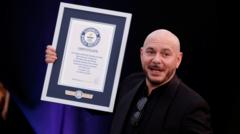
Armando Christian Pérez, known globally as Pitbull, just turned London’s Hyde Park into a massive, coordinated branding exercise disguised as a communal dance party. During his performance at the BST Hyde Park festival, thousands of fans simultaneously donned silicone masks of the artist's face, securing an official Guinness World Record for the largest gathering of people wearing lookalike masks.
While the crowd celebrated a moment of seemingly spontaneous, high-energy fun, the event actually serves as a masterclass in modern entertainment marketing. Achieving a Guinness World Record at a major music festival is rarely a stroke of luck. It is a highly engineered logistical feat that bridges the gap between mass fan engagement and corporate brand equity. In an era where live music touring costs are skyrocketing and artist-to-fan connections are increasingly mediated by algorithms, Pitbull’s London stunt provides a blueprint for how legacy pop acts can manufacture cultural relevance and command global headlines without relying on a new hit single.
The Engineering of a Modern Crowd Spectacle
Pop concerts used to be passive viewing experiences. You bought a ticket, you stood in a field, you watched the performer. Today, the live music economy demands participation.
To pull off a certified record, the logistics must be flawless. For the Hyde Park attempt, thousands of specialized, identical masks had to be manufactured, shipped, and distributed to a fluid, moving crowd of festival-goers. This requires a small army of event staff, strict stewarding, and precise timing. According to official Guinness guidelines for mass gatherings, participants must stay in a designated area and maintain the record-breaking condition—in this case, keeping the masks securely on—for a specified, unbroken duration.
It is a high-stakes gamble for a promoter. If the crowd refuses to cooperate, or if the distribution bottlenecks at the security gates, the stunt collapses under its own weight. The financial outlay for the props, the adjudication fees, and the staff hours becomes a total loss.
Yet, Pitbull’s team understood a fundamental truth about modern festival audiences. People want to be part of the show. By transforming the audience from spectators into active participants in a world record, the organizers guaranteed a level of crowd engagement that a standard festival set simply cannot replicate.
The Guinness Premium and the Currency of Attention
Why chase a Guinness World Record in the first place? The answer lies in the unique way global media consumption has fractured.
A successful music chart debut no longer holds the monocultural weight it did twenty years ago. Streaming metrics are easily manipulated, and radio play is heavily segmented. A Guinness World Record certificate, however, remains a universally understood symbol of achievement. It cuts through the noise. It translates perfectly across international news desks, social media feeds, and morning talk shows.
Stunt ROI Component     Estimated Resource Investment    Strategic Media Value
--------------------------------------------------------------------------------------
Prop Manufacturing      Moderate (Bulk printing)        High visual footprint
Official Adjudication   High flat fee                   Instant global credibility
Staff Logistics         High operational demand         Guaranteed crowd control
For Pitbull, an artist who has successfully transitioned from a Miami rap fixture to a corporate-friendly global ambassador of optimism, this record is pure marketing gold. It reinforces his core brand identity. He is "Mr. Worldwide," a figure associated with boundless energy, global unity, and unpretentious fun. The visual of thousands of people wearing his face is surreal, slightly absurd, and instantly shareable. It is tailor-made for the TikTok era, where striking, bizarre imagery drives organic reach far better than a standard press release.
The Post-Pandemic Live Music Crisis
To understand why a veteran artist resorts to mass mask-wearing stunts, one must look at the brutal realities of the current touring market. The live music industry is trapped in a paradox. Ticket prices are at an all-time high, yet independent festivals are collapsing at an alarming rate due to inflation, soaring production costs, and shifting consumer habits.
Audiences are becoming far more selective about where they spend their discretionary income. A line-up featuring great music is no longer enough to guarantee a sell-out. Festivals need moments. They need distinct, unmissable events that make the attendee feel as though they are participating in a historic cultural milestone.
The Illusion of Authenticity
This shifts the burden onto the artists. Performers are no longer just delivering a musical set; they are expected to facilitate a communal experience.
Critics often dismiss these stunts as cheap gimmicks that detract from the musical integrity of a live performance. There is a valid argument that turning a concert into a record-breaking attempt reduces art to a corporate activation. When a crowd is instructed exactly when to put on a mask and how long to stand still for a adjudicator's camera, the raw, unpredictable magic of live rock and roll or hip-hop is replaced by corporate choreography.
But the modern pop music landscape has little room for purism. Pitbull has survived in a notoriously fickle industry by leaning into the theatricality of his persona. He does not pretend to be a brooding, reclusive auteur. He is an entertainer. By aligning his show with a structured, record-breaking event, he delivered exactly what the Hyde Park crowd wanted: a collective memory and a distinct photo opportunity to prove they were there.
The Blueprint for Legacy Acts
The success of the Hyde Park spectacle will likely trigger a wave of imitators across the summer festival circuit. Legacy artists who rely on catalog hits rather than current chart positioning need innovative ways to keep their names in the cultural conversation.
We are likely to see an increase in these highly structured, participatory stunts at major European and American festivals. Whether it is synchronized lighting, mass costume changes, or coordinated digital displays via audience smartphones, the boundary between the stage and the crowd will continue to erode.
The strategy is not without risk. If an artist attempts a similar record and fails due to poor crowd turnout or logistical mismanagement, the resulting public relations fallout can be deeply embarrassing. It exposes the machinery behind the celebrity facade, revealing a desperate bid for relevance rather than a triumphant moment of fan connection.
Pitbull walked that tightrope in London and won. He neutralized the inherent cynicism of a corporate stunt by leaning completely into the joy of the absurd. The thousands of fans sweating under silicone masks in Hyde Park didn't care about the marketing metrics or the logistical calculations driving the afternoon. They wanted to be part of a moment that felt larger than life, and for fifteen minutes under the London sun, they were.