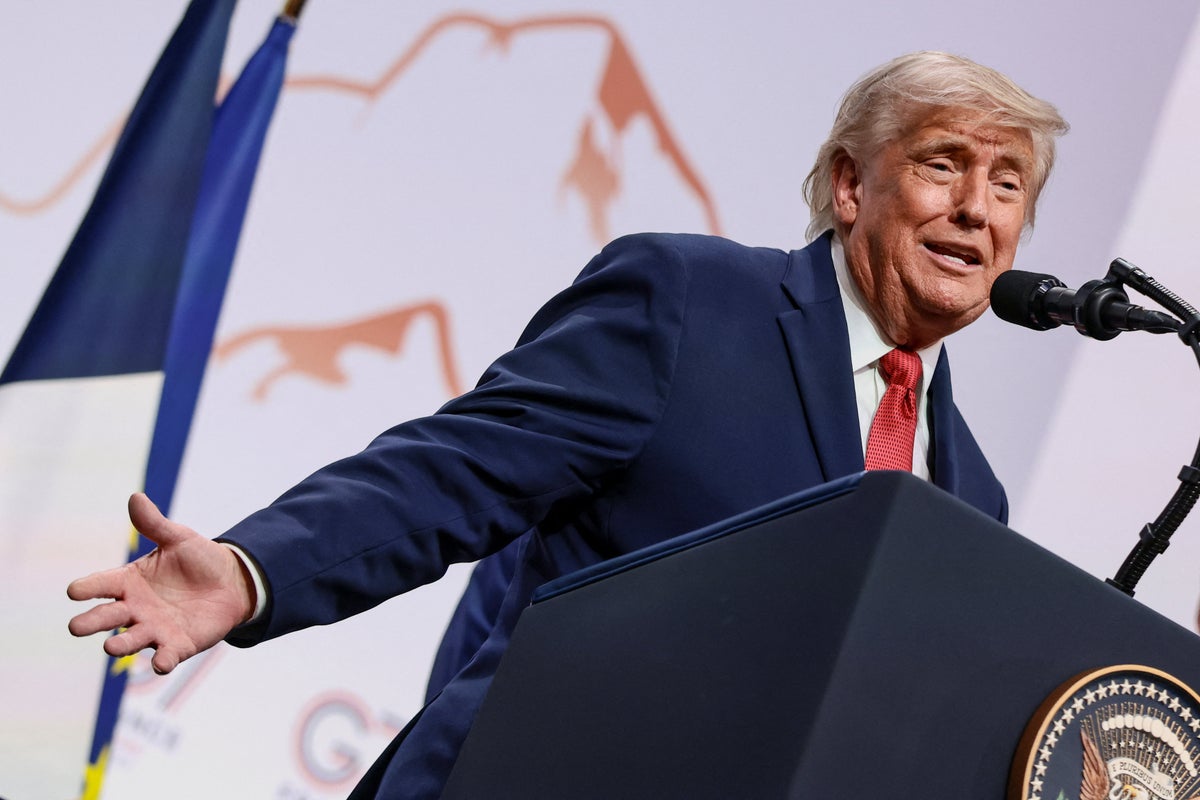
Donald Trump laid bare the exact terms of his political partnership with Vice President JD Vance during a G7 press conference in France. Confronted with the staggering stakes of a tentative memorandum of understanding intended to halt the Middle East war, Trump openly detailed his strategy for managing the potential fallout. If the high-stakes accord with Tehran succeeds, Trump will claim absolute ownership. If it collapses into renewed regional violence, the blame will be funneled entirely to his vice president.
"This way, if it works out, I'm going to take the credit," Trump stated, confirming he favored the idea of using Vance as a diplomatic shield. "If it doesn't work out, I'm blaming JD.".
The casual pronouncement was delivered with a characteristic grin, but the structural reality underlying the remark is anything but a joke. Behind the theatrical humbug lies a sophisticated institutional insulation strategy. By deploying Vance to sign a highly volatile, unratified document, Trump preserves his own political capital while testing the structural loyalty of the heir apparent to the America First movement. This maneuver exposes a profound, simmering ideological friction inside the administration over the entire architecture of American foreign policy.
The Anatomy of a Memorandum Shield
A memorandum of understanding is a notoriously fragile instrument of statecraft. It is not a formal treaty requiring Senate ratification, nor does it possess the permanent force of international law. It is an executive-level handshake, highly vulnerable to shifting political winds and immediate violations on the ground.
Trump signaled his deep ambivalence about the arrangement by explicitly noting the document might not be the kind of accord he should directly sign. The solution was to dispatch Vance to handle the formal signing ceremony.
This structure creates a distinct operational layer between the presidency and a foreign policy gamble that could fall apart within weeks. The terms of the tentative deal require Iran to dismantle portions of its enriched uranium stockpile, yet Trump has simultaneously threatened to resume intense airstrikes if Tehran fails to comply. By positioning Vance at the signing table, Trump establishes a built-in escape hatch. If the clerical regime in Tehran cheats, or if domestic political blowback from hawkish factions becomes too severe, the administration can pivot instantly by framing the failure as a logistical breakdown overseen by the vice president's team.
Deep Ideological Friction Under the Surface
The tactical positioning reveals a deeper tension regarding international intervention that has characterized the relationship between both men. Vance entered national politics as a prominent voice for restraint, routinely arguing that the United States must stop squandering blood and treasure on protracted foreign entanglements. His past public statements drew a sharp line against expansive operations in the Middle East.
Trump has acknowledged this foundational divide. Earlier this year at his Doral golf resort, the president admitted to reporters that Vance was philosophically a little bit different regarding the initial military operations against Iranian targets. Trump noted that his vice president was noticeably less enthusiastic about launching the strikes, even as he downplayed any functional rift.
| Foreign Policy Dimension | The Trump Doctrine | The Vance Framework |
|---|---|---|
| Use of Force | High-leverage, unilateral kinetic strikes | Strict avoidance of protracted overseas commitments |
| Diplomatic Agreements | Transnational transactions driven by executive dominance | Systemic skepticism of long-term foreign obligations |
| Accountability Model | Centralized praise, distributed institutional blame | Execution of policy goals despite philosophical doubts |
This friction undercuts the projection of a unified executive branch. Vance has spent months defending the administration's aggressive actions on conservative media, explicitly attempting to differentiate the current strategy from the decade-long nation-building failures of the Iraq War era. Yet, by forcing Vance to front an unpredictable diplomatic agreement, Trump forces his vice president to shoulder the explicit risk of a policy he initially viewed with skepticism.
The High Cost of the Success Or Blame Subcontract
Subcontracting the risk of major international agreements alters the traditional mechanics of vice-presidential succession. Historically, running mates are assigned secondary domestic initiatives or symbolic foreign tours to build up their statesman credentials without endangering the core executive agenda.
Trump has inverted this convention. The vice presidency becomes an operational buffer zone where high-risk liabilities are processed.
The immediate political fallout lands squarely on Vance's future ambitions. Republican factions are already deeply divided over the administration's aggressive posture, with populist isolationists expressing frustration over the departure from strict domestic priorities. If Vance signs a deal that fails to permanently neutralize Tehran's nuclear ambitions, his standing as the natural successor to the populist movement in 2028 will face immediate challenges from internal rivals. He will be stained by the failure, while Trump remains insulated, free to declare that his subordinates simply failed to execute his grand vision.
Statecraft under this framework operates as a zero-sum corporate hierarchy where the chief executive retains the equity of success and spins off the liabilities of failure to the junior partner. Vance has accepted these terms, betting that total public compliance will protect his long-term standing. The upcoming implementation of the memorandum will prove whether that gamble holds, or if he has willingly walked into a trap designed to preserve the principal at the expense of the deputy.