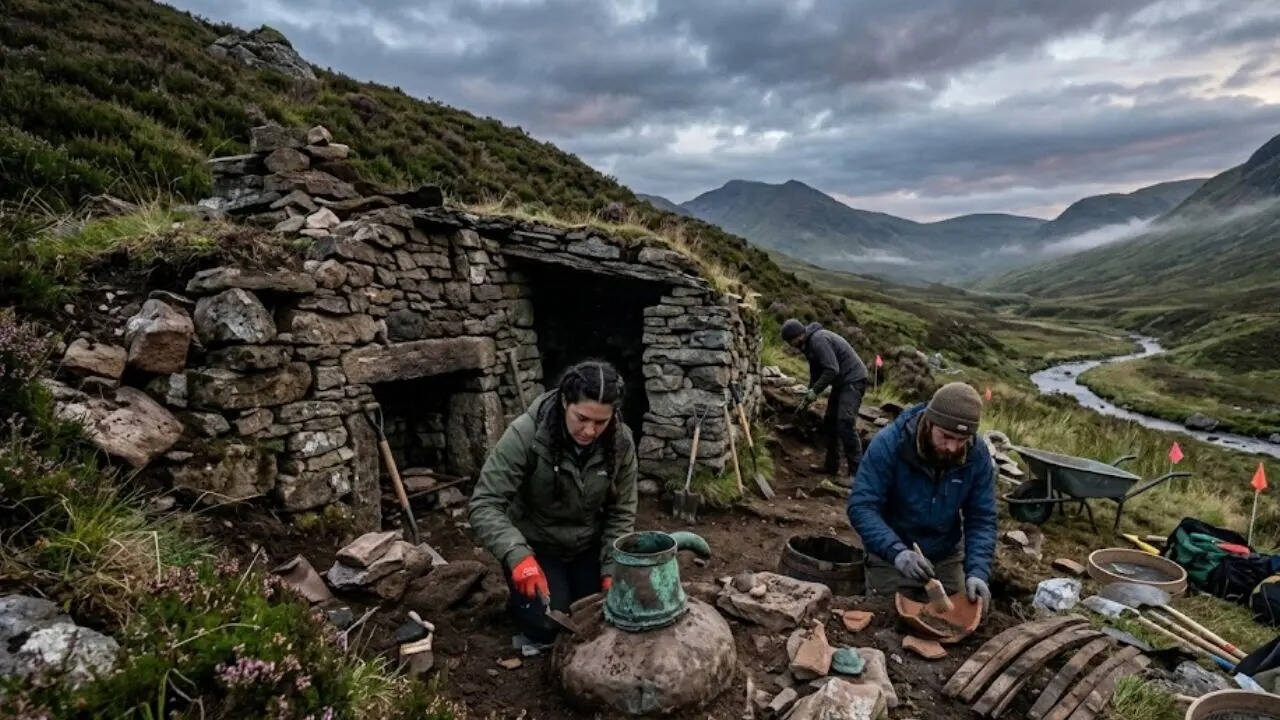
Archaeologists recently pulled back the heather on a remarkably well-preserved 19th-century whisky distillery hidden in the rugged folds of the Cairngorms. While initial reports framed this as a quaint discovery of "lost heritage," the reality is far more gritty. This site represents the front lines of a forgotten economic war. In the 1800s, these remote glens weren't just scenic backdrops; they were a high-stakes network of industrial resistance where local distillers risked everything to bypass the crushing grip of the British Excise tax.
The Architecture of Defiance
The remains found near the River Dee are not the ruins of a legitimate business that fell on hard times. This was a "bothy" distillery, a clandestine operation built specifically to vanish into the terrain.
To understand why a group of highlanders would lug heavy copper stills and bags of barley into a desolate mountain pass, you have to follow the money. In 1823, the Excise Act sought to formalize the whisky trade. It demanded a £10 license fee and a set payment per gallon of spirit produced. For a small-scale crofter, those terms were a death sentence. The choice was simple: starve or go underground.
The site reveals a sophisticated understanding of logistics and concealment. These weren't amateur setups. The structures were often built into hillsides, with turf roofs that rendered them invisible from a distance. They utilized the freezing meltwater of the Highlands to cool their worm tubs—the coiled pipes where steam turns back into liquid gold—while the peat smoke, which would normally give away their position, was often diverted through underground flues or released only under the cover of heavy mist or darkness.
Tax Evasion as a Cultural Identity
The conflict between the "Gaugers"—the excise officers—and the illicit distillers was a cat-and-mouse game that defined the Highland economy for decades. It was a brutal, physical struggle.
History often romanticizes the smuggler, but the men and women running these hidden stills lived in constant fear of informants and raids. A single discovery meant the destruction of their equipment and likely a prison sentence. Yet, the community was almost entirely complicit. It was a collective middle finger to a Westminster government that seemed intent on taxing the North into oblivion.
We see this reflected in the very design of the equipment. Portable stills were prized. If the word came down the glen that the Gaugers were approaching, the entire operation had to be stripped and hidden in a peat bog within minutes. The archaeological record shows us a "lean" manufacturing process born out of pure necessity.
The Myth of the Pure Spirit
Modern marketing would have you believe that these illicit spirits were the pinnacle of craft. The truth is much more complicated. Without the oversight of the law, quality varied wildly.
While some distillers took pride in their "uisge beatha," others were not above stretching their product with less-than-ideal ingredients. However, the illicit trade actually forced a specific type of innovation. Because they couldn't age their spirits in large warehouses for years—lest they be seized—the distillers focused on heavy peat smoke and small-batch intensity to mask the harshness of young spirit. This profile, born of the need to move product fast, eventually became the signature of Highland and Islay whiskies that the world craves today.
The Business of Being Caught
When the 1823 Act finally lowered the barriers to entry, it didn't immediately end the underground trade. It just changed the math. Large landowners began to realize that they could make more money by helping their tenants go legal than by turning a blind eye to the stills.
The Duke of Gordon, for instance, famously encouraged George Smith to take out the first legal license in the Glenlivet valley. Smith’s reward for "turning" was a pair of pistols to defend himself against his former colleagues who viewed him as a traitor to the cause. The archaeology of these hidden sites marks the exact point where the rugged, individualist economy of the Highlands was forcibly integrated into the global British Empire.
Beyond the Stones and Turf
What the excavators are finding today isn't just stone walls and charred wood. They are uncovering the remnants of a survival strategy.
Every shard of glass and every trace of barley found at these high-altitude sites tells a story of a population that refused to be regulated out of existence. These ruins are a reminder that the Scotch whisky industry wasn't built in the boardroom; it was forged in the mud, through the sheer stubbornness of people who preferred the risk of the mountain to the safety of the taxman’s ledger.
The next time you see a bottle of single malt with a high price tag and a glossy label, look past the branding. The DNA of that spirit belongs to a group of rebels in a damp stone hut, watching the horizon for a red coat while the spirit dripped slowly into a wooden bucket. The real history of whisky is written in the dirt of the Highlands, in places that were never meant to be found.
The preservation of these sites is a race against time and the elements. As the peat shifts and the climate changes, the evidence of this massive, shadow industry is eroding. We are losing the physical proof of a time when an entire region operated outside the law, driven by a mixture of poverty, pride, and an intimate knowledge of the land. These hidden distilleries are the last witnesses to a world where the line between a businessman and a criminal was nothing more than a paid-up license and a government stamp.