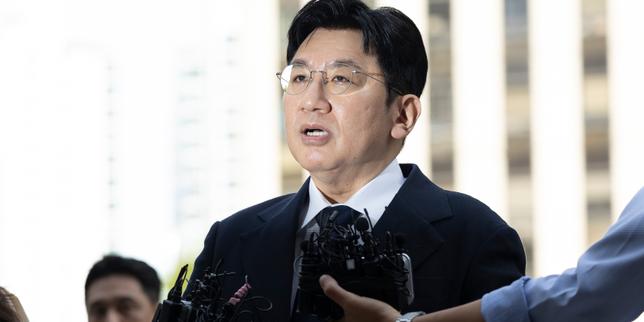
Bang Si-hyuk built a fortress on the backs of seven men, but the walls are finally cracking. The mastermind behind BTS, known to the world as "Hitman" Bang, currently faces a legal and reputational firestorm in South Korea that threatens to dismantle the very industry he revolutionized. This is not just a story about a music mogul in trouble; it is a clinical look at how the aggressive pursuit of corporate expansion and a "multi-label" strategy created a toxic environment that South Korean regulators and criminal investigators can no longer ignore.
The core of the crisis stems from allegations of market manipulation, the mistreatment of executives, and a power struggle that has exposed the dark underbelly of K-pop’s corporate governance. While the public focuses on the potential for arrests, the real damage lies in the systemic failure of HYBE to manage its own internal culture. Bang’s ambition to turn a talent agency into a tech-driven lifestyle platform has left the company overleveraged and legally vulnerable.
The Illusion of the Multi Label System
When HYBE rebranded from Big Hit Entertainment, Bang Si-hyuk sold investors a dream of diversification. By acquiring smaller labels like Pledis, Source Music, and ADOR, he argued that HYBE would no longer be solely dependent on the success of BTS. It looked brilliant on a balance sheet. In practice, it created a series of warring fiefdoms.
The most public fracture involved Min Hee-jin, the creative force behind the girl group NewJeans. The ensuing legal battle wasn't just a personnel dispute. It was a disclosure of how HYBE operates. Leaked internal documents and court filings suggest a pattern of surveillance, workplace harassment, and attempts to "standardize" creativity that rubbed against the independence promised to these sub-labels.
Regulatory bodies in Seoul are now looking at whether HYBE’s top brass engaged in unfair trade practices to suppress internal competition. The South Korean Fair Trade Commission (FTC) has been circling the company, investigating whether it abused its dominant market position. For a company that trades on the "wholesome" image of its idols, the revelation of cutthroat, potentially illegal corporate maneuvering is a death knell for brand equity.
Financial Engineering and Market Manipulation Risks
Money is the root of the current legal peril. The Financial Supervisory Service (FSS) has been scrutinizing the massive stock movements associated with HYBE’s acquisitions and the personal divestments of its executives.
The pressure is immense. K-pop is no longer a niche export; it is a pillar of the South Korean economy. When a company the size of HYBE faces allegations of stock price manipulation, it becomes a matter of national economic security.
- Stock Volatility: HYBE’s share price has become a rollercoaster, reacting more to courtroom drama than to album sales.
- The BTS Gap: With members serving in the military or pursuing solo projects, the company’s revenue streams are under heavy stress, leading to desperate measures to keep margins high.
- Institutional Skepticism: Global investors who once saw K-pop as a safe bet are now pricing in "governance risk," a term that usually precedes a mass exodus of capital.
Bang Si-hyuk’s personal involvement in these financial decisions is the primary focus of investigators. If it can be proven that he directed or had knowledge of activities intended to artificially inflate the company's value during key acquisition windows, an arrest warrant is not just a possibility—it is a logical next step for a prosecution team under pressure to show they aren't soft on "chaebol-style" corruption.
The Human Cost of the Hitman Strategy
We often talk about K-pop in terms of "training periods" and "visuals." We rarely talk about the psychological toll of the corporate machinery on the executives and staff who keep the lights on. The "Hitman" persona was once a badge of honor for Bang, signifying his ability to craft hits with mathematical precision. Today, it feels more like a description of his management style.
Internal reports describe a "burn and discard" culture. Staff members at HYBE headquarters in Yongsan speak of 100-hour work weeks and a climate of fear where questioning the central leadership is viewed as treason. This isn't just bad for morale; it's a structural weakness. When a company loses its best creative minds because they can't stand the environment, the product inevitably suffers. We are already seeing this in the "cookie-cutter" feel of some recent debuts under the HYBE umbrella.
The Geopolitical Fallout
Seoul is watching this closely because HYBE is a soft-power juggernaut. The South Korean government has used BTS as diplomatic avatars for years. Seeing the architect of that success in handcuffs would be a massive embarrassment on the global stage.
However, the current administration in South Korea has made "fairness" in the capital markets a central campaign promise. They cannot afford to look like they are protecting a music mogul while ordinary investors lose their savings to market manipulation. This puts Bang Si-hyuk in a pincer movement: he is too big to fail, but too visible to ignore.
The SM Entertainment Ghost
Much of the current animosity can be traced back to the botched attempt to hostilely take over SM Entertainment. That move signaled to the entire industry that HYBE wasn't just looking to grow—it was looking to monopolize. The fallout from that failed bid left a paper trail of communications that investigators are still picking through. It revealed a level of arrogance that has turned former allies into witnesses for the prosecution.
Transparency as a Survival Tactic
HYBE has attempted to pivot by hiring heavy-hitting legal teams and launching PR campaigns centered on "new management." It isn't working. You cannot fix a systemic transparency issue with a new press release.
For the company to survive without Bang Si-hyuk at the helm—a scenario that institutional investors are now actively modeling—there must be a total purging of the shadow-management structures that currently exist. The "Chairman’s Office" at HYBE operates with a level of opacity that belongs in the 1980s, not in a modern, publicly traded global corporation.
The End of the Founder Era
The K-pop industry is maturing, and with that maturity comes the painful transition from founder-led cults of personality to institutionalized corporate governance. Lee Soo-man (SM), Yang Hyun-suk (YG), and Park Jin-young (JYP) all faced their own reckonings. Bang Si-hyuk is simply the last and largest domino to wobble.
The tragedy of the situation is that Bang really did change the world. He proved that a small agency from a non-Western country could dominate the Billboard charts through sheer grit and digital savvy. But the skills required to build a startup are rarely the skills required to manage a multi-billion dollar conglomerate.
The "Hitman" is currently learning that in the world of high finance and criminal law, there are no fan votes to save you. The evidence doesn't care about your Billboard 200 ranking. It only cares about the ledger.
The next few months will determine if HYBE remains the leader of the Hallyu wave or becomes a cautionary tale of what happens when a founder's ego outpaces their legal department’s ability to say "no." If the authorities move forward with an arrest, the shockwaves will be felt from the boardrooms of Wall Street to the streets of Seoul.
The industry must prepare for a post-Bang Si-hyuk reality.


