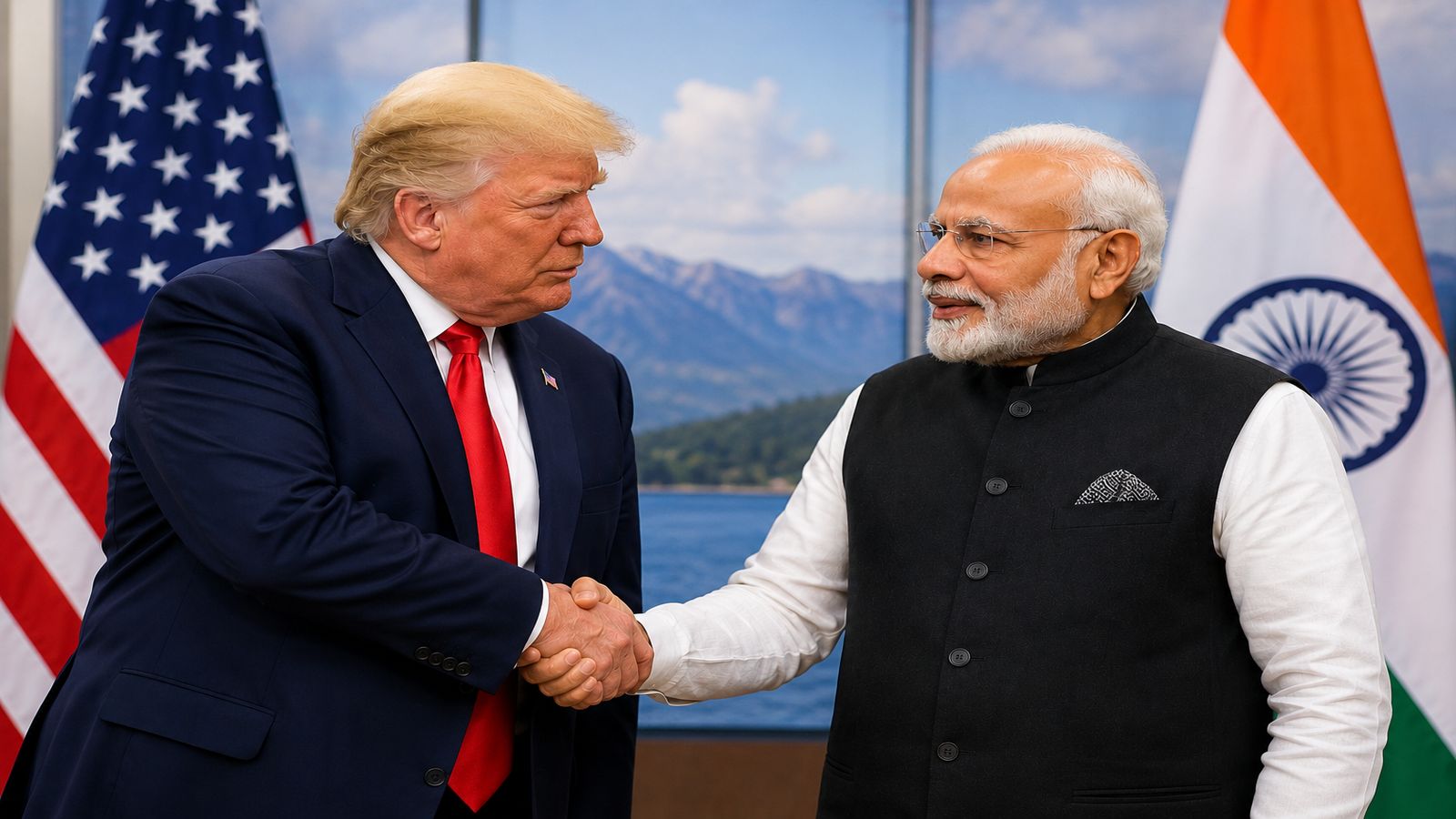
The televised handshakes between Donald Trump and Narendra Modi at the G7 summit in Evian, France, suggested a restoration of the warm personal chemistry that defined their earlier interactions. Cameras captured smiles, firm grips, and familiar declarations of mutual respect. But behind this staged diplomatic theater lies a relationship defined by unprecedented friction, commercial coercion, and literal casualties. The public narrative of two global powers smoothly aligning their strategic interests is a carefully managed illusion. In reality, Washington and New Delhi are locked in a cold, transactional struggle where geopolitical cooperation is constantly held hostage by trade penalties and divergent national egos.
The immediate catalyst for the current tension is not merely a dispute over export duties or intellectual property. It involves the bodies of Indian merchant sailors killed by American military action in the Middle East.
Blood in the Strait of Hormuz
On June 10, a United States military strike targeted the Palau-flagged oil tanker MT Settebello off the coast of Oman, enforcing a strict maritime blockade amid the widening regional war involving Iran. The attack disabled the vessel but also killed three Indian crew members, including deck cadet Aditya Sharma, engine fitter Shivanand Chaurasiya, and chief engineer Patnala Suresh. The incident followed a similar American strike two days earlier on another commercial vessel, the Marivex, which carried two dozen Indian seafarers.
New Delhi responded with uncharacteristic diplomatic fury. The Ministry of External Affairs summoned the American Chargé d'Affaires in New Delhi twice in forty-eight hours, lodging a vehement protest against the use of lethal force against civilian shipping. For a country that prides itself on protecting its global diaspora, the killings were an outright humiliation.
Yet, when Modi sat down with Trump in Evian, the public readout minimized the tragedy. The official briefing noted that Modi underlined the importance of the safety of seafarers and freedom of navigation, wrapping a profound national grievance in the sterile vocabulary of international maritime law.
The political calculations behind this restraint are obvious but grim. Modi faces intense domestic pressure from opposition parties who accuse his government of displaying a weak, submissive posture toward Washington. At the same time, the Indian prime minister cannot afford to alienate a mercurial American president when a multi-billion-dollar trade deal hangs in the balance. United States Secretary of State Marco Rubio defended the strikes, maintaining that Washington will tolerate zero violations of its blockade in the Strait of Hormuz. This rigid stance leaves New Delhi with no recourse but to absorb the domestic political damage while attempting to salvage economic negotiations.
The Nobel Prize Dispute and the 50 Percent Tariff Weapon
To understand how the relationship deteriorated to this point, one must look back to the hidden diplomatic crisis of May 2025. Following a brief but intense military escalation between India and Pakistan, a fragile ceasefire was established. Almost immediately, Trump publicly claimed direct credit for mediating the truce. Sources within the diplomatic corps confirm that the White House was actively eyeing the achievement as a foundational piece for a Nobel Peace Prize nomination.
New Delhi broke the script. Adhering to its decades-old policy of strict bilateralism regarding Pakistan, the Indian government issued flat denials of any American third-party intervention. India insisted the ceasefire was achieved through direct military channels without foreign assistance.
This public contradiction deeply insulted the American president. The retaliation was swift and economic. Trump abruptly cancelled his planned August 2025 visit to New Delhi for the Quad summit, sending Marco Rubio in his place and leaving Indian planners with a massive logistical and diplomatic void.
The true punishment came from the United States Trade Representative. Labeling India the maharaja of tariffs, the Trump administration unleashed a staggering 50 percent total duty on Indian goods. The penalty was structured in two layers. A baseline 25 percent reciprocal tariff was applied to counter India’s domestic protectionist barriers. An additional 25 percent was slapped onto Indian imports as an explicit penalty for New Delhi's continued purchase of discounted crude oil from the Russian Federation.
For the latter half of 2025, bilateral trade withered under the weight of these duties. India’s engineering goods, textiles, and pharmaceuticals saw their margins wiped out in the American market. The sudden economic shock forced New Delhi to realize that strategic status as a counterweight to China would not protect it from Washington’s economic nationalist agenda.
Buying Peace with American Oil
The thaw that led to the Evian meeting was not born out of renewed strategic affection. It was purchased through an explicit economic capitulation. In February 2026, the two nations announced an interim framework for a bilateral trade agreement designed to drop the punitive 50 percent tariff down to a manageable 18 percent.
The concessions required from India were immense. To secure the executive order removing the Russian oil penalty, New Delhi agreed to completely halt its purchases of crude from Moscow. This was a massive reversal for India, which had spent years defending its sovereign right to buy energy from any source despite Western pressure.
India-US Trade Framework (February 2026 Shift)
─────────────────────────────────────────────────────────────────
Old Tariff Rate (2025):     50% (25% Reciprocal + 25% Russian Oil Penalty)
New Interim Rate (2026):    18%
India's Key Concession:     Total cessation of Russian crude imports
India's Purchase Pledge:    $500 Billion in US energy and tech commitments
─────────────────────────────────────────────────────────────────
India committed to replacing the lost Russian supply by purchasing more than $500 billion worth of American energy, coal, and information technology products over a multi-year period. The agreement also forced India to dismantle non-tariff barriers affecting American agricultural exports, specifically opening its highly protected domestic market to American tree nuts, fresh fruits, and distilled grains.
This economic pivot has triggered a separate political crisis inside India. Powerful farm unions, a critical and volatile voting bloc, have already launched widespread protests across several Indian states, accusing the government of sacrificing local agricultural livelihoods to appease Washington. The Indian economy is also grappling with inflation caused by the wider Middle Eastern conflict, which has provoked over 550 separate public protests regarding the rising cost of living. Modi is walking an exceptionally thin wire, trading domestic stability for relief from American economic warfare.
The Institutional Decay of the Quad
While the newly minted India-United States Compact on Military Partnership, Accelerated Commerce, and Technology looks impressive on paper, the institutional foundations of the partnership are fraying. The Quad security grouping, comprising the United States, India, Japan, and Australia, is increasingly seen in New Delhi as an unreliable vehicle.
When Trump cancelled his attendance at the New Delhi summit in 2025 over a personal diplomatic slight, he demonstrated that personal grievances can instantly derail multilateral security frameworks. Indian defense strategists have taken note. While India's Ministry of Defence recently approved a multi-billion-dollar purchase of six additional P-8I Neptune anti-submarine warfare aircraft from American manufacturers, the acquisition is viewed as a necessary transaction to secure maritime surveillance rather than a sign of deep trust.
Washington views the relationship through a single lens, wanting India to act as a military barrier in the Indo-Pacific while expecting complete compliance with American foreign policy priorities in Europe and the Middle East. New Delhi, conversely, maintains a doctrine of strategic autonomy. It views the American expectation of total alignment as an infringement on its sovereignty. The tragedy in the Strait of Hormuz exposed this gap perfectly. The United States expected India to quietly accept the collateral damage of an American blockade, while India expected its strategic partner to respect the neutrality of its merchant sailors. Both sides walked away from the incident with deepened cynicism.
The Friction of Two Nationalist Agendas
The fundamental flaw in the Washington-New Delhi axis is that both nations are currently governed by political movements rooted in intense economic nationalism. The America First doctrine cannot easily coexist with India's Make in India initiative. Both policies are designed to accomplish the exact same goal, which is to hoard manufacturing capacity, protect domestic industries, and reduce reliance on foreign supply chains.
When two nations are explicitly trying to protect their own workers at the expense of global trade liquidity, every trade negotiation becomes a zero-sum conflict. The interim trade agreement is a temporary truce, not a permanent peace. United States Trade Representative Jamieson Greer is scheduled to arrive in India to iron out the technical details of the trade pact, but the talks are expected to be contentious. The United States is demanding stringent bilateral digital trade rules that target India's data localization laws, a demand that New Delhi’s tech sector is actively resisting.
This is a relationship that operates entirely without a safety net. It lacks the deep institutional, cultural, and treaty-based ties that bind the United States to its traditional allies in Europe or East Asia. It is a partnership run by two highly transactional leaders who view foreign policy as a series of corporate negotiations. In such an environment, an angry phone call, a disputed tweet, or another errant missile strike in a distant shipping lane can instantly dismantle months of diplomatic progress. The handshakes in Evian were not a sign of a bridged distance, but a temporary pause in a long, exhausting diplomatic standoff.


