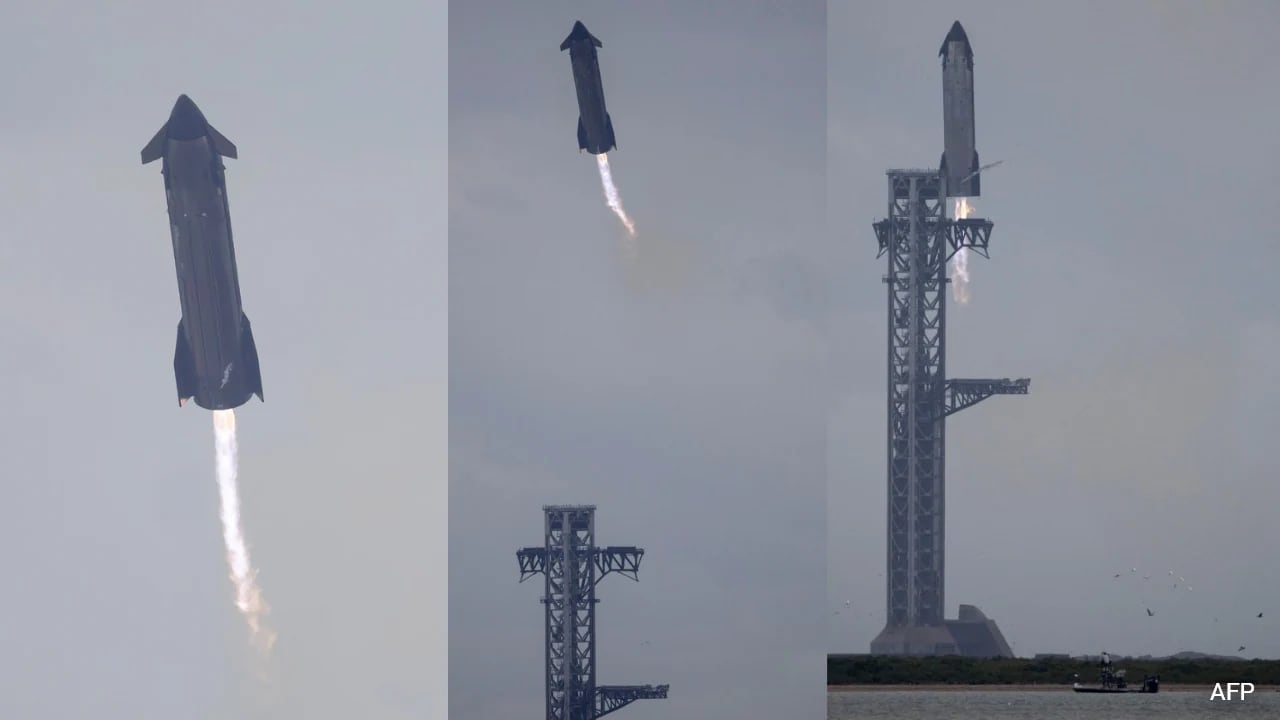
On October 13, 2024, SpaceX achieved what aerospace engineers spent decades dismissing as reckless fantasy. During its fifth integrated test flight, the 232-foot Super Heavy booster returned from the edge of space, relit its engines to arrest a supersonic descent, and hovered directly into the mechanical arms of its Boca Chica launch tower.
The hardware survived. The tower held.
Most media coverage treated the event like a sci-fi spectacle, marveling at the sheer audacity of catching a skyscraper with giant steel chopsticks. They missed the real story. The Starship booster catch was never meant to be a stunt for the cameras. It is a cold, calculated engineering response to the tyranny of the rocket equation, a brutal mathematical trap that has kept orbital flight prohibitively expensive since the dawn of the Space Age. By stripping away landing legs and pushing structural complexity onto the ground, SpaceX is attempting to turn orbital launch vehicles into commercial airliners.
The Weight Penalty That Nearly Killed Reusability
To understand why SpaceX risked destroying its primary launch pad to catch a falling rocket, you have to look at mass fractions. Every kilogram of hardware attached to a rocket stage that does not contain propellant or payload is dead weight. In orbital mechanics, that dead weight carries an exponential penalty.
When SpaceX pioneered propulsive landings with the Falcon 9, it bolted four massive carbon-fiber and aluminum landing legs to the base of the first stage. Those legs weigh roughly 2,000 kilograms. They require hydraulic actuators, locking mechanisms, and reinforced structural hardpoints on the airframe to absorb the shock of touchdown. On a medium-lift rocket like Falcon 9, that mass penalty is acceptable. You lose a fraction of your payload capacity to low Earth orbit, you recover the booster on a drone ship, and the economics still beat throwing the rocket into the ocean.
Scale that architecture up to Super Heavy, and the math breaks down.
Super Heavy is a stainless-steel cylinder standing 71 meters tall and 9 meters wide, powered by 33 Raptor engines. At liftoff, it holds roughly 3,400 metric tons of subcooled liquid methane and liquid oxygen. To support the dry mass of that vehicle upon landing—even when nearly empty of propellant—landing legs would need to be colossal. They would add tens of tons of structural weight to the bottom of the rocket, shifting the center of gravity downward and forcing the booster to burn significantly more fuel just to lift its own landing gear off the pad.
Worse yet, legs require wide, flat landing zones. Every time a Falcon 9 touches down on an autonomous spaceport drone ship, recovery crews must spend days securing the vehicle, towing it back to port, craning it onto a transporter, and hauling it to a refurbishment hangar before technicians can even begin inspecting the engines.
SpaceX looked at that operational bottleneck and asked an uncomfortable question. Why carry landing gear into space at all when the launch tower is already sitting on the ground doing nothing?
Anatomy of the Mechazilla Catch
The system SpaceX built to replace landing legs is formally known as the Orbital Launch and Integration Tower, though engineers and spaceflight observers universally call it Mechazilla. Standing roughly 146 meters tall in South Texas, the steel lattice structure serves three distinct functions. It stacks the Starship upper stage onto the Super Heavy booster, feeds propellants and power to the vehicle prior to liftoff, and catches the returning hardware out of mid-air.
The catch mechanism itself consists of two massive structural arms mounted to a carriage that rides vertically along the tower's main columns via a system of pulleys and steel cables. These arms do not grab the rocket like a claw. Trying to clamp onto the pressurized, thin-walled stainless-steel skin of a rocket fuselage would crush it like an empty soda can.
Instead, the booster carries two small, reinforced load-bearing pins—often referred to as lifting points—mounted just below its forward grid fins. These pins are tied directly into the rocket's primary structural ring, the strongest part of the airframe, which already bears the compressive loads of a fully fueled upper stage sitting on top of it during launch.
The Terminal Guidance Choreography
Executing the catch requires a level of precision that borders on the absurd. Following stage separation at an altitude of roughly 70 kilometers, Super Heavy flips around and performs a boostback burn to reverse its trajectory, aiming directly back toward the Gulf Coast of Texas.
As it plunges back into the thicker layers of the atmosphere, the booster relies on four electrically actuated waffle-style grid fins to steer. Unlike Falcon 9, which uses titanium grid fins that fold flush against the body during ascent, Super Heavy's fins are fixed in place and made of welded steel. They act like aerodynamic rudders, slicing through hypersonic airflow to guide the falling cylinder toward a virtual target point hovering just off the coast, safety-buffered away from the launch site until the final seconds of flight.
Only when the booster's onboard flight computers verify that all systems are nominal—engine health, propellant reserves, hydraulic pressures, and tower readiness—does the vehicle command a final divert maneuver toward the tower.
Thirteen of the booster's 33 Raptor engines ignite for the landing burn, rapidly decelerating the falling mass from supersonic speeds. Within seconds, ten of those engines shut down, leaving only the three center gimbaled engines firing to balance the rocket like a broomstick on the palm of a hand. As the booster's vertical velocity drops to near zero, it translates sideways toward the open arms of Mechazilla.
The arms close around the fuselage just beneath the lifting pins. There is no violent snap. The booster simply settles downward by a few inches until its pins rest squarely on the shock-absorbing tracks mounted along the top of the catch arms, at which point the remaining three engines shut down.
The Hidden Engineering Compromises
Press releases and livestream commentary tend to smooth over the violent reality of what happens during those final ten seconds. Catching a rocket introduces severe engineering compromises that SpaceX is still actively trying to solve.
First, there is the issue of acoustic and thermal shock. Even throttled down, three Raptor engines firing inside the confined geometry of the launch tower generate immense acoustic energy and superheated exhaust plumes. During Flight 5, the booster's outer chine—a structural fairing running down the side of the tank that houses propellant lines and avionics—suffered visible heat damage and buckling just prior to touchdown. The heat from the engines, combined with aerodynamic friction during reentry, pushed the stainless steel close to its thermal limits.
Second, guidance tolerances leave zero room for sensor drift. A Falcon 9 landing on a concrete pad at Cape Canaveral has a target circle roughly 50 meters wide. If wind shear pushes the rocket three meters to the left at the last second, it lands slightly off-center and nobody cares. On Mechazilla, the clearance between the booster's 9-meter body and the catch arms is measured in centimeters.
To achieve that accuracy, SpaceX cannot rely on standard civilian GPS, which suffers from atmospheric interference and latency. The booster uses a combination of high-frequency inertial measurement units, radar altimeters, and direct radio-frequency ranging transponders mounted on the tower itself. The rocket and the tower are constantly talking to each other, updating relative position data hundreds of times per second. If a gust of coastal wind pushes the booster off its glide slope, the gimbaled center engines must vector thrust instantaneously to correct the lateral drift without inducing a pendulum swing that would slam the tail of the rocket into the tower legs.
The Ground Support Paradox
By removing landing legs from the rocket, SpaceX did not eliminate complexity. It simply relocated it.
Every mechanical component taken off Super Heavy was added to Mechazilla. The catch arms, the draw-works winches, the hydraulic damping systems, and the massive concrete foundation anchoring the tower must now survive the dynamic load of a 250-ton object dropping onto them at several meters per second, immediately after enduring the acoustic blast of 33 Raptor engines at liftoff.
If a Falcon 9 suffers an engine failure during landing and crashes into a drone ship, SpaceX loses a booster and damages a replaceable barge. If Super Heavy suffers a guidance failure during the final three seconds of a catch attempt, it does not just destroy the rocket. It destroys the Stage Zero ground infrastructure—the orbital launch mount, the propellant tank farm, and the tower itself. Rebuilding a damaged booster takes months. Rebuilding a flattened orbital launch complex takes over a year.
Why Competitors Are Watching With Unease
Despite the catastrophic risk profile, traditional aerospace contractors and rival launch providers are staring at the Boca Chica footage with quiet dread.
For decades, the global launch market operated on an expendable model. Companies like United Launch Alliance (ULA), Arianespace, and Mitsubishi Heavy Industries built bespoke rockets that burned up in the atmosphere after a single flight. When SpaceX introduced the reusable Falcon 9 in 2015, competitors initially argued that refurbishment costs would outweigh the savings of recovering hardware. They were wrong. By 2024, Falcon 9 was launching more than twice a week, capturing the vast majority of global commercial payload mass and forcing rivals to scramble toward partial reusability.
Now, those rivals are building rockets designed to compete with Falcon 9—vehicles like Blue Origin's New Glenn, ULA's Vulcan Centaur, and Europe's Ariane 6. None of them utilize tower-catch architecture. New Glenn, the closest direct competitor in terms of reusability, still relies on heavy, deployable landing legs and a sea-going recovery vessel.
If SpaceX proves that tower catches can be executed reliably without extensive refurbishment, the economic gap between Starship and the rest of the industry will widen into an unbridgeable chasm.
Consider the turnaround time. With a tower catch, the Super Heavy booster lands directly back on the same crane system that lifted it onto the launch mount in the first place. In theory, the tower arms can lower the caught booster straight back onto the orbital launch ring, mate a freshly fueled Starship upper stage on top of it, pump new propellants into the tanks, and launch again within hours.
Hypothetically, if SpaceX achieves even a fraction of that rapid cadence—say, turning around a booster in 48 hours instead of 48 days—the marginal cost of putting a kilogram of payload into orbit drops from thousands of dollars to mere tens of dollars. At that price point, traditional satellite manufacturing changes overnight. Engineers no longer need to spend hundreds of millions of dollars miniaturizing components or testing radiation-hardened electronics to survive 15 years in orbit. They can build heavy, cheap satellites out of off-the-shelf industrial hardware and launch replacements whenever they break.
The Upper Stage Problem Nobody Has Solved Yet
Catching the Super Heavy booster was only half of the equation, and frankly, it was the easier half.
Super Heavy never reaches orbital velocity. It separates from the upper stage at roughly Mach 5 or Mach 6, well below the roughly Mach 25 required to stay in orbit. Because it moves relatively slowly, the booster does not require a thermal protection system made of fragile ceramic heat-shield tiles. Its bare 304L stainless-steel hull can absorb the heat of reentry without melting.
The Starship upper stage faces an entirely different physical nightmare.
To make the entire system 100 percent reusable, SpaceX must also catch the 50-meter Starship upper stage using the exact same tower arms. Unlike the booster, the upper stage reenters the atmosphere from full orbital velocity, plowing into upper-atmospheric plasma at temperatures exceeding 1,400 degrees Celsius.
To survive that inferno, the windward belly of the ship is covered in roughly 18,000 hexagonal silica-based heat-shield tiles. Throughout early test flights, those tiles have repeatedly cracked, shaken loose under engine vibration, or burned through around the vehicle's forward aerodynamic flaps. On Flight 4 and Flight 5, intense plasma breached the hinge seals of the forward flaps, visibly melting the underlying steel structure even as the vehicle managed to maintain attitude control down to a soft splashdown in the Indian Ocean.
Catching the upper stage means those fragile ceramic tiles must survive orbital reentry intact, endure the acoustic roar of a landing burn, and absorb the mechanical shock of being grabbed by steel arms—all without shedding debris or requiring weeks of manual tile replacement between flights.
The Regulatory and Environmental Wall
Even if SpaceX solves every aerodynamic, thermal, and structural hurdle, the company still faces a bottleneck that cannot be engineered away with stainless steel: geography and regulation.
Boca Chica, Texas, sits on a narrow strip of coastal land bordered by wildlife refuges, wetlands, and the Rio Grande. Under existing environmental assessments and launch licenses issued by the Federal Aviation Administration (FAA), SpaceX is strictly capped on the number of annual launches and landings it can conduct from South Texas.
Every time a Super Heavy booster returns from space and decelerates through the sound barrier over the Texas coast, it generates a massive double sonic boom that rattles windows across Brownsville and South Padre Island. Launching and catching rockets a few times a year is tolerable to local communities and environmental regulators. Doing it multiple times a day—the cadence required to fulfill SpaceX's ambitions for its Starlink satellite constellation and NASA's Artemis lunar lander program—will trigger intense legal battles over noise pollution, coastal access closures, and habitat disruption.
SpaceX is actively constructing a second Starship launch and catch tower at Kennedy Space Center's Launch Complex 39A in Florida to bypass the geographic constraints of Boca Chica. Yet Florida presents its own set of headaches. Pad 39A sits mere miles away from active launch complexes operated by NASA, Blue Origin, and ULA. Airspace closures over the Eastern Range are already fiercely contested, and persuading range safety officers to allow a 232-foot booster to fall out of the sky directly toward historic infrastructure at Cape Canaveral requires years of safety modeling and regulatory friction.
What Comes Next in the Flight Test Campaign
SpaceX does not design hardware to pass static reviews; it builds hardware to break it in public and iterate on the wreckage. The successful Flight 5 catch proved that the foundational physics of the Mechazilla concept work in the real world, not just in computational fluid dynamics simulations.
Now comes the harder part. Moving from a single historic demonstration to a routine operational system requires upgrading the booster to the Version 2 architecture, which stretches the propellant tanks, increases thrust, and redesigns the forward chines and hot-staging ring to shed excess weight. Simultaneously, flight controllers must push the upper stage through progressively steeper reentry profiles to expose every remaining weak spot in the heat shield before attempting the first orbital ship catch.
The aerospace industry spent sixty years treating rockets like artillery shells—expensive, single-use tubes blasted into the sky and abandoned to the sea. Watching Mechazilla pluck a twenty-story steel cylinder out of the Texas air did not just validate a daring piece of mechanical engineering. It rendered every expendable rocket currently sitting on a drawing board obsolete before its first flight.